
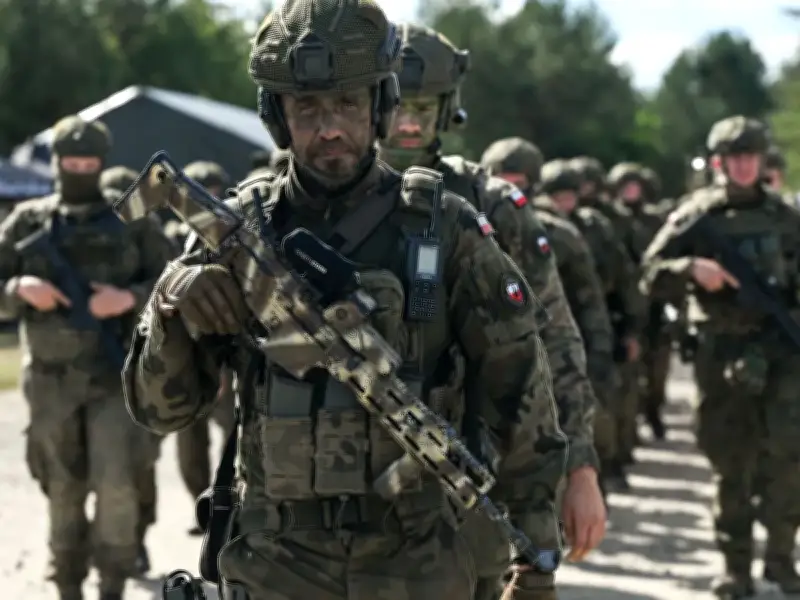
Polish Prime Minister Donald Tusk has sent "substantial" forces to the country's border with Russia following warnings from Polish and allied intelligence about potential provocations. The deployment came just hours before Polish forces foiled a possible "provocation" overnight on the border with the Russian exclave of Kaliningrad.
Tusk said on Tuesday that Polish and allied intelligence had warned for weeks that "acts of sabotage or more serious provocations could occur on the border with Russia" in the first days of November, including "the intrusion of armed individuals into Polish territory".
Deployment of Police and Counter-Terrorism Units
"After receiving more precise information that incidents could occur in the first half of November, including the incursion of armed individuals into Polish territory, we decided to deploy substantial police forces, counter-terrorism units and reinforce the Border Guard," Tusk told a press conference after the Council of Ministers meeting.
The deployment was already under way by Monday, with National Police Chief Marek Boroń confirming to Polish media that a "large group of police officers" from forces in several provinces had arrived in the border area, along with counter-terrorism units, the military, Border Guard and special services.
Disturbing Movement on the Kaliningrad Border
Tusk said that shortly after midnight on Tuesday, he was informed by the border guard of "disturbing movement" on the border with the Russian exclave of Kaliningrad. He gave few details but said that "individuals with flashlights" had been observed in the border area. Polish forces "successfully prevented any attempted acts of provocation, if that was the intention", he added.
Poland, NATO's largest member on the alliance's eastern flank, borders Russia's Kaliningrad exclave to the north and Belarus, Moscow's close ally, to the east. Warsaw has repeatedly accused Russia of "sabotage" since Moscow launched its full-scale invasion of Ukraine in 2022, and plays a key logistical role in getting Western military and humanitarian aid into Ukraine.
Warnings of Further Escalation
Tusk has been warning for months that Russia might be preparing a more serious hybrid attack against a NATO country. His warnings have become increasingly specific as he received intelligence from NATO, Ukrainian and US secret services, including the CIA, he said.
Tusk said it was not possible to confirm with full certainty that the incident was an attempted provocation. He said Russia's intensified escalation would continue and was unlikely to be limited to this incident.




