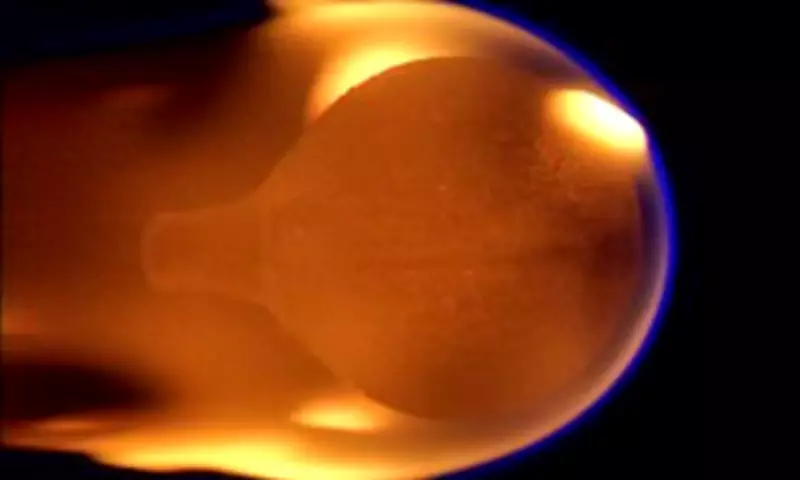
NASA has unveiled plans to conduct a controlled fire experiment on the lunar surface to study how flames behave in low gravity, a critical step for ensuring astronaut safety during future missions. Fire poses a unique danger in space because it behaves differently than on Earth, especially in environments like the Moon or the International Space Station (ISS), where gravity is reduced.
Why Fire is More Dangerous on the Moon
On Earth, gravity causes hot, less-dense air to rise, drawing in cooler, oxygen-rich air at the base of a flame. This process can sometimes lead to 'blowoff,' where the air current extinguishes a weak fire. However, on the Moon, where gravity is only one-sixth as strong, this process occurs much more slowly. This means that the flow of oxygen can sustain a small flame without being strong enough to extinguish it. Some studies suggest that lunar gravity may be a near-perfect environment for starting fires, with the required oxygen concentration at its absolute minimum.
The Flammability Test on the Moon
Later this year, NASA will launch an uncrewed Commercial Lunar Payload Service (CLPS) mission carrying a sealed chamber containing four fuel samples. These materials will be ignited while cameras and sensors monitor flame spread and oxygen consumption. This experiment, named the Flammability of Materials on the Moon (FM) test, will be the first time a fire is lit on the lunar surface and the first opportunity for NASA to observe a large fire in space over an extended period.

Importance for Artemis Missions
As NASA prepares to return humans to the Moon with the Artemis IV mission in 2028, understanding fire behavior is critical. Astronauts will live in habitats filled with oxygen at pressures similar to Earth, making fires a genuine hazard. Dr. Paul Ferkul of NASA Glenn Research Center and his co-authors note that 'partial-g fire in an extraterrestrial habitat is a real hazard that is expected to be substantially worse than in 0-g and potentially worse than even 1-g.'
Challenges in Testing Fire in Space
Currently, NASA relies on the NASA-STD-6001B test, which involves holding a six-inch flame to a material sample. If it burns more than six inches or drips burning debris, it fails. However, this test does not accurately replicate space conditions. In microgravity, fire does not 'point' upwards but forms spherical blobs that spread outward. To simulate these conditions on Earth, NASA drops burning materials from high towers or uses parabolic flights, but these only provide a few seconds of microgravity. On the ISS, the Combustion Integrated Rack has hosted about 1,500 small fires, but safety limits prevent large-scale tests.
Previous Insights from Saffire
The Spacecraft Fire Safety (Saffire) experiment ignited cotton, fiberglass, and acrylic sheets inside an uncrewed Cygnus cargo capsule before it burned up in Earth's atmosphere. This revealed unexpected phenomena, such as flames spreading against airflow and burning hotter on thinner materials. These results convinced NASA that a clearer picture of lunar fire behavior is needed.
Future Lunar Habitats
Looking ahead, the Moon could host permanent settlements. Professor Bernard Foing of the European Space Agency's 'Moon Village' scheme predicts that by 2030, an initial settlement of six to ten pioneers could grow to 100 by 2040 and include families by 2050. Resources like basalt for 3D-printing and water ice for rocket fuel make the Moon a strategic outpost for further space exploration.