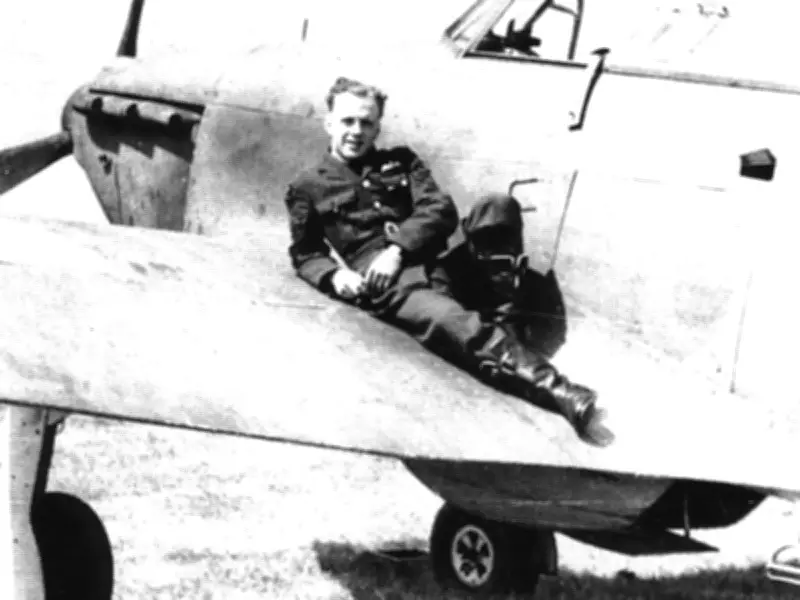
Ray Towers Holmes, a Wallasey-born journalist who later reported on cases at Liverpool Crown Court, became a national hero in 1940 when he deliberately flew his Hurricane fighter into a German bomber heading towards Buckingham Palace. Known as 'Arty' to his fellow servicemen, he was serving with 504 Squadron during the Battle of Britain when he carried out the extraordinary act that brought down the enemy aircraft.
From Crime Reporter to RAF Pilot
Before joining the Royal Air Force Reserve in 1936, Holmes had worked as a crime reporter on the Birkenhead Advertiser and then for his father's press agency. He became a member of 504 Squadron in June 1940, as Britain entered the height of the Battle of Britain.
On September 15, 1940, the 25-year-old was flying a Hurricane when he spotted three German Dornier Do 17 bombers heading towards central London. He attacked two of the aircraft before turning his attention to the third, which was approaching Buckingham Palace. As he attempted to open fire, he discovered his machine guns had run out of ammunition.
A Split-Second Decision
With no bullets left, Holmes made the decision to fly his Hurricane into the German bomber at around 400mph, striking its tail with his own aircraft. Years later, he recalled the moment, saying: "As I fired, my ammunition gave out. I thought, Hell, he's got away now. And there he was coming along, and his tail looked very fragile and very inviting."
He added: "So I thought I'd just take off the tip of his tail. So I went straight at it along him and hit his port fin with my port wing."
Holmes had not realised the devastating effect the collision would have. He later discovered that the impact had torn away the entire rear section of the German aircraft, including its twin tails. The bomber plunged towards the streets below, killing three of its five crew members.
Bailing Out Over Victoria
His own Hurricane was badly damaged in the collision, sending it into a potentially fatal spin. He was forced to bail out, striking the roof of his aircraft as he escaped before managing to open his parachute. Suspended above the railway lines leading into Victoria Station, he feared he was about to land on the electrified tracks.
He recalled: "I got hold of the guy ropes and stopped the spinning and looked down. I was right over the railway lines running into Victoria Station. I thought: 'Hell, I'm going to get electrocuted now after all this!' Then I was swinging towards a row of houses."
He said: "I hit the roof of one and could not get any grip on the slates in my stockinged feet. I slithered down the roof until I got to the gutter and thought: 'Now I'm going to break my back and kill myself falling off a three-storey house'."
He added: "But as I fell there was a sudden jerk and I stopped with just my toes on the ground. My canopy had snagged over an up pipe running past the gutter and that had stopped me. But both my feet were inside a dustbin, the lid was on the ground; the bin had obviously had just been emptied. My two toes touched the bottom of the bin but my heels were off the ground."
Later Life and Legacy
Holmes continued serving in the RAF for the remainder of the war, becoming an instructor who taught Russian pilots to fly Hurricanes. He also undertook reconnaissance missions, including photographing Hitler's hideout at Berchtesgaden. By the end of the conflict, he had reached the rank of Flight Lieutenant and was serving as the King's Messenger, delivering mail for Prime Minister Sir Winston Churchill.
After the war, he returned to journalism, establishing his own court reporting agency and spending many years covering cases at Liverpool Crown Court. In 1997, he published his autobiography, Sky Spy: From Six Miles High to Hitler's Bunker. His wartime story was revisited in 2004 when the remains of his crashed Hurricane were excavated from the streets of London for a National Geographic documentary. The remains of the German bomber he brought down are displayed at the Imperial War Museum.
Holmes died at Hoylake Cottage Hospital in June 2005, aged 90, following a two-year battle with cancer. His contribution was later commemorated at a ceremony at the 504 Squadron base, where his former squadron was presented with a model of the Hurricane made from its melted-down engine.