
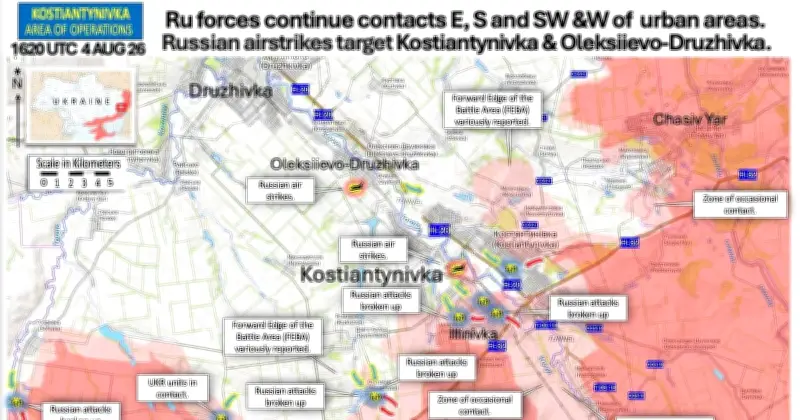
A newly published war map by former Navy SEAL Chuck Pfarrer reveals Russian forces are advancing in Ukraine's Donetsk Oblast using small assault groups supported by intense glide-bomb and artillery strikes, reducing large parts of Kostiantynivka to rubble.
Map details Russian tactics
Pfarrer, a former Navy SEAL Team 6 Squadron leader and war correspondent for The Kyiv Post, posted the map on X on Tuesday. It shows nearly half a dozen locations along the eastern frontier where Russian attacks have been broken up, alongside areas experiencing Russian air strikes and zones of occasional contact.
Russian forces have struck both urban centres like Kostiantynivka and rural communities such as Oleksiievo-Druzhivka, both in Donetsk Oblast. Pfarrer noted that these areas have endured devastating air strikes that have reduced large portions of the city to rubble.
Expert commentary
"Russian forces continue infil of built up areas using small assault groups, supported by intense glide-bomb (KAB) and artillery fires that have reduced large portions of the city to rubble. Contacts are now generalized across a majority of the urban area," Pfarrer stated on X.
Pfarrer, author of the New York Times best-selling autobiography Warrior Soul: The Memoir of a Navy SEAL, has reported from conflict zones for decades, including Benghazi and Kabul, where he was embedded with the Afghan Air Force.
Challenges for Russia
Pfarrer and colleague Jason Jay Smart argued that Russia still needs to seize Kostiantynivka, Druzhkivka, Kramatorsk, and Sloviansk before President Vladimir Putin can claim control of Donetsk. However, they contend that "each fortress city demands an urban battle his depleted army may no longer survive."
The pair also noted Russia faces troop recruitment issues and "weaker logistics" that offer "no credible path to rapid victory," following unsuccessful attempts in Bakhmut and Pokrovsk. They highlighted "fuel shortages, damaged refineries, depleted vehicles and collapsing supply lines" making every Russian advance harder to reinforce, connect, and hold against Ukrainian counterattacks.
Additionally, they observed that "Ukrainian drones can isolate small assault groups before ammunition, water and replacements arrive, turning limited gains into exposed positions that consume the soldiers and equipment required for the next attack."




