Macron Details France's Nuclear Doctrine Amid European Security Concerns
President Emmanuel Macron is delivering a pivotal address on Monday regarding France's nuclear deterrence policy, as European allies voice increasing apprehension about potential American disengagement and ongoing Russian threats. This speech comes at a critical juncture for European security architecture.
France's Strategic Nuclear Position
As the European Union's sole nuclear power, France maintains a strictly defensive deterrence doctrine designed to protect the nation's "vital interests." Macron has consistently argued that these vital interests possess a "European dimension," suggesting France's nuclear umbrella extends beyond its borders to support continental stability.
While France participates in NATO, it retains complete autonomy over its nuclear forces while contributing to the alliance's overall deterrence framework. According to the French Constitution, the president serves as commander-in-chief of the armed forces and holds exclusive authority to authorize potential nuclear weapon deployment.

France's Nuclear Capabilities: A Detailed Breakdown
1 Warship: France's aircraft carrier Charles de Gaulle represents Europe's only surface warship capable of deploying nuclear weapons via Rafale fighter jets using catapult-assisted launches. The navy's flagship recently operated in the North Atlantic and Baltic Sea, including a stop in Malmo, Sweden. Due to extended periodic overhauls, France lacks permanent sea-based air nuclear capability. Macron confirmed in December plans to construct a new nuclear-powered aircraft carrier to replace Charles de Gaulle by 2038.
4 Submarines: France operates four nuclear-armed submarines: Le Triomphant, Le Téméraire, Le Vigilant, and Le Terrible. These 138-meter vessels, each manned by approximately 110 crew members, are based at the highly secretive Ile Longue facility on the Atlantic coast. Each submarine can carry 16 M51 intercontinental ballistic missiles equipped with multiple warheads. Since 1972, France has maintained continuous at-sea deterrence with at least one nuclear-armed submarine constantly on patrol.
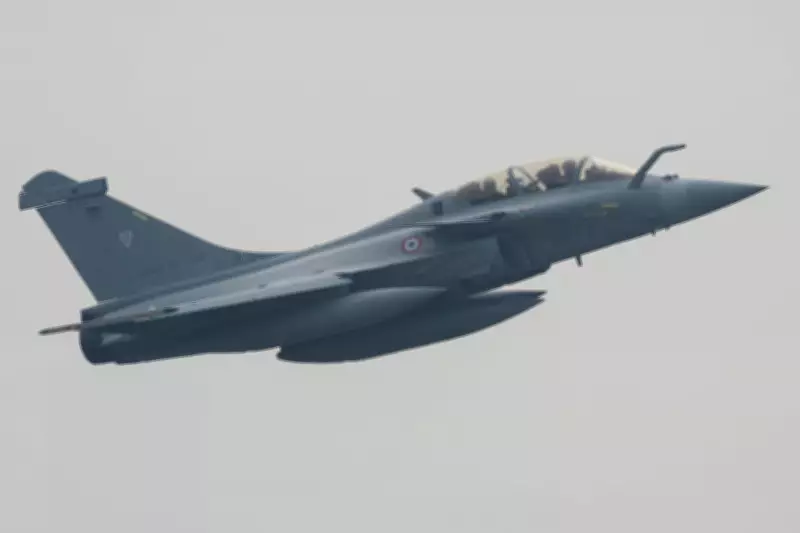
500 Kilometers (310 Miles): The ASMPA air-launched cruise missile (enhanced medium-range air-to-surface missile) boasts an estimated 500-kilometer range. Deployed by Rafale fighter jets, this weapon serves as a final warning mechanism before potential escalation to large-scale nuclear conflict. Operated by the Strategic Air Forces established in 1964 and based at three French locations, these missiles can also be launched from the Charles de Gaulle aircraft carrier.
8,000 to 10,000 Kilometers (5,000 to 6,200 Miles): The M51 submarine-launched ballistic missile features an estimated range of 8,000 to 10,000 kilometers, though exact specifications remain classified. The upgraded M51 entered operational service in October with improved accuracy and enhanced missile defense penetration capabilities, according to the French Defense Ministry. Each missile carries multiple independently targetable nuclear warheads.
290 Warheads: France maintains approximately 290 nuclear warheads according to recent data from the Stockholm International Peace Research Institute and Federation of American Scientists. Over 80% of these warheads are submarine-launched, positioning France as the world's fourth-largest nuclear power behind Russia (over 4,300 warheads), the United States (approximately 3,700), and China (about 600). The United Kingdom, no longer an EU member but a NATO ally, possesses roughly 225 warheads. All five nations are recognized nuclear-weapon states under the Nuclear Non-Proliferation Treaty.
Global Nuclear Context
India, Pakistan, and North Korea have publicly acknowledged nuclear weapons possession, while Israel is widely believed to maintain an undeclared arsenal. Exact stockpile numbers remain closely guarded state secrets across nuclear-armed nations.

Iran continues to insist its nuclear program serves exclusively peaceful purposes, despite recent uranium enrichment to 60% purity—approaching weapons-grade levels of 90%. The UN nuclear watchdog recently reported inability to verify whether Iran has suspended all uranium enrichment activities, according to documents reviewed by The Associated Press prior to recent U.S. and Israeli military actions against Iran.