
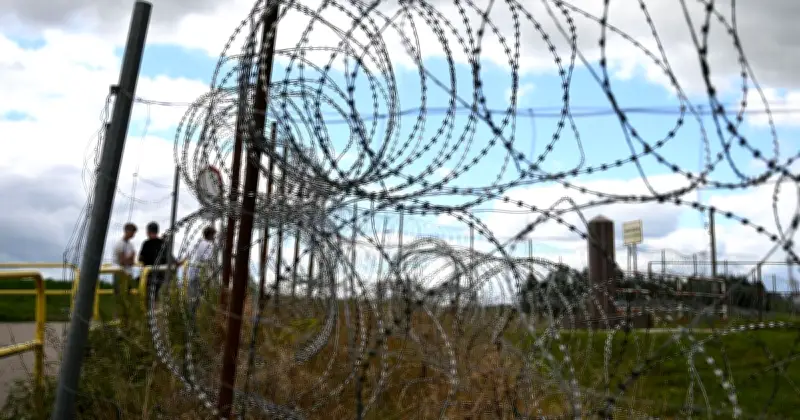
Lithuania will dig 20-metre-wide anti-mobility trenches along its borders with Russia's Kaliningrad exclave and Belarus, the government confirmed on Wednesday, as part of a wider fortification drive on NATO's eastern flank.
Cabinet approves defensive engineering plan
The Lithuanian cabinet approved changes to its defensive engineering plan, creating a new counter-mobility belt starting from the edge of the border patrol track and extending into Lithuanian territory. In areas designated by the armed forces as operational zones, the strips can reach 150 metres in width.
Construction of the defensive lines is scheduled for completion by the end of 2028 at a cost of about £43 million (€50 million). Deputy Defence Minister Tomas Mikelkevičius said the measures aim to make the best use of Lithuania's terrain and engineering obstacles “to impede an adversary's movement if necessary and create more favourable conditions for our armed forces to operate.”
Expansion of counter-mobility parks and wetland restoration
The number of military counter-mobility engineering parks — storage sites for obstacles such as concrete dragon's teeth, roadblocks and other barriers — will rise from 27 to 50 by the same deadline. Authorities also approved wetland restoration in border areas, to be finished by the end of 2030. Officials said restoring the hydrological regime will make the ground difficult for heavy military vehicles to cross within a few years.
The decision forms part of Lithuania's contribution to the Baltic Defence Line, a joint project with Estonia and Latvia launched in 2024 to fortify roughly 950 kilometres of border with Russia and Belarus. The system is not a continuous wall but a layered network of anti-tank ditches, dragon's teeth, prepared bridge demolitions, bunkers, equipment depots and wartime minefields designed to delay an advancing force and channel it into kill zones.
Regional context and strategic significance
Poland is building a parallel East Shield programme along its borders with Belarus and Kaliningrad, while Estonia continues installing hundreds of bunkers and dozens of kilometres of anti-tank ditches. Baltic leaders have repeatedly cited the difficulty of retaking territory once seized, a lesson drawn from Russia's war in Ukraine.
Lithuanian President Gitanas Nausėda said in mid-July that intelligence assessments indicated Russia was planning potential attacks on critical infrastructure in the Baltic states or Poland. Neighbouring governments have also warned of hybrid threats, sabotage and false-flag operations. Russia, for its part, has expanded military infrastructure near the borders of Finland, the Baltic states and Norway, with capacity assessments pointing to tens of thousands of additional personnel in the longer term.
The trenches and related works will not stop a determined invasion on their own. They are intended to buy time for NATO reinforcements under the alliance's collective defence commitment. Lithuania shares more than 250 kilometres of land border with Kaliningrad and nearly 680 kilometres with Belarus, including the strategically sensitive Suwałki Gap that links the Baltic states to the rest of the alliance.
Work on the engineering parks and obstacle strips will proceed in stages through 2028. Officials stress the measures are defensive and will not involve explosives in peacetime. The project underscores how far NATO's eastern members have moved from post-Cold War demilitarisation toward permanent physical barriers on the frontier with Russia.




