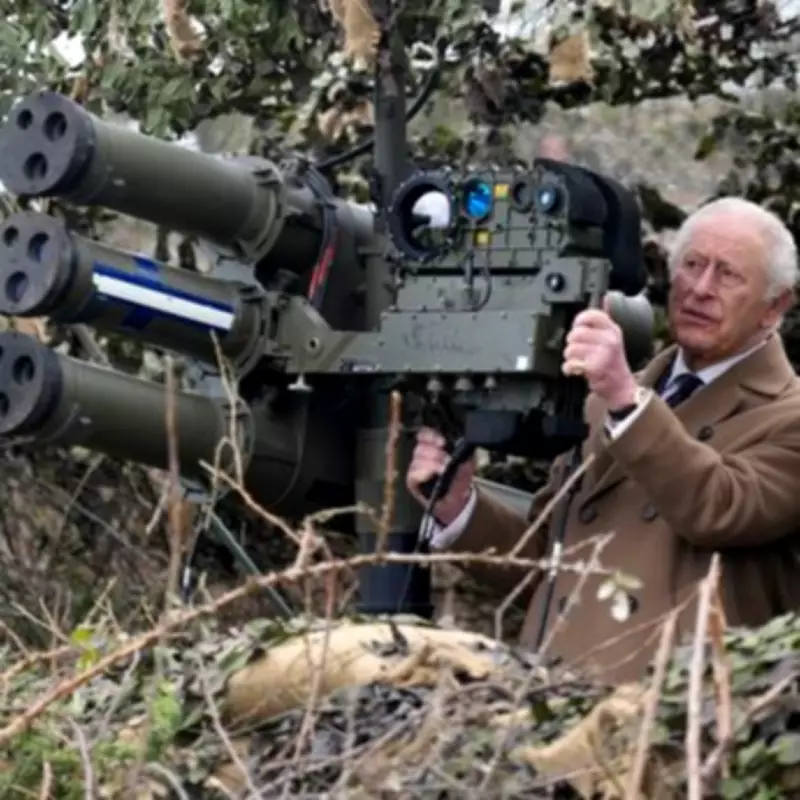
King Charles has personally tested an advanced air defence missile launcher during a significant visit to Baker Barracks on Thorney Island in Hampshire. The monarch, in his role as Captain General of the Royal Regiment of Artillery, engaged directly with military equipment designed to neutralise enemy drones and helicopters, gaining firsthand insight into modern defence capabilities.
Hands-On Experience with Defence Technology
During the visit, King Charles was able to handle the missile launcher and look through its sophisticated aiming unit. Soldiers demonstrated the system's operation under a camouflage net, with drones simulating threats overhead. The launcher, when deployed by trained operators, can destroy hostile targets in approximately four seconds, providing rapid response to aerial threats.
Lieutenant Colonel Maarten Magee described the occasion as an "absolute privilege," noting that the King showed particular interest in how British forces are adapting to contemporary security challenges. "He got a flavour of what we are facing," Magee remarked, characterising the visit as a "once-in-a-lifetime experience for the regiment and the island."

Ceremonial Arrival and Royal Duties
King Charles arrived at the barracks shortly after 1pm via helicopter, dressed in a suit complemented by a regimental tie and pin. His entrance was marked by a traditional 21-gun salute performed by the 1st Regiment Royal Horse Artillery, who fired seven rounds each in honour of the royal guest.
The visit marked his first official engagement with the 7th Air Defence Group Royal Artillery units since assuming the ceremonial position of Captain General on August 11, 2023. This role, historically held by King George VI from 1947 and Queen Elizabeth II from 1952, places Charles as the ceremonial head of the Royal Artillery, which comprises 14 regular regiments and seven reserve regiments.
Connecting with Military Families
Beyond the technological demonstrations, King Charles dedicated substantial time to interacting with military personnel and their families. He officially opened the Junior Ranks' Restaurant, where he conducted video calls with service members stationed in Saudi Arabia, Estonia, Cyprus, and the Falkland Islands.
During these conversations, troops expressed their eagerness to return home, to which Charles responded optimistically, "It won't be long hopefully." The emotional significance of these connections was highlighted when five-year-old Poppy Harding, daughter of Sergeant Jack Harding based in the Falklands, presented the King with a heartfelt letter.
Support for Military Families
Charley Harding, wife of Sergeant Harding and mother to Poppy, explained that the letter conveyed appreciation for the royal family's support of military families. "It's just nice that obviously with our husbands away and other family members, to have him come down and recognise that us as families do struggle as well," she said. "It's great."
The challenges faced by families during deployments were further emphasised by Jade McGowan, whose husband Andrew is currently stationed in Cyprus without a confirmed return date. King Charles inquired about her nearly eight-month-old twins, Hamish and Brodie, demonstrating genuine concern for family welfare.
Reflecting on the interaction, McGowan noted, "It makes it a bit easier, doesn't it, to know that you're not alone and that you don't feel that you are alone, because there is so much support."
Historical Context and Regimental Pride
The Royal Regiment of Artillery, founded in 1716, carries the Battle Honour "Ubique" meaning "everywhere," reflecting its participation in virtually every conflict involving the British Army. King Charles's visit reinforced the enduring connection between the monarchy and military traditions, while highlighting contemporary defence strategies against evolving threats.
Families, nursery children, and school pupils gathered at the barracks to witness the military welcome, underscoring the community aspect of military life. The visit not only showcased advanced defence technology but also emphasised the human element of service, recognition, and support within the armed forces community.