Iran's Underground Missile Cities Defy Destruction Efforts
According to newly published United States intelligence assessments, Iran is demonstrating remarkable resilience in restoring its missile capabilities mere hours after facilities are targeted by American and Israeli airstrikes. This revelation directly contradicts earlier White House assertions that Tehran's strike potential was being systematically crippled.
Granite Mountains Provide Impenetrable Shield
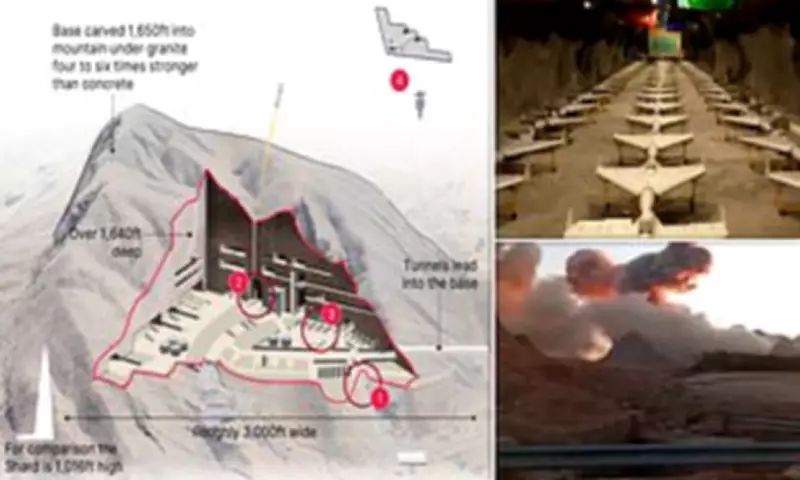
The intelligence report, cited by The New York Times, highlights that Iran has constructed massive missile bunkers buried deep within granite mountain ranges. These geological formations can withstand pressures far exceeding the limits of conventional construction materials, creating what experts describe as the toughest possible barrier against even the most powerful American bunker-busting munitions.
The GBU-57 Massive Ordnance Penetrator, considered the United States' most formidable earth-penetrating weapon, faces significant challenges against these fortified positions. Granite naturally absorbs and disperses explosive energy, dramatically reducing the effectiveness of conventional strikes.

Sophisticated Underground Networks
One particularly notable facility is the Yazd missile base, believed to feature an automated rail system running through extensive tunnels. This network connects assembly areas, storage depots, and multiple concealed exits carved into different mountain faces. Iranian propaganda videos have showcased similar underground complexes where mobile launchers are rapidly deployed, fired, and withdrawn behind heavy armored doors.
Dr. Amichai Mittelman, a tunnelling expert consulted by Globes, emphasized the defensive advantage: 'The mountains in Iran provide a level of protection 50-100 meters thick of rock that is hard to crack even by heavy bombs.'
Strategic Preservation and Deception
American officials warn that Tehran is deliberately preserving its missile strength to maintain pressure throughout prolonged conflict and retain leverage post-hostilities. The intelligence assessment reveals significant uncertainty about actual destruction rates, as Iran has deployed decoy launchers and can quickly recover functional systems from seemingly damaged sites.
Analyst Shanaka Anslem Perera told the Statesman: 'The mountain does not care how many sorties are flown above it. The railway does not care how many portals are sealed. The geology is the defence, and the geology has been there for 300 million years.'
Diminishing Returns in Strike Campaign
Despite the Pentagon reporting 11,000 targets hit in the war's first five weeks and Israeli forces claiming destruction of three-quarters of Iran's launchers by early March, missile launches from Iran have continued. Launch rates have decreased from hundreds daily to approximately forty recently, with roughly twenty aimed at Israel each day.
Meanwhile, Iran continues deploying 50-100 drones daily across the region, most intercepted by defense systems. Military analysts caution that hunting remaining launch systems yields diminishing returns, given Iran's vast territory and extensive network of concealed facilities.
Conflicting Assessments and Regional Incidents
The intelligence findings follow a CNN report suggesting approximately half of Iran's ballistic missile launchers remain intact after over a month of strikes. White House spokeswoman Anna Kelly countered: 'Iranian ballistic missile and drone attacks are down around 90 percent, their navy is wiped out, two-thirds of their production facilities are damaged or destroyed.'
Regional incidents underscore ongoing threats. In Dubai, debris from an intercepted drone struck a United States technology office, causing no injuries but highlighting Tehran's previous warnings about targeting American tech firms in the Middle East. United States special forces were deployed to rescue a downed F-15E pilot, while Iranian authorities offered substantial rewards for information leading to capture of missing personnel.

United States Defense Secretary Pete Hegseth maintained determination: 'Yes, they will still shoot some missiles, but we will shoot them down. They will go underground, but we will find them.' However, the Royal United Services Institute notes that penetrating hardened underground facilities requires multiple precision strikes on identical points, detailed intelligence about internal layouts, and sustained follow-up attacks to prevent rapid repairs—all while suppressing air defenses across dispersed sites.
Experts suggest the apparent slowdown in Iranian attacks may reflect tactical adaptation, with Tehran becoming more adept at concealing mobile launchers after use. The Islamic Republic's years-long investment in cavernous mountain bunkers appears to be paying strategic dividends, preserving a substantial arsenal despite relentless aerial bombardment.