Iran's Expanding Drone Capability Raises Alarm Across Europe
Concerns are intensifying regarding Iran's capacity to conduct long-range attacks against European targets using advanced suicide drones and ballistic missiles. This follows a recent FBI alert warning of potential Iranian drone strikes on California's West Coast, highlighting Tehran's retaliatory capabilities against Western nations.
Drone Warfare as Primary Retaliation Tool
The Islamic Republic has increasingly employed drone warfare as its principal method of retaliation in the Middle East. These unmanned aerial vehicles have emerged as highly influential weapons systems, enabling forces to execute long-range assaults at relatively minimal costs while overwhelming sophisticated air defence networks.
On March 1, an Iranian Shahed kamikaze drone successfully struck a British Royal Air Force base in Cyprus, occurring just days after joint US-Israeli air strikes targeted Iranian leadership. The following day witnessed Iran's second attempted attack on the British installation, with RAF Typhoons from RAF Akrotiri intercepting two unmanned suicide drones moments before impact.

Technical Specifications and Range Capabilities
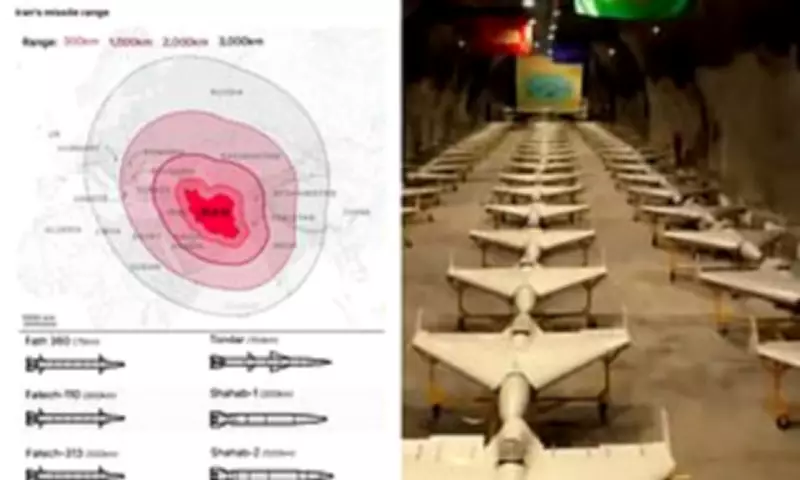
Iranian Shahed suicide drones possess an operational range extending to 2,500 kilometres. These weapons have been extensively deployed by Russia in Ukraine, causing substantial destruction and civilian casualties. The drones typically operate in coordinated swarms, each carrying warheads weighing between 30 and 50 kilograms specifically engineered to overwhelm air defence systems and disable regional power grids.
If launched from Iranian territory toward Europe, these drones could potentially reach nations including Moldova, Bulgaria, and Ukraine. At maximum extension, they could threaten popular tourist destinations such as Athens, Greece, and Bucharest, Romania. Launch positions from Hezbollah strongholds in Lebanon could extend their penetration even deeper into continental Europe.
Expert Analysis on Threat Nature
Defence specialists emphasize that the primary concern lies not in large-scale swarm attacks against urban centres, but rather in smaller, precisely targeted strikes against critical infrastructure. Brett Velicovich, a defence expert and founder of drone company Powerus, explained to the Daily Mail that Shahed-136 loitering munition drones possess both the range and capability to threaten European territories.
"These drones represent a far more plausible threat than missile strikes because they operate below the threshold that would trigger open warfare with NATO," Velicovich noted. "The genuine risk involves smaller, deniable strikes launched through proxy networks or covert operatives targeting essential infrastructure including airports, energy facilities, and transportation hubs."
Stealth Enhancements and Production Scale
Iran recently unveiled a stealthier iteration of its notorious Shahed kamikaze drone, potentially complicating detection by Western air defence systems. Images of the modified Shahed-101 loitering munition revealed structural alterations suggesting quieter operational capabilities compared to earlier variants.
Unlike conventional Shahed drones utilizing rear-mounted gasoline engines that produce distinctive buzzing sounds, the new version appears to incorporate a nose-mounted propeller powered by an electric motor. This configuration pulls the aircraft through airspace rather than pushing from the rear, potentially reducing both acoustic and thermal signatures while making radar and infrared detection more challenging.
The Shahed-101 functions as an autonomous, electric-powered loitering munition designed to carry high-explosive warheads. It can remain operational within battlespace environments while searching for targets before executing direct impact detonations, utilizing rocket-assisted launch systems for takeoff.
Iran's strategic advantage extends to production scale, with open-source intelligence and defence analysts estimating the total Shahed fleet across all variants at between 80,000 and 100,000 units. Combined with ongoing monthly production rates of approximately 500 drones, if deployed at full capacity, these numbers could translate into daily waves exceeding 2,500 drones for sustained periods, potentially overwhelming European air defences.

Missile Arsenal and European Defence Systems
Beyond drone capabilities, Iran maintains substantial missile stockpiles, with the Khorramshahr 4 representing the most lethal variant boasting ranges between 2,000 and 3,000 kilometres while carrying 1,500-kilogram warheads. If launched in coordinated volleys, these missiles could reach extensive European territories including Greece, Italy, Germany, Poland, and Denmark.
Dr. Sidharth Kaushal, a senior research fellow at RUSI, identified the Khorramshahr as a derivative of North Korean ballistic missile technology, historically speculated as potential delivery vehicles for nuclear warheads should Iran develop such capabilities.
European interception of these projectiles would rely heavily on US defence architecture, including the Aegis Ashore installation in Deveselu, Romania, equipped with SM-3 interceptors. Additional coverage could be provided by Arleigh Burke-class destroyer vessels deployed throughout the Mediterranean and Germany's recently acquired Arrow 3 defence system.
Sleeper Cell Activation and Cyber Threats
Security concerns extend beyond conventional weaponry to include potential activation of Iranian sleeper terror cells across Europe. These covert operatives typically infiltrate countries while maintaining low profiles before receiving activation orders to execute terrorism, espionage, or sabotage missions.
Encrypted communications intercepted earlier this week, believed to originate from within Iran, were transmitted as operational triggers for sleeper assets across multiple countries following recent events in Tehran. This development coincides with the United Kingdom reviewing its terror threat level, with Defence Secretary John Healey acknowledging risks of increasing Iranian indiscriminate retaliatory attacks.
MI5 previously warned that Iran orchestrated twenty potentially deadly plots within the UK during the past twelve months. There is growing apprehension regarding coordination between Iran's Islamic Revolutionary Guard Corps and Lebanese militia group Hezbollah, which maintains suspected support networks of sleeper agents throughout Europe.
Cybersecurity Incidents and Border Security Concerns
Iran recently launched cyber offensives against international targets, including a significant attack against Michigan-based medical technology company Stryker. The Tehran-aligned Handala group claimed responsibility for wiping over 200,000 systems and extracting 50 terabytes of data in retaliation for military strikes against Iran.
US President Donald Trump addressed the California drone threat during recent remarks, emphasizing federal law enforcement investigations while criticizing border policies he believes facilitate sleeper cell infiltration. The Daily Mail exclusively reported last year how Iranian and Venezuelan cooperation has contributed to increasing sleeper cell presence around the United States, with border policies potentially exacerbating these security challenges.
Defence experts urge Western nations to enhance counter-drone defences around critical infrastructure, improve international intelligence sharing, and disrupt supply networks providing components to hostile actors. Velicovich emphasized the necessity of treating drone threats similarly to cybersecurity challenges: "persistent, unpredictable, and capable of appearing anywhere."