
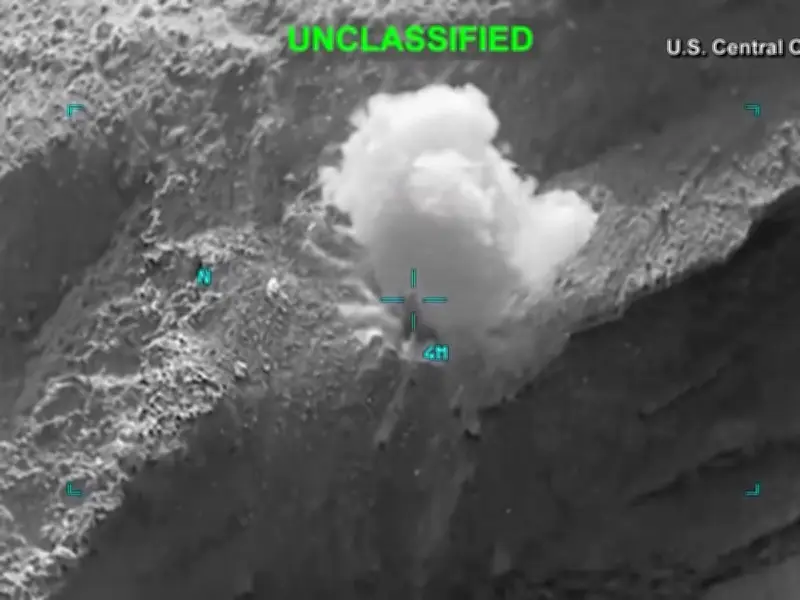
The £40 billion war on Iran has damaged world economies and made Middle Eastern fault lines increasingly unstable, while depleting the US military's weapons stocks to dangerously low levels. Under President Donald Trump, the world's most powerful military has seen its arsenal shrink, and Beijing is watching closely as the west's ability to aid Taiwan in a conflict diminishes daily.
Terror groups such as Islamic State and al-Qaeda are burgeoning in neglected ungoverned spaces across the Middle East, central and south Asia and Africa, and all have their eyes on Europe. Iran's Islamic Revolutionary Guard Corps is unleashing proxy forces in Yemen to do deals with al-Qaeda groups in Somalia such as al-Shabab.
The war has encouraged Tehran to let the Shia-Sunni Muslim schism slip, allowing its Shia proxies to link up with Sunni groups. Previously, its friendship of convenience with Sunni Hamas in Gaza was the most obvious Shia-Sunni link-up, but now terror alliances are becoming ever more dangerous.
Security source warns of rising threat to Europe
One UK security source told the Mirror: "We are witnessing an escalation, a heightened risk of Islamic State on the rise and it is plotting against Europe. With so many resources going into the Iran crisis and the freezing of the Strait of Hormuz inevitably terror groups will take advantage in places such as Afghanistan, the Middle East and in Africa and the threat level is rising. And on Iran specifically we are seeing a large-scale increase in US munitions and fire-power arrive in the Middle East in preparation for a major increase in tempo. This war could go on well into the long-term and despite the talks that are apparently happening the prognosis for chance of peace any time soon is slim."
It will take years for America to re-arm with missile stocks adequate enough to police global stability. The conflict is fuelling conditions for conflict in Europe and the Middle East to converge dangerously as allies take up positions alongside belligerents. After years of defence spending negligence, Europe is frantically arms racing to appease Trump's demands for NATO members to do more.
Diplomacy and Russian intelligence
The war has severely damaged the delicate balance of global diplomacy. Trump's misplaced trust in the world's despots was evident when he was asked about China apparently smuggling 400 rocket launchers through Pakistan and into Iran. Trump replied that President Xi had "told me very strongly he wouldn't partake. And he knows I would be quite disappointed."
It is nearly certain that Russian intelligence is feeding the Iranian military with information on US bases in the Middle East, drawing the west's enemies closer. It is possible that some American military personnel killed or wounded were victims of Russian intelligence aid to Tehran, as they have the capability to pinpoint base locations such as the one in Jordan.
According to the Pentagon, 18 American service members have been killed and more than 600 wounded in the conflict. The Iranian Health Ministry said more than 3,500 people have been killed in the war.
Missile stocks stretched thin
The Iran conflict has also affected Ukraine, which desperately needs Patriot defence missiles. The Patriot is used to target aircraft, ballistic and cruise missiles, and is particularly valuable in Ukraine as Russia's President Vladimir Putin has stepped up attacks on Kyiv with ballistic missiles. Their near vertical trajectory and speed make ballistic weapons difficult to shoot down with anything other than Patriots or similar.
Before the ceasefire on April 8, US forces had struck over 13,000 targets across Iran, according to the White House. American air defences intercepted over 1,700 Iranian drones and ballistic missiles over the same period, at great cost to US defensive missile stocks.
According to the Centre for Strategic and International Studies (CSIS), as many as 1,430 Patriot interceptors were used from an estimated pre-war stockpile of about 2,330. Each Patriot interceptor costs approximately £3m, and some were used to shoot down £30,000 drones. Patriots are made at the rate of 650 a year, so it will take at least two years to get back to pre-war levels.
Also used was a newer, more sophisticated system known as Terminal High Altitude Area Defense (THAAD), which has a longer range and higher intercept altitudes than the older Patriot. CSIS estimates between 190 and 290 were fired out of an estimated pre-war stock of 360. America has just seven THAAD batteries, so the Iran war could leave the US without a system critical to defending against ballistic missile threats from countries such as China or North Korea.
Before the war, the US had some 3,000 Tomahawk attack missiles but has, according to sources, fired at least 1,000 and is running short. Getting back to normal stock levels could take until 2031. The Tomahawk Land Attack Missile (TLAM) is usually fired from ships or submarines at targets well over 1,000 miles away, often hard shelters such as bunkers or fortress-like buildings, allowing attacks from a stand-off position.
Trump himself admitted production was slow, saying: "We have the best quality in the world. But we need a little more speed." So-called Secretary of War Pete Hegseth recently told the Senate Appropriations Committee the Pentagon needs another £68bn for "critical shortfalls."
Taiwan in the crosshairs
Beijing's President Xi said years ago that his army had to be ready for a Taiwan invasion by 2027. With the US entrenched in the Middle East with little sign of an exit strategy, this is becoming a headache for the US. China may feel the next couple of years would provide the optimum opportunity for success in taking Taiwan, with the US short of ammunition.
Tel Aviv's Institute for National Security Studies says it could be as soon as 2027 and may include selective or extensive missile strikes; a civilian maritime quarantine or military blockade; the seizure of one of the Kinmen Islands close to China; a special operation aimed at decapitating Taiwan's leadership; and a full-scale amphibious invasion of Taiwan itself.




