
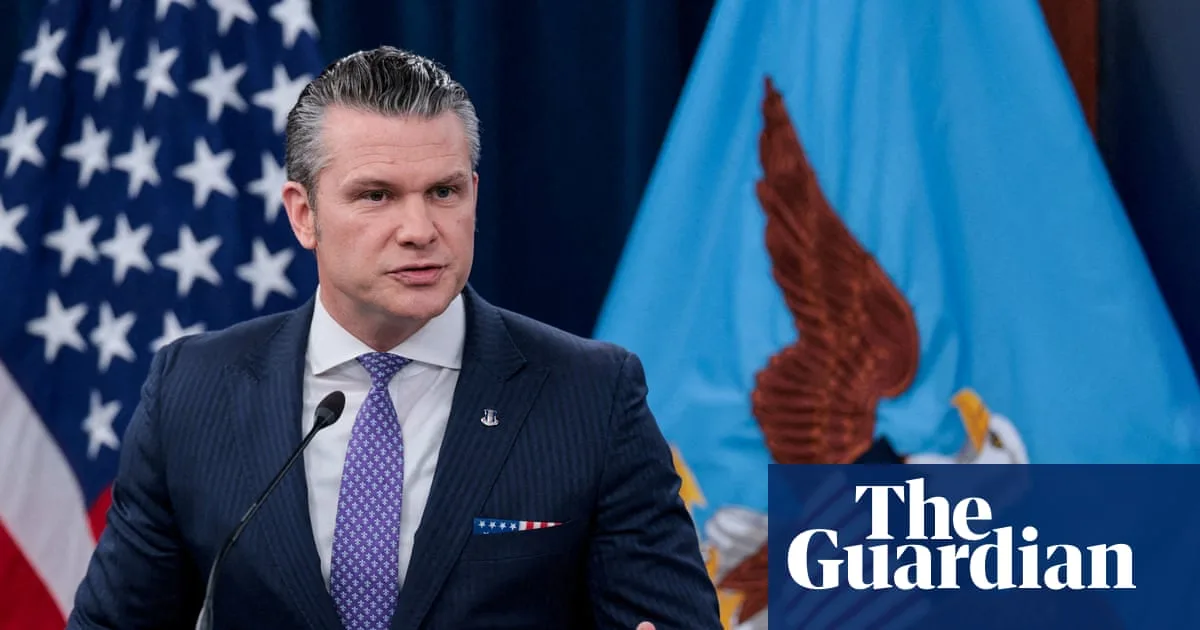
US Defense Secretary Pete Hegseth told the Senate on Tuesday that the American-Israeli campaign against Iran has cost $37.5bn to date, as he faced growing anger over the conflict's expense and the recent deaths of three US service members. Appearing before the Senate appropriations committee, Hegseth presented an updated cost estimate and defended the Trump administration's request for an additional $88bn in supplemental funding, calling it 'urgent and necessary'.
Accompanied by General Dan Caine, chairman of the Joint Chiefs of Staff, Hegseth argued that the Pentagon was running low on funds to sustain operations. Of the total request, $67.1bn is specifically designated for the Iran war effort. 'Without these funds, we face critical shortfalls,' Hegseth warned, saying it would threaten the Pentagon's ability to 'pay our service members, rapidly replenish equipment and munitions, and sustain vital operations without disruption'.
This was the defense secretary's first sustained public questioning since a brief ceasefire collapsed and fighting resumed. At least two US soldiers were killed in an Iranian attack on Friday, and another died in Iraq destroying an Iranian drone, bringing the American death toll since February to 17. Nearly 100 troops have been wounded, though most injuries were minor.
Democratic Vice-Chair Patty Murray demanded Hegseth explain what the war had achieved, accusing the administration of shifting its rationale. 'We hear a different rationale for this war every few days,' she said, noting justifications had moved from pre-empting threats to regime change, dismantling Iran's nuclear programme, and now to reopening the Strait of Hormuz, a waterway that 'was fully open, toll-free, before this war began'. She added, 'Here we are, five months later. The strait is closed... this war is now spiralling out of control again.'
Hegseth framed the funding request as a cost of deterrence, arguing, 'The best way to create peace is to prepare for war, to deter it.' He said the $21bn readiness portion would cover military pay, equipment replacement, and fuel shortfalls, while the $46bn capability portion would expand production of munitions like solid rocket motors and hypersonics. Without the funds, he warned of 'critical shortfalls' and said failing to fund the Pentagon at $1.5tn was 'the greatest threat that our nation faces'.
Senators from both parties expressed concerns. Republican Susan Collins of Maine, who faces a re-election contest, has backed war-powers resolutions to limit presidential authority over the conflict. She asked about the impact on military exercises if the supplemental funding is not provided; Hegseth replied that training 'would have to be curtailed'. Some Democrats also plan to criticise Office of Management and Budget Director Russell Vought, who earlier gave a lower cost estimate of $30bn, believed by experts to be a severe undercount.




