Defence Secretary's Personal Revelation on Iran War Casualties
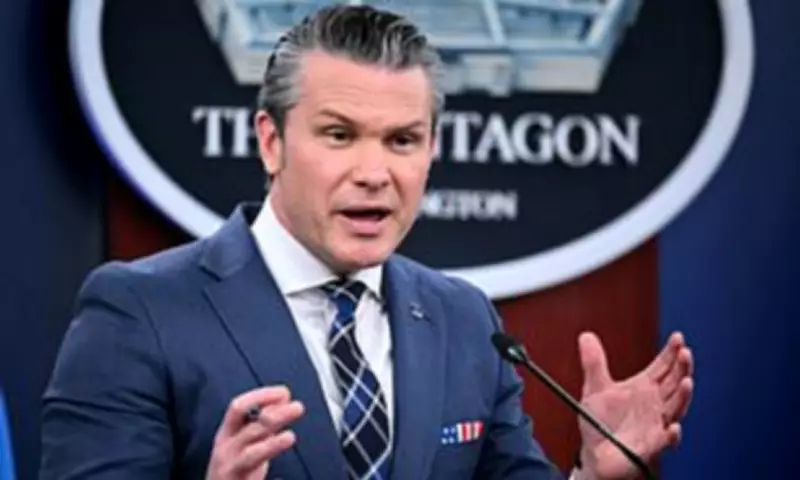
US Defence Secretary Pete Hegseth has revealed a poignant personal moment involving his young son, who questioned him about the ongoing war against Iran. The disclosure came during a press briefing at the Pentagon on Thursday, where Hegseth discussed the conflict's progress and its human cost.
A Father's Explanation to His Son
'My 13-year-old son popped into my office last night while I was editing these remarks. He asked about the war and the families I met at Dover,' Hegseth told reporters. 'I looked at him and said, "They died for you, son. So your generation doesn't have to deal with a nuclear Iran."'
This conversation occurred as Hegseth prepared for the briefing, highlighting the personal toll of military decisions. The Defence Secretary had recently greeted the bodies of six US airmen at Dover Air Force Base on Wednesday, who perished during Operation Epic Fury. President Donald Trump and other senior administration officials were present at the dignified transfer ceremony alongside the families of the fallen troops.

Mounting Casualties and Operational Details
Since President Trump launched the war against Iran three weeks ago, 13 US service members have been killed, with over 200 troops wounded. The conflict has seen significant incidents, including the crash of a KC-135 Air Force refueling aircraft in western Iraq last week, which killed all six crew members. Officials confirmed the crash was not caused by Iranian or enemy fire.
Operation Epic Fury continues, with US forces, including aircraft like the F/A-18F Super Hornet from the USS Abraham Lincoln, actively engaged. Meanwhile, regional tensions have escalated, with reports of Israeli air strikes in Lebanon and Iranian responses targeting energy infrastructure.
Hegseth's Defence of the War and Criticism of Media
Later in the briefing, Hegseth declared the war in Iran an overwhelming success, while launching a sharp critique of the media and US allies. He accused the press of suffering from 'Trump Derangement Syndrome,' claiming they 'want President Trump to fail,' but asserted that the American people 'know better.'
Hegseth also lashed out at 'ungrateful allies in Europe,' arguing that the entire world 'should be saying one thing to President Trump: Thank You.' He insisted the conflict would not become a 'quagmire' like previous wars in Iraq and Afghanistan, which he attributed to 'foolish politicians like Bush, Obama and Biden.'
Economic Impact and Regional Fallout
The war has triggered significant economic repercussions, with skyrocketing oil prices prompting fresh inflation warnings from central banks, including the Federal Reserve. Gasoline prices have surged to an average of $3.90 per gallon from $2.90 before the conflict began, as the Strait of Hormuz—a critical oil transit route—remains blockaded by Iranian mines and missiles.
On Thursday, US crude oil jumped by 1.5 percent, while Brent crude, the global benchmark, shot up by 5.9 percent to hit $114 per barrel. Markets were further rattled after Iran struck a massive Qatar gas field in retaliation for an Israeli attack, sending oil and gas prices spiking.
Diplomatic Strains and Allied Concerns
President Trump has previously urged Israel to refrain from strikes on Iran's energy infrastructure amid growing concerns over soaring prices, as he faces crucial midterm elections in November. America's Arab allies have expressed fury at Israel's attacks and the US failure to prevent them.
According to reports, Gulf allies have demanded the Trump administration halt all US and Israeli strikes on Iranian energy infrastructure, fearing vulnerability in the conflict. This diplomatic tension underscores the complex regional dynamics at play.
Hegseth's briefing, marked by personal anecdotes and forceful rhetoric, comes at a time of heightened military engagement and economic uncertainty, as the US navigates the challenges of the Iran war.