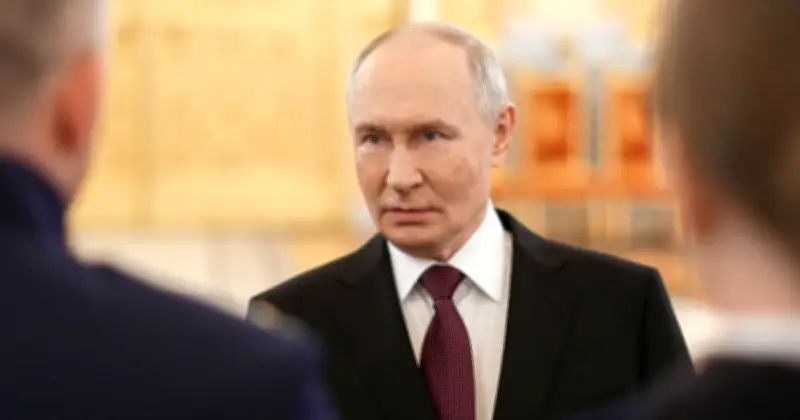
Estonia will defend itself in the event of an attempted Russian incursion, Vladimir Putin has been warned. The warning comes after the Institute for the Study of War (ISW) proposed a “Limited Russian Incursion Into Estonia” scenario, which an Estonian expert has now disputed.
Proposed Narva scenario
The ISW scenario suggested that Russian agents would already be in position in Narva, Estonia’s third largest city, to seize its museum, Narva Town Hall, and as many other nearby buildings as they can to “declare the establishment of the Narva People’s Republic (NPR)”.
The ISW’s scenario added: “The Russian agents identify themselves (truthfully for once) as Russian citizens and call on Moscow to defend them against Estonian efforts to root them out. The request is immediately granted.
“The Kremlin announces that Russian drone and air defense units have been assigned the task of defending the Russian citizens of the NPR from bases in Russia and that Russian military forces have not entered and will not enter Estonian territory unless Estonia escalates the crisis.”
Localised stalemate
The scenario continued: “Estonian police and forces in the area try to clear the positions rapidly but come under small arms fire from NPR fighters (supported by Russian Spetsnaz and other special elements and ground forces prepositioned in Estonia and moving rapidly to cross the bridge from Russia) with infantry weapons but not fighting vehicles.”
Experts then suggested that drone elements based in Russia would “rapidly begin striking Estonian forces attempting to clear the positions, and the Russian elements in Narva operate their own tactical drones to good effect”.
“The situation quickly becomes a localized stalemate as Estonian personnel immediately in the area are unprepared to defend against large volumes of Russian FPV strike drones, including fiber optic drones, protecting the NPR fighters,” the ISW added.
The Kremlin would then demand that all Estonian military, police, and government personnel “evacuate the territory”, researchers wrote. Moscow would then threaten to “launch an expanded strike campaign against Estonian forces if fighting continues, and to further expand that strike campaign against any NATO state that involves itself in operations against the NPR”.
“The NPR and the Kremlin assert that the situation in Narva is an internal matter resulting from Estonia’s mistreatment of Russian citizens and denies that it constitutes a Russian attack on NATO. On the contrary, the Kremlin claims, it is a defensive measure in response to Estonian aggression,” the ISW added.
Expert disputes assumptions
Merili Arjakas, a research fellow at The International Centre for Defence and Security (ICDS) — a think tank in Estonia specialising in security, defence and foreign policy issues — and the editor-in-chief of foreign policy magazine Diplomaatia, has disputed this sequence of proposed events.
She told The Express that NATO countries are less experienced at using drones, but added: “The usual problem with such scenarios is that they are based on assumptions that are neither explained nor justified.
“First, that Estonia is incapable of detecting and preventing a number of Russian agents with weaponry from infiltrating across the border.
“An exact number is usually not mentioned, but we can assume it would require at least tens if not hundreds of men completely invisible to the border guard and counter-intelligence.
“Second, that these agents would be able to quickly seize positions on Estonian territory without facing any or sufficient response.
“Third, that a response will not be forthcoming at the national or NATO level due to the inability or unwillingness of the Estonian government and military to use force and of other allied countries to refrain from ‘escalatory’ steps.
“And fourth, any such ‘limited’ incursion would not be met with a NATO response against Russian own vulnerabilities elsewhere.”
Estonia’s defence measures
Ms Arjakas highlighted that NATO countries have declared that any military threat against its members’ territory will be treated as such.
“While I acknowledge the degree of uncertainty in our collective response, stemming both from the different political views in some capitals and from the simple fact that such a test of NATO unity has not happened before, I think it is an unfounded assumption that no or only a little response would come from us, our regional partners, the British contingent in Estonia, and other allies,” the expert added.
She then warned that Estonia has measures in place to counter a Russian incursion. Ms Arjakas said: “To be able to deter and, if needed, defend against any Russian attack, Estonia maintains and trains a reserve-based military force, with additional volunteers from the Defence League.
“We have invested a great deal of money in acquiring weaponry and ammunition for short- and long-range strikes and air defence.
“We cooperate closely with our partners for NATO’s forward presence. We also know that there is no end to the salami-slicing technique — there would be nothing ‘limited’ about a Russian incursion.
“Any aggressive plan against us must be disrupted or countered pre-emptively.
“While any security agency or military can have its blind spots, in my opinion, it would require more than just a statement ‘the military will not be able to do anything’ for an analysis to be taken credibly.”