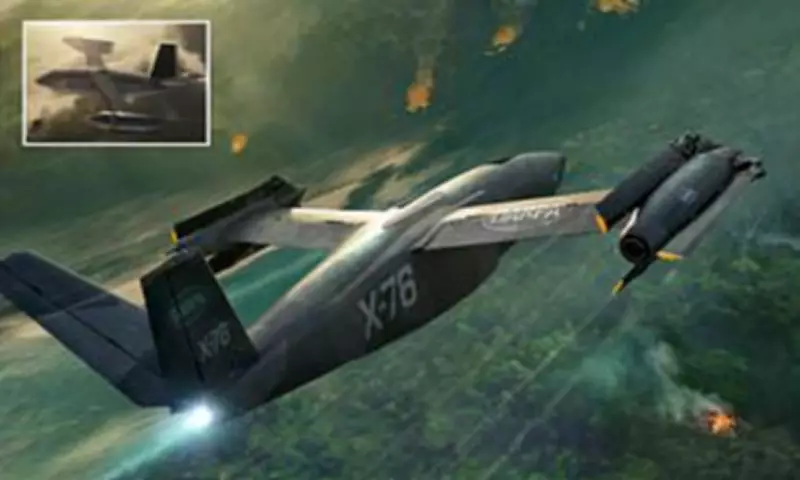
The Pentagon's most secretive research division has dramatically unveiled detailed renderings of its latest experimental military aircraft, designed specifically for unique and critical special operations missions that demand unprecedented flexibility and speed.
A Revolutionary Hybrid Design
The newly revealed aircraft, designated the X-76, represents a groundbreaking joint development effort between the Defense Advanced Research Projects Agency (DARPA), the United States Special Operations Command, and leading aerospace manufacturer Bell Textron. This designation notably commemorates the 250th anniversary of the United States, adding symbolic significance to the project.
DARPA, the Pentagon's advanced research and development arm, formally announced this next-generation, high-speed, runway-independent aircraft on Monday through an official press release. The agency emphasized that the primary objective is to eliminate one of the battlefield's most persistent and difficult dilemmas: the choice between the high speed of conventional fixed-wing aircraft, which require prepared runways, and the go-anywhere flexibility of slower vertical takeoff and landing helicopters.

Blending Aircraft and Helicopter Capabilities
The X-76 achieves this ambitious goal by ingeniously blending aircraft and helicopter features. It utilizes advanced vertical takeoff and landing (VTOL) systems combined with high-speed jet propulsion capabilities. This hybrid approach is engineered to completely eliminate military dependency on traditional runways, a longstanding operational constraint.
DARPA released two distinct renderings of the next-generation plane, clearly showing both an unmanned drone version and a manned cockpit version. The visualizations reveal a craft with a notably wide-body frame, strongly suggesting it possesses the capacity to transport not only troops but also military vehicles, potentially including artillery systems and light tanks.
Transforming Military Deployment
If the X-76 successfully achieves its design specifications for carrying both personnel and vehicles, it could fundamentally transform how United States forces deploy heavy assets into combat zones lacking any established landing strips or prepared surfaces. This capability would provide strategic advantages in rapid reinforcement and surprise deployment scenarios.
'The SPRINT program is a joint effort between DARPA and U.S. Special Operations Command to advance technologies that could break the long-standing military trade-off between the high speed of fixed-wing aircraft and the agile, runway-independent operations of vertical takeoff and landing platforms,' the official DARPA release stated definitively.
It further elaborated: 'The design, construction, and flight testing of the X-76 will drive innovative, runway-independent, vertical-lift capability with jet-like cruise performance and inform future operational needs and requirements.'
Ambitious Performance Targets
The program's primary technical goal is to create a combat aircraft capable of cruising at speeds exceeding 460 miles per hour while retaining the ability to hover effectively in 'austere environments' and operate reliably from 'unprepared surfaces' such as rough terrain or confined spaces.
Commander Ian Higgins, DARPA's SPRINT program manager, provided compelling insight into the strategic thinking behind the project. 'For too long, the runway has been both an enabler and a tether, granting speed but creating a critical vulnerability,' Higgins explained. 'With SPRINT, we're not just building an X-plane; we're building options. We're working to deliver the option of surprise, the option of rapid reinforcement, and the option of life-saving speed, anywhere on the globe, without needing any runway at all.'
Future Testing and Development Timeline
The X-76 is currently projected to begin its crucial flight testing phase in 2028, marking a significant milestone in its development journey. This aircraft represents the latest addition to the Pentagon's prestigious X-series, or experimental aircraft program, which has historically produced some of the most innovative aviation technologies.

The Pentagon is concurrently developing other advanced experimental aircraft, including the X-47 next-generation fighter, which has already undergone hundreds of hours of successful test flights according to DARPA reports. Additionally, the X-65, an experimental aircraft constructed without conventional exterior movable parts like rudders or flaps, is now expected to commence its test flights in 2027 following earlier developmental delays.
These parallel projects underscore the United States military's sustained commitment to pushing the boundaries of aerospace technology, with the X-76 positioned as a potentially transformative asset for special operations forces requiring unprecedented mobility and tactical flexibility in future conflicts.