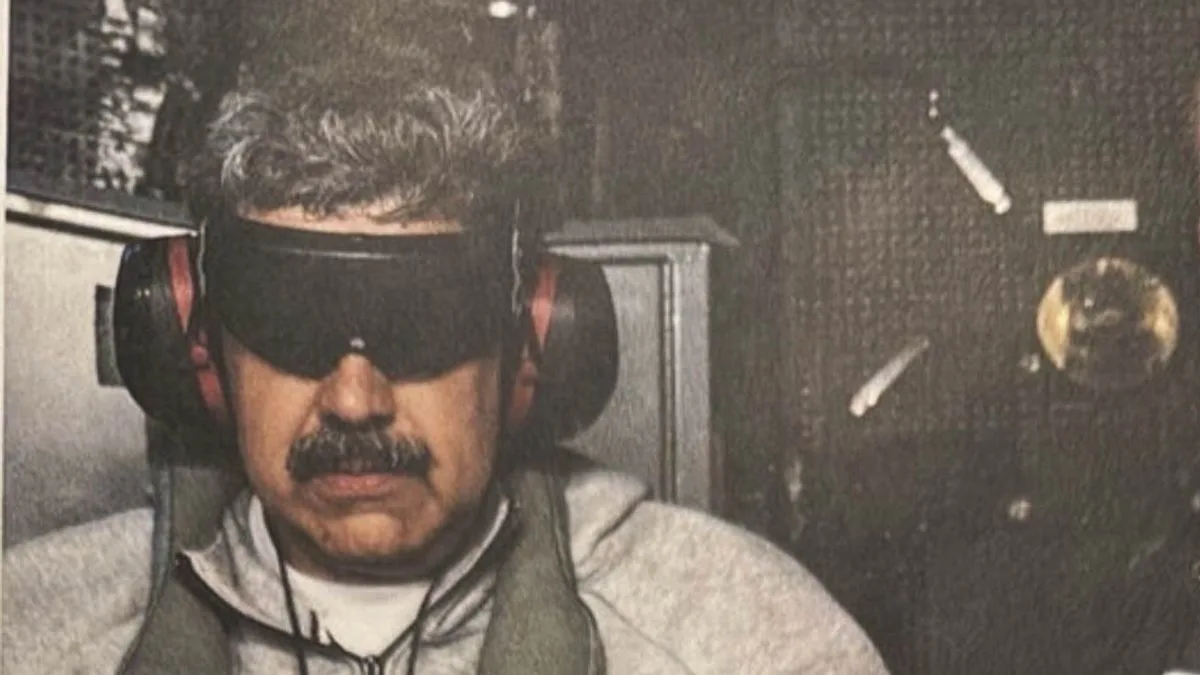
CIA's 'Killer Elite' Ground Branch Led Covert Op to Capture Venezuela's Maduro
CIA's Secret Unit Spearheaded Maduro Capture Operation

In an exclusive revelation, it can be disclosed that America's most clandestine and lethal CIA unit was the hidden force behind the operation to capture Venezuelan President Nicolás Maduro. The covert team, known as 'Ground Branch', laid the groundwork for the dramatic special forces raid on Maduro's Caracas fortress.

The Shadowy Preparations in Caracas

The elite Ground Branch operatives from the CIA's Special Activities Centre infiltrated the Venezuelan capital as early as August. Their mission was to meticulously monitor Maduro's every move and prepare the battlefield for a later assault by US Army Delta Force commandos.

Operating from a network of safe houses, the team covertly mapped entry points to Maduro's compound and compiled a detailed 'pattern of life' dossier on the leader and his security detail. This involved calculating his daily routines, estimating wall thicknesses, locating bullet-proof windows, and tracing the patrol routes of his bodyguards.

For weeks, the operatives lived under extreme tension, evading Caracas's security and counter-intelligence teams in a mission where a single mistake could have proven catastrophic. Their covert work unfolded as a US Navy fleet gathered ominously off the Venezuelan coast, creating an atmosphere of impending invasion.

The High-Stakes Raid and Aftermath

The meticulously planned operation culminated on a Saturday, involving a staggering force of 150 warplanes and 11 ships. The raid successfully seized the 63-year-old Maduro, his wife Cilia Flores, and several associates amid a series of explosions.

This week, Maduro and his wife appeared in a New York court, where they were arraigned on narco-terrorism charges. Both entered pleas of not guilty.

The Ground Branch personnel are drawn from the most elite ranks of the US military and intelligence community, including former Army Delta Force operators and Navy SEALs. They are retrained in advanced spycraft, including sabotage, assassination, intelligence gathering, and operating undetected behind enemy lines.

A Mission of 'Plausible Deniability'

This extended undercover deployment was considered an unusually long and high-risk 'black op' for the unit. It operated under strict plausible deniability protocols, meaning the US government would have been unable to acknowledge or assist the operatives had they been captured by Venezuelan authorities.

A Western security source described the mission's difficulty: "That was a profoundly difficult mission to undertake, to maintain cover for so long on one operation, especially with so many moving parts, defectors, sources. And there was no official cover either so had they been caught it would have been very difficult for them."

The operation was significantly aided by defectors from within the Venezuelan military and intelligence services, who 'flipped' and helped regular CIA officers identify key targets. Concurrently, while Ground Branch worked in the shadows, other CIA agents were persuading regime defectors to provide critical intelligence on Maduro's inner circle.

The unit itself was born from a Cold War-era need identified in the 1980s for a paramilitary force capable of linking US military services with intelligence agencies. Its creation was partly spurred by the failure of Operation Eagle Claw, the disastrous 1980 attempt to rescue American hostages in Iran.

For the duration of the Caracas mission, US President Donald Trump monitored the events live from a situation room. The closest equivalent within the British system is the SAS's secretive 'E Squadron', which works closely with MI6 on similar clandestine tasks.




