
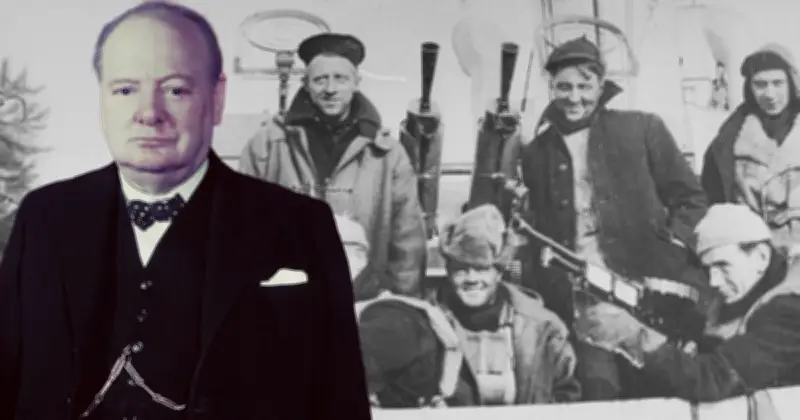
Churchill's Pirates were a force of 70,000 fishermen, volunteers, and landlubbers who manned more than 6,000 small boats in the Allied fight during World War II. They faced ceaseless perils in the Arctic, as described by Winston Churchill himself.
The Northern Gem and the PQ17 Convoy
Sid Kerslake, a former fisherman from Hull, was aboard the armed trawler Northern Gem in July 1942. The ship was part of a close escort force protecting 36 merchant ships carrying war materiel to the Soviet Union. The convoy, codenamed PQ17, was the biggest sent to Russia at that time.
On July 2, 1942, Kerslake was enjoying tomato juice on deck when action stations sounded. Six German biplanes approached, and a torpedo headed for the Gem. The captain shouted "Hard aport!" and the ship swung clear.
The Scattering of PQ17
Two days later, Kerslake saw at least 25 He 111 bombers approaching. Despite three ships being sunk or crippled, the convoy held its own. However, the Admiralty, fearing an attack by the Tirpitz, ordered the convoy to scatter on July 4. The order was premature, but the damage was done. Of the 34 merchant ships, 22 were sunk by air and U-boat attacks.
Kerslake watched the scatter flags and said, "What are we splitting up for? We're better off as we are, on our own we have no chance at all!" He was scared, being only 22.
The Royal Naval Patrol Service
The Northern Gem was part of the Royal Naval Patrol Service, nicknamed "Churchill's Pirates" for their rag-tag appearance and fishing gear. Ships were requisitioned from ports like Hull, Grimsby, and Aberdeen, converted in two weeks, and sent to sea with volunteer crews.
From 4,000 men initially, the service grew to over 70,000 sailors in 6,000 ships by August 1945. They hunted U-boats, escorted convoys, and patrolled mangrove swamps. They took part in Dunkirk, North Africa, Italy, and D-Day.
The Cost and a Rescue
The service lost more ships than all other Royal Navy sections combined, with at least 410 armed fishing vessels sunk and 3,218 men killed.
In December 1942, the Northern Gem was ordered to collect survivors from the destroyer Achates, hit by German fire. Kerslake tried to save a young lad who was too cold to move, and he heard him cry for his mother as he disappeared. Below decks, the messrooms were full of shocked and injured men.
Years later, a survivor wrote to Kerslake, thanking him for pulling him aboard and giving him "a cup of good old neaters." Churchill saluted their "iron, unyielding, unwearying tenacity." Their story is now told in full in a new book.




