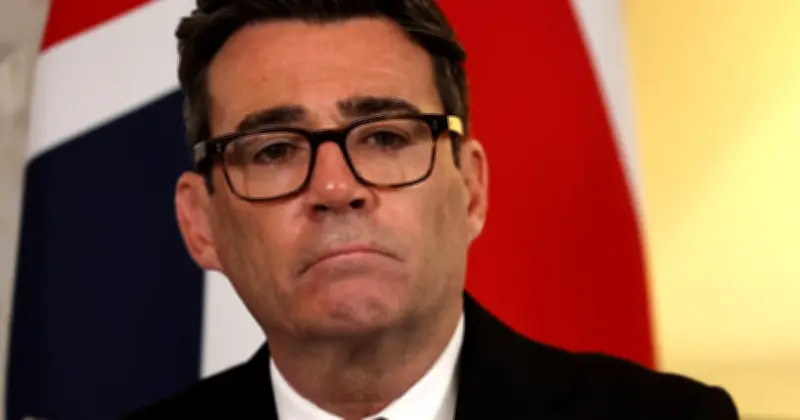
Andy Burnham is facing pressure to rapidly increase defence spending amid rising Russian threats, with senior Tories warning that a failure to boost military coffers would leave "Britain less safe".
A new report warns the UK has "glaring gaps" in its military capabilities in the Arctic High North that could leave the country vulnerable to Vladimir Putin's forces. The Commons Defence Committee urged the Government to bolster the number of armed forces and ships in the region by 2030 – the year from which former prime minister Sir Keir Starmer predicted Moscow could attack NATO.
High North Strategic Challenges
The High North has become crucial for the UK's defence and security, with Putin increasingly sending spy ships based there into British waters. At the same time, doubts have been cast on Washington's commitment to European security.
Failing to defend the region could leave underwater cables and pipelines carrying key data and energy to the UK exposed to sabotage during peacetime, the committee said. In the event of conflict, it said Russia could threaten the UK's population, civilian and military infrastructure and vital Atlantic supply routes from the US.
The MPs highlighted a shortfall in anti-submarine warfare at a time when the greatest Russian threat comes from its submarines and naval sabotage forces. The best deterrent is the Royal Navy's anti-submarine warships and nuclear-powered submarines, but these are ageing and often out of action under maintenance.
Naval Capability Shortfalls
There are currently five Type 23 frigates, which track down hostile submarines and protect the UK's nuclear weapons, and six Type 45 destroyers in service – just over half of the Royal Navy's requirement for 19 vessels. Eight new Type 26 frigates will eventually take over, but construction is slow.
The committee's inquiry also heard of "a shockingly low availability" of submarines, and that the UK appeared to have temporarily lost its ability to operate them beneath Arctic ice. This would allow Russia in a conflict to conceal its nuclear submarines under the ice unchallenged while its attack submarines surge forward.
Committee chairman Tan Dhesi said: "The High North poses a major strategic challenge for the UK's security. This is a demanding, hostile environment, and one that our greatest adversary, Russia, is seeking to dominate for military advantage."
"The UK needs to be willing to address a hard truth: it does not currently have all the capabilities to operate successfully in the High North. Russian submarine and sabotage forces in the High North pose direct risks to the North Atlantic and the UK, including the nuclear deterrent."
Political Pressure and Spending Delays
The Kremlin is seeking to exploit the High North, loosely defined as the Arctic and parts of the North Atlantic, for minerals and for control over shipping routes as melting sea ice makes them more accessible.
Conservative shadow minister for war readiness Stuart Anderson said: "This Defence Committee report exposes glaring capability gaps in the High North at a time when the threat of war with Russia is rising. If NATO could be at war with Russia as soon as 2030, as the former prime minister warned, that means time is just as important as money."
"To deter war we must be ready for it, that means spending money now, not kicking the can down the road until it's too late. The Chancellor must come to the Budget with his plan for spending 3% of GDP on defence by 2030 – anything less leaves Britain at risk in the High North."
A major row over delays to defence funding has now been reignited, with a senior Tory accusing the Prime Minister of a "humiliating retreat" for pushing back a decision until next year. The Government had been expected to carry out a spending review, which would set out the long-awaited timetable for rearmament, in the spring.
However, Mr Burnham – who says the Government "will fully fund the defence investment plan" – has pushed it back until this time next year, in the hope that Britain's economy will have improved by then.
Shadow Defence Secretary James Cartlidge told the Express that Mr Healey quit his old job as defence secretary in Sir Keir's government "because he said refusing to commit to spending 3% of GDP on defence by 2030 was making Britain less safe". "Now he is the one in charge of the country's finances, yet we are no closer to hitting the target he said was essential," Mr Cartlidge added.
He described the decision to push back the 3% commitment as a "huge and humiliating retreat". He added: "Labour talk tough on defence, but their refusal to get a grip on the spiralling welfare bill and put the money into the Armed Forces is putting us all in danger."
Military and Security Warnings
It comes after the head of the Army warned that political leaders are about to call on ordinary Britons to prepare for war. Gen Sir Roly Walker also urged troops to get ready, declaring: "Our nation is going to need you."
MI5 chief Sir Ken McCallum has also suggested ordinary Britons may soon have a role to play in defending the nation. In his annual address in London last week, he said Russia is "aggressor number one", adding: "My message to the British public is this: you have a stake in our national resilience. You too have a vital role to play. It might be quiet. It might be life-saving. It all counts."
The Chief of Defence Staff, Sir Richard Knighton, told BBC Radio 4's Today programme in June that "this is the most dangerous period I've known". He added that Russia has been "probing, challenging, testing our defences".
A Government spokesperson said: "This Government is delivering the largest sustained increase in defence spending since the Cold War, while making meaningful welfare reforms to deliver nearly £2 billion in savings by the end of the decade. Through the Defence Investment Plan we are transforming our Armed Forces, backed by £298 billion, rebuilding warfighting readiness and ensuring we are ready to face future threats."
"The UK will always meet our NATO commitments. At the spending review the Chancellor will set a target date for 3%, as part of a clear path to meeting our NATO commitment of spending 3.5% of GDP by 2035."