
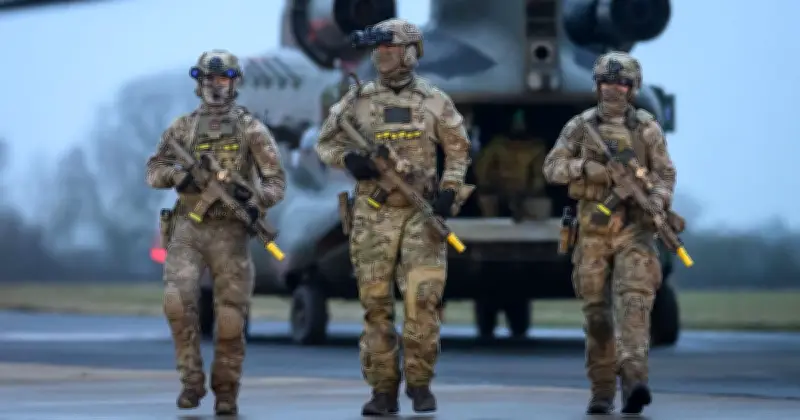
British soldiers deploying to Poland this month for a major exercise would be allowed to fire back if attacked by Russian forces, Western officials have suggested. The drills rehearse how European troops would help maintain peace in Ukraine following a ceasefire.
Exercise Details and Force Readiness
Some 2,800 European troops will head to Poland later this month for Exercise Koalicja, which gets underway on November 9 and is set to last two weeks. Three hundred British troops are involved in the exercise, which is taking place across land, sea and air.
Soldiers from the British Army's 7 Brigade, known as the Desert Rats, will rehearse key logistical movements. RAF Typhoon fighter jets and a Voyager tanker will fly sorties simulating how they would reassure commercial air travel once Ukraine's skies reopen.
Military personnel from Belgium, Estonia, France, Germany, Lithuania, the Netherlands, Poland, Spain, Sweden and Turkey are also taking part.
Rules of Engagement and Mission
The Multinational Force Ukraine (MNF-U), the military arm of the Coalition of the Willing alliance, was declared ready to operate in July. Western officials said the force would be able to deploy to Ukraine within about a month of a peace deal being struck.
A Western official said the MNF-U will "protect" itself against any aggression and that defence chiefs have been "working on an appropriate set" of rules of engagement in the event of a Russian attack. They also said: "Of course, there is the reality that Russia may choose to challenge the MNF-U in a variety of different areas. One may well, for example, be in the information domain. However, we will be ready to respond as necessary in order to make sure we protect our force and can deliver our mission and our mandate."
The official stressed the MNF-U would be "defensive in nature, with no intention that the force is designed for operational offensive action". They said the upcoming drills will see personnel rehearse protecting themselves against the "full spectrum of threats".
Leadership and Strategic Role
Lieutenant General Tom Bateman, commander of the MNF-U, said the "main effort" of the force would be the regeneration of Ukraine's armed forces. The British three-star general said: "The MNF-U will provide logistics, equipment and training expertise to help accelerate the regeneration and reconstitution of Ukraine's armed forces. MNF-U personnel will also train alongside the armed forces of Ukraine to strengthen interoperability and enhance operational capability."
A Western official said the training would have a "reciprocal benefit", highlighting Ukraine's "enormous experience" in modern warfare with the full-scale conflict approaching its sixth year. Lt Gen Bateman said the MNF-U "must be ready" to act if peace is secured in Ukraine.
He said it will not be used in a peacekeeping or ceasefire-monitoring mission, while stressing it is "not designed" for offensive operations. He added: "Its purpose is to provide reassurance and support the regeneration of Ukraine's armed forces, strengthening their ability to deter and, if necessary, defend against future Russian aggression."
Deployment Conditions and Next Steps
Lt Gen Bateman said the MNF-U would only deploy to Ukraine at the invitation of the Kyiv Government after a peace deal and once the "necessary political and military conditions" have been met. Vladimir Putin previously rejected proposals for Western troops in Ukraine after a ceasefire, warning international forces deployed to the country would be "legitimate targets".
Despite all being NATO members, the MNF-U falls outside of alliance duties. The US is a notable absence in the MNF-U, with the Trump administration previously telling European allies to take more responsibility for continental security. A Western official said the force is "not dependent upon US systems". It is unclear whether Washington is providing intelligence to its allies.
Turkish forces will stand up the MNF-U's maritime element in Istanbul during Exercise Koalicja. They will test plans for maritime mine clearance in the Black Sea, enabling commercial shipping to safely return to Ukrainian ports. The MNF-U's headquarters are set to move from Paris to London by the end of this year, and a fresh round of US-led ceasefire talks is set to begin next week, with officials from Washington, Kyiv and Moscow due to meet in Abu Dhabi.




