
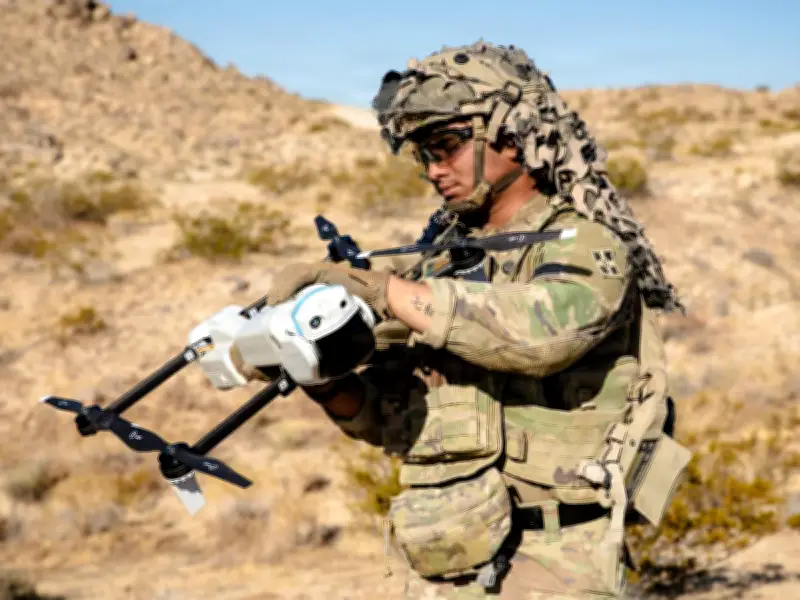
Heat shimmered over the Mojave Desert as a British soldier stepped out with a small controller in hand. Above, an unmanned aircraft circled almost invisibly, feeding live images of enemy positions to a screen below. Coordinates were passed, targets confirmed, and munitions fell on hostile ground no soldier could safely reach.
Sirens marked a direct hit. Survivors dropped to their knees, tightening tourniquets and treating the wounded in the dust. Before they had finished, driverless trucks and desert buggies were already surging across the battlefield, ferrying water, ammunition, equipment and reinforcements. No drivers. No pilots. No shouted orders.
Five Eyes exercise tests the wars to come
British and allied troops took part in Project Convergence-Capstone 6 (PC-C6) at the US Army's National Training Centre at Fort Irwin, an exercise bringing together the Five Eyes alliance of Britain, the United States, Canada, Australia and New Zealand. In temperatures up to 49C, soldiers tested how to fight an enemy armed with drones, cyber weapons, signal jammers and AI systems.
The familiar image of troops advancing behind tanks while commanders study paper maps is being overtaken by something faster, more connected and potentially more deadly. A drone can spot a target beyond the horizon. AI can examine streams of video, intercepted signals and battlefield data in moments. A commander can launch a strike before an enemy realises it has been found. The aim is to compress decisions that take hours into seconds.
Humans still make the final call
None of the gear being tested was fully autonomous, according to Colonel Jim Howard, commander of the British Army's Experimentation and Trials Group. "You allow AI to do the science, and the human to do the art. You're not looking at replacing people, you are augmenting and accelerating people, and giving them the tools to be faster and better, and more lethal," he said.
Senior officers insist the machines are not being allowed to choose who lives and dies. The machine finds patterns, processes data and points towards danger. The human makes the judgment and gives the order. But the balance is shifting. A soldier may still pull the trigger, yet AI could increasingly determine what they see.
Digital vulnerabilities
Col Howard said that if an enemy can be located and struck before British soldiers are exposed, fewer lives are placed in danger. But there is another threat: every drone, sensor, vehicle and communication system depends on software. An enemy that can hack or jam that network could blind an entire force, stop its vehicles or feed commanders false information.
British teams therefore attacked their own gear to test its resilience. "All capabilities went through electronic warfare attack and jamming, to see how resilient they are. Some are able to shrug it off – there's some very clever tech," Col Howard said.
At Fort Irwin, up to 60 pieces of gear were pushed through the dust and heat, including acoustic sensors, aerial drones and unmanned ground vehicles. "There are technologies in that tent you could buy tomorrow. Others are more emergent and are going to require a bit more work," Col Howard added.
Allies train as one
British troops were inserted into a US corps-level operation and required to connect their equipment with systems used by all five allied nations. Brigadier Karen Peek, the UK task force commander for PC-C6, said no country could face the emerging threat alone. "It is more complex than ever, and technology is evolving at a rapid rate. Making sure that we train as we would fight is really important," she said.
Fighting an enemy they cannot see or hear, armies that cannot communicate or move quickly enough may be destroyed before they know what is happening. Yet Brig Peek said the most important achievement was not found inside any tech. "This exercise is about way more; it's about people, and building that trust. The allies are learning, adapting, innovating, and we are much more ready now for future challenges."
The soldiers remain at the centre of the fight. They still carry the weapons and make the final decisions. But all around them, largely unseen, AI is already beginning to dominate the battlefield.




