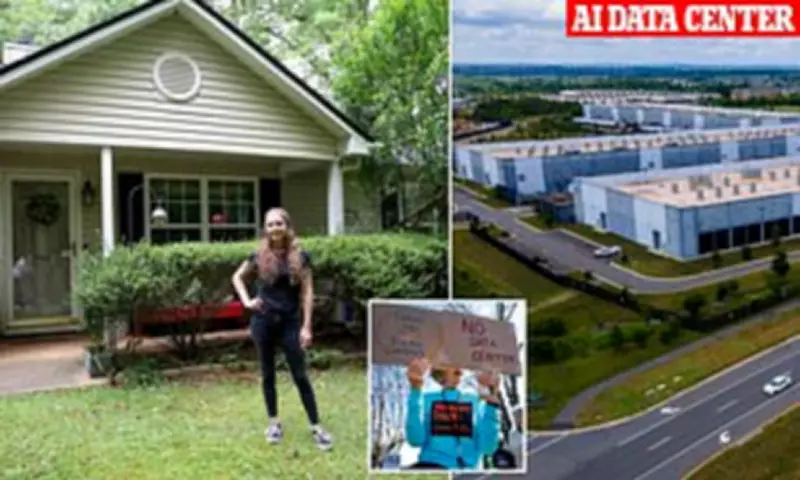
Ansley Brown never imagined that the modest house tucked away in the woods of rural Georgia, the home her mother bought as a struggling single parent, could one day be seized through eminent domain to help power a new generation of massive AI data centers.
'They are literally taking my childhood home,' the 27-year-old told the Daily Mail in an exclusive interview as she stood outside the house where she first moved in back in 2002 and where her mother still lives today. 'They want to demolish this property and all two and a half acres of it to build transmission poles for the AI data centers.'
For Brown's mother, Angela Hall, the house represented something she fought hard for. 'I was a very poor single mother before this,' Hall, 49, told the Daily Mail while sitting in her living room. 'I lived in a housing project when Ansley was tiny. I worked my butt off for this house.'

Now Hall has until August 1 to find and buy a new home she can afford - and move her furniture, dogs, cats, chickens, and 20 koi fish out of the property she thought she would someday leave to her granddaughter.
Unexpected Battle Against AI Infrastructure
Brown said she had never heard of the multi-billion dollar industrial projects tied to the AI boom that are popping up all over the US until representatives from Georgia Power began showing up in the area about a year ago to conduct surveys and assessments. Later, she said, they came to her mother's door and visited other homeowners nearby. Brown says residents also received what she called 'intimidating' letters saying their properties would be taken through eminent domain and that they had no choice.
Electric utility firm Georgia Power says it needs additional transmission lines to meet soaring electricity demand driven by the rapid expansion of AI data centers, particularly in Coweta and Fayette counties. As many as 21 homes and 330 properties - sometimes just vacant private land - are reportedly being taken by Georgia Power, although the company said in a statement that they are planning to pay homeowners above market value for their houses and that they are in positive negotiations with many residents including Angela Hall.
Broader Opposition to Data Centers
Brown's fight, which began with TikTok videos that went viral, centers specifically on Georgia Power and the land needed for transmission infrastructure. But across the area surrounding Newnan, a broader battle is unfolding over the AI buildout itself. The 35-mile radius around her home has become a flashpoint for activism against a spate of data centers planned for what residents describe as tranquil, pastoral neighborhoods.
'They think we're a bunch of rednecks and they can dump these centers here and we won't be able to do anything about it,' Brown said. The biggest fight is against Project Sail, a proposed $17 billion AI data center planned on roughly 830 acres of rural land in western Coweta County near Newnan. The current plan calls for nine buildings totaling more than 4.3 million square feet and an estimated 900 megawatts of power demand — enough electricity to rival a nuclear reactor's output.
Despite a year of fierce opposition, Coweta commissioners approved the project in a 3-2 rezoning vote in April, allowing the land to shift from rural conservation to industrial use. But groups like Stop Project Sail and Citizens for a Rural Coweta have since taken legal action, arguing the county ignored its own land-use plans and environmental concerns.
Residents Voice Concerns
Among those fighting the project is Laura Beth Sofolo, a 47-year-old mother of six in Newnan. She said her family moved to Georgia seeking peace and open space after leaving Colorado. She and her husband bought a home on acreage with woods and a creek where their children ride bikes and take evening walks, only to discover in December 2024 that Project Sail was slated to be built next door.

'They're saying 10 years of constant construction,' Sofolo told the Daily Mail. 'The roads here are not very safe, and now they're talking about putting in roundabouts and redoing roads, and these are just local two-way country roads. We have kids on the spectrum. I'm very worried about the generators going off and them getting upset, and just the constant noise. One reason we moved out here was because they need the peace and quiet. Now we don't know what to do, or what we can do. Property values here have already nosedived. There are houses near me that have been listed for months.'
Georgia Power's Response
Georgia Power said it was aware of Ansley Brown's videos and told the Daily Mail it spent months negotiating with her mother and made her an offer that was 125% higher than her appraiser's valuation, but that Angela Hall ultimately chose not to finalize the agreement. The company added that eminent domain is used only as a last resort and occurs in fewer than 1% of its land transactions, with most agreements providing compensation above market value or additional benefits for homeowners.
Ansley Brown said the higher offer came only after her TikTok video went viral and they had offered much less money originally. But she said she and her mother want to fight to keep her home. Brown says the modest property was meant to be a 'forever' home that she and her mother believed would be kept in the family for generations.
National Trend and Economic Concerns
Georgia is hardly alone in this battle. Across the US, similar fights over AI data centers are unfolding in Virginia, Colorado, Arizona, Tennessee, Michigan, and Texas, where residents have raised concerns over noise, water use and rapid industrial growth. In Utah, backlash has grown around the proposed 66,000-acre Stratos AI Project. Box Elder County commissioners approved the project earlier this month after contentious public hearings and thousands of objections.
Ansley Brown says she sympathizes with residents there. Going up against the companies driving the AI data-center boom leaves many people feeling powerless, she said. 'It makes you feel like America is not free. When you have a billion-dollar company and you yourself are just an average American, what are you supposed to do?'
Steve Swope, 69, a retired businessman who lives on a farm in Newnan, is among the activists fighting Project Sail, although he says he's not opposed to all AI data centers. 'Technology is important,' Swope told the Daily Mail. 'Data centers are going to be important going forward. They're essential infrastructure for our country, but they need to be put in the proper place, not in rural neighborhoods on top of families.'
But Swope also believes the economics driving the AI boom may prove unstable. He sees parallels to the dot-com collapse of the late 1990s. Recent estimates suggest building the infrastructure needed for the AI boom could cost between roughly $3 trillion and more than $5 trillion globally over the next several years. 'But revenue generated by data centers in 2024 was somewhere around $600 billion,' Swope said. 'How is ChatGPT going to make up their investment in data centers by selling $20 subscriptions to the general public? The answer is no. That will never happen.'
Swope warned that partially completed facilities could become abandoned industrial shells if the market cools before construction is finished. 'What happens to those buildings? Who's left holding the bag? The big companies like Microsoft will just walk away. They've despoiled the land. They literally ruin people's lives, and they've got basically ... giant rat farms.'
Policy and Personal Impact
Last year the White House issued an executive order accelerating construction of data centers. Critics say the order weakens regulatory review, offers loans and grants to developers and opens federal land for projects they view as noisy, electricity-and-water-intensive eyesores at best — and surveillance behemoths at worst. Supporters, who often have financial ties to the AI data centers, argue the projects are an inevitable transformation necessary for economic growth and competition with China.
But Ansley Brown says it's a 'war' for her and she won't stop fighting. 'This is supposed to be a forever home for my mom, and this home is actually supposed to be left to my daughter. So they are taking away from three generations.' Her mother said she does not know whether her home can ultimately be saved, but hopes her family's experience serves as a warning. 'Let us be a red flag for what's coming down the road. These data centers are destroying our way of life. We got to stand up, we got to get together and stand up and fight for what's right.'