
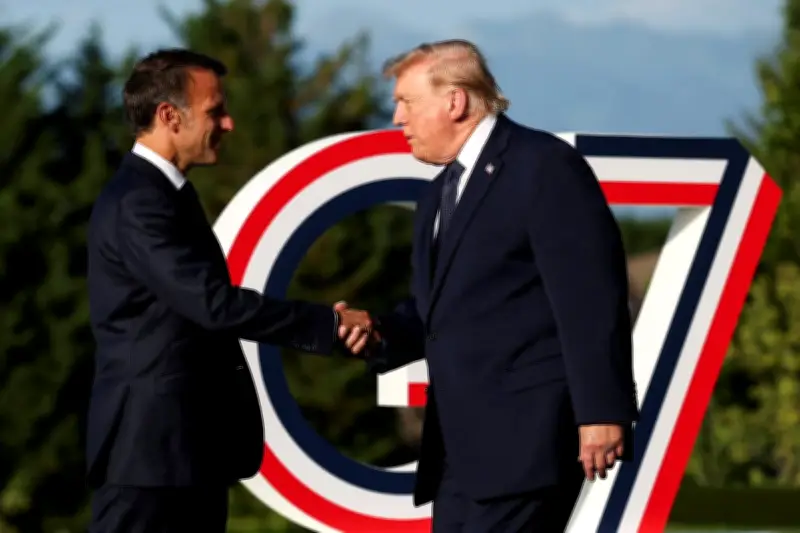
Donald Trump does not believe the US would "need much help" in ensuring the free passage of shipping in the Strait of Hormuz because of the peace deal with Iran. However, the US president said he did not believe it was "a bad idea to have a ship or two" from other countries based in the strategic waterway.
Defensive Mission Plans
The UK and France have led plans for a defensive mission to protect and reassure vessels in the channel once hostilities are over, including the deployment of autonomous mine-hunting equipment. Mr Trump made his remarks after arriving at a meeting of heads from the G7 group of leading democracies in Evian, France, where the emerging agreement made with Tehran to end the four-month-long war was set to top the agenda, along with Ukraine.
Ending Iran's Stranglehold
Ending Iran's stranglehold on the critical Gulf channel, which has disrupted global oil and gas supplies and driven up fuel and food prices, had been a key demand in negotiations with Iran. The previous reluctance by allies to be drawn into the conflict has fuelled frictions with the White House.
During talks with his French counterpart Emmanuel Macron, Mr Trump said: "I don't think we're going to need much help, because we have an agreement where it's going to be open and it's toll-free. So I don't think we're going to need much help, but I don't think it's a bad idea to have a ship or two up here from a few countries."
Mr Macron had said France could have fighter jets patrolling the strait as soon as Tuesday and had an aircraft carrier already in the region.
UK's Role
Earlier, welcoming the "breakthrough" agreement between Washington and Tehran, Prime Minister Sir Keir Starmer told a news conference that Britain also stood ready to help safeguard the sea route. He said: "You will know that we took preparatory action as a coalition of countries, led by myself and President Macron, to put together those countries that are prepared to do some of the reassurance work that's needed when we get to a moment like this to help get vessels through the Strait of Hormuz. We've got military planning behind that, so I hope now we can play our part in relation to that."
Market Reactions
Oil prices fell sharply after the announcement of a peace deal, with Brent Crude, the global benchmark, dropping more than 5% on Monday to just over 82 US dollars a barrel, marking its lowest level for more than three months. Stock markets also jumped higher in Europe and Asia as investors breathed a sigh of relief.
The US-Iran agreement will be formally signed in Switzerland on Friday. However, while the deal will halt the conflict, lift the US blockade and reopen the strategic Strait of Hormuz, it leaves Iran's disputed nuclear plans to further negotiations. Tehran insists its intentions are peaceful, but the US and Israel fear the regime could build a weapon with its stockpile of highly enriched uranium.
Mr Trump said: "The main thing is that Iran will not have a nuclear weapon, they fully agreed to that with strong policing powers, and they won't have a nuclear weapon, which is what it was all about, because they probably would have used it if they had it."
The president was unsure whether he would be at the signing of the agreement with Tehran, which will be attended by vice president JD Vance. He said: "It depends. I'll probably be gone by then. I may be involved, I may not, but JD is coming in for that." On releasing the agreement document itself, he said: "Probably pretty soon, I would say after some time after Friday."




