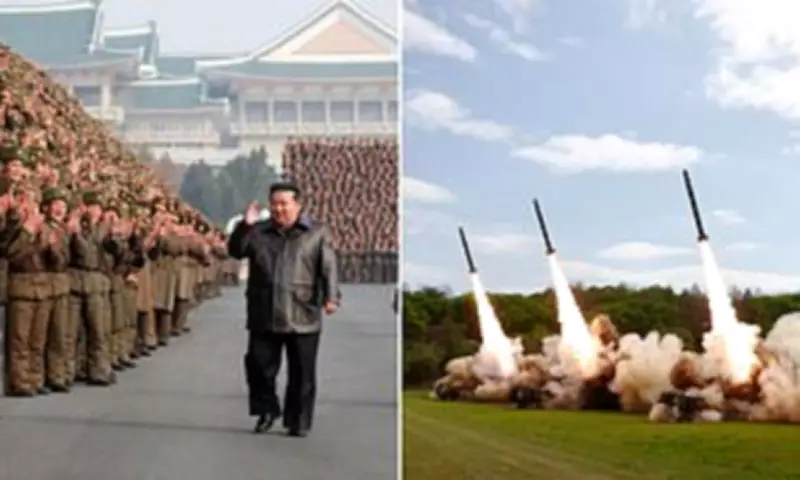
Kim Jong Un has amended North Korea's constitution to mandate an automatic retaliatory nuclear strike by the military in the event he is assassinated or incapacitated. This move, according to South Korea's National Intelligence Service (NIS), was influenced by the killing of Iran's supreme leader Ayatollah Ali Khamenei and senior advisers during the initial phase of joint US-Israeli attacks on Tehran.
Constitutional Revision Adopted
The NIS reported that the constitutional revision was adopted during the first session of the 15th Supreme People's Assembly, which convened in Pyongyang on March 22. The changes formalize procedures for a nuclear response if Kim is killed or unable to command the armed forces. Under the revised Article 3 of North Korea's nuclear policy law, a retaliatory nuclear strike would be launched 'automatically and immediately' if the country's nuclear command-and-control system is threatened by hostile attacks, according to the NIS briefing.
Concerns Over Leadership Security
Analysts suggest the decision reflects deep concern within the regime following the successful US and Israeli strikes targeting Iran's senior leadership. Professor Andrei Lankov, an expert in North Korean studies at Kookmin University in Seoul, noted that Pyongyang would have closely studied the attacks on Tehran and viewed them as a stark warning. He stated that the North Korean regime was likely alarmed by the speed and precision with which Iran's military and political leadership were targeted.

Experts believe the changes ensure North Korea could still execute a devastating nuclear response even if Kim is eliminated in the opening moments of a conflict. Kim is known for his intense focus on personal security, surrounded by bodyguards, avoiding air travel, and using a heavily armored private train with advanced security systems.
Challenges in Assassination Attempts
Any attempt to assassinate Kim would likely be significantly more difficult than the strikes in Iran due to North Korea's extreme isolation. The country's borders remain effectively sealed, and the few foreign diplomats, aid workers, and businesspeople permitted entry are under constant surveillance and tight restrictions. Analysts also noted that intelligence-gathering methods used in Iran would be harder to replicate in North Korea due to limited CCTV networks and a tightly controlled domestic intranet.
Professor Lankov added that North Korea's leadership is also worried about advances in satellite surveillance technology, which could potentially track military movements or identify the locations of senior officials during a conflict. He emphasized that if the regime believed it faced destruction, military commanders responsible for launching nuclear weapons would almost certainly obey orders for retaliation. According to Lankov, any retaliatory strike would most likely target the United States rather than South Korea, which he said poses little realistic threat of launching an independent attack on the North.
Deployment of New Artillery
The reports coincided with North Korea's announcement of plans to deploy a new type of long-range artillery weapon near the South Korean border. State media reported that Kim visited a munitions factory this week to inspect production of a new 155mm self-propelled howitzer. The official Korean Central News Agency claimed the artillery system has a range of more than 37 miles and will begin deployment to frontline units later this year. That range would place central Seoul and large parts of Gyeonggi province, South Korea's most densely populated region, within striking distance.