
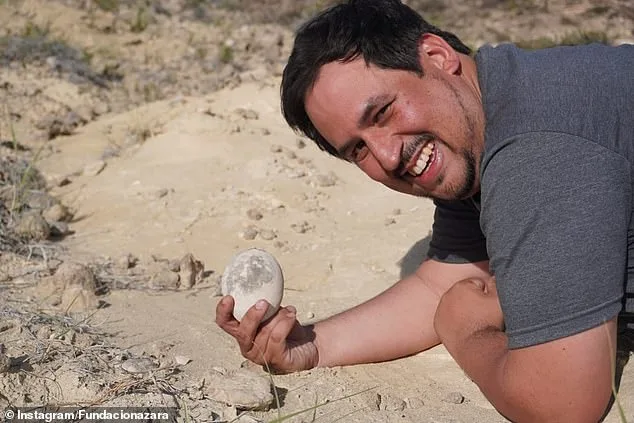
A remarkably well-preserved dinosaur egg, estimated to be 70 million years old, has been unearthed in Rio Negro, Patagonia, Argentina. The fossil, which closely resembles an ostrich egg, is believed to have been laid by a member of the Bonapartenykus genus—a small, carnivorous theropod that roamed the region during the late Cretaceous period.
Experts have described the find as exceptional, given the rarity of well-preserved dinosaur eggs, particularly those from carnivorous species. Gonzalo Muñoz of the Bernardo Rivadavia Argentine Museum of Natural Sciences told National Geographic: 'It was a complete and utter surprise. It's not uncommon to find dinosaur fossils, but the issue with eggs is that they are much less common.'
The egg was discovered by group leader Federico Agnolín, who spotted it resting on the surface of the dusty ground. The team plans to conduct in-depth scans to determine whether the egg contains embryonic material. If an embryo is found, it would mark one of the most significant paleontological breakthroughs in South American history, offering new insights into dinosaur development and hatching.
The discovery was part of the Cretaceous Expedition I, which also uncovered mammal teeth and snake vertebrae, suggesting the site was once a nesting ground. The egg and other findings will be sent to the Argentine Museum of Natural Sciences for further study.




