
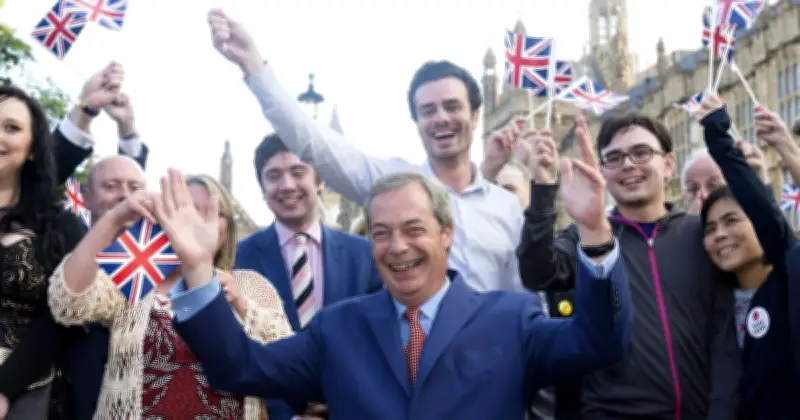
Nigel Farage has accused British political leaders of failing to understand the “forgotten places” across the country that wanted a “fairer deal” when they voted for Brexit. The Reform UK leader, speaking on the 10th anniversary of the 2016 EU referendum, is widely seen as the catalyst for Britain’s withdrawal from the European Union.
The Case for a Knighthood
Farage’s role in securing Brexit has led some supporters to call for him to be knighted, arguing he helped the UK reclaim its sovereignty. The former member of the European Parliament remains a polarising figure, with praise from those who view the departure as a victory for national independence.
Economic Impact and Criticism
However, critics hold Farage responsible for Britain’s economic struggles in the 2020s. The Office for Budget Responsibility (OBR) estimates that Brexit will ultimately leave UK trade about 15% lower and the economy around 4% smaller than it would have been inside the EU. This has fuelled opposition to any royal honour.
Writing on his Substack, Farage accused the political establishment of being unable to accept the result, which he believes ignited the collapse of the traditional two-party system. He wrote: “Ten years ago, today, the British people triggered an earthquake that caught the Westminster class completely off guard. We’re still feeling the aftershocks today. Everything that’s happened since 23rd June 2016, has to be seen through that lens. When the result was announced, the landscape of British politics shifted permanently. The two-party system proved unable to process this, unable and unwilling to accept the vote to leave, or to implement it in the way the voters wanted. And as a direct result of this betrayal, the voting blocs that sustained the uniparty consensus collapsed.”
Political Reactions and Future Prospects
Andy Burnham, widely seen as a potential future prime minister after his Makerfield by-election win and Sir Keir Starmer’s resignation, has pledged not to “re-run” old Brexit arguments. He has sought to downplay reversing the 2016 referendum but expressed a desire to see the UK rejoin the EU within his lifetime.
EU relations minister Mr Thomas-Symonds, speaking at an event by the UK in a Changing Europe think tank, argued that a hard-headed relationship with Europe is needed to protect British homes. He launched an attack on Farage over the Reform leader’s remarks about Ukraine, accusing him of “consistently supported Russia, and tried to pretend that our interests could ever align with a dictator’s”. Writing in the Telegraph, Thomas-Symonds said: “From declaring in 2014 that ‘I think the European Union, frankly, does have blood on its hands in the Ukraine’, and that he didn’t want a ‘European foreign policy’, to suggesting in 2024 that Nato and the EU’s ‘eastward expansion’ gave a reason for Putin to ‘go to war’. His rationale for doing so, it seems, has been to ultimately undermine the favouritism of the European Union. So consumed with being anti-Europe, engrossed by an ideological necessity for separation, he has chosen to fall on one side of a worldview. The wrong side.” He added: “Allowing a worldview sympathetic to Putin to hold the balance of power would be an unprecedented threat to national security.”
Readers are invited to vote in the poll and join the debate in the comments section.




