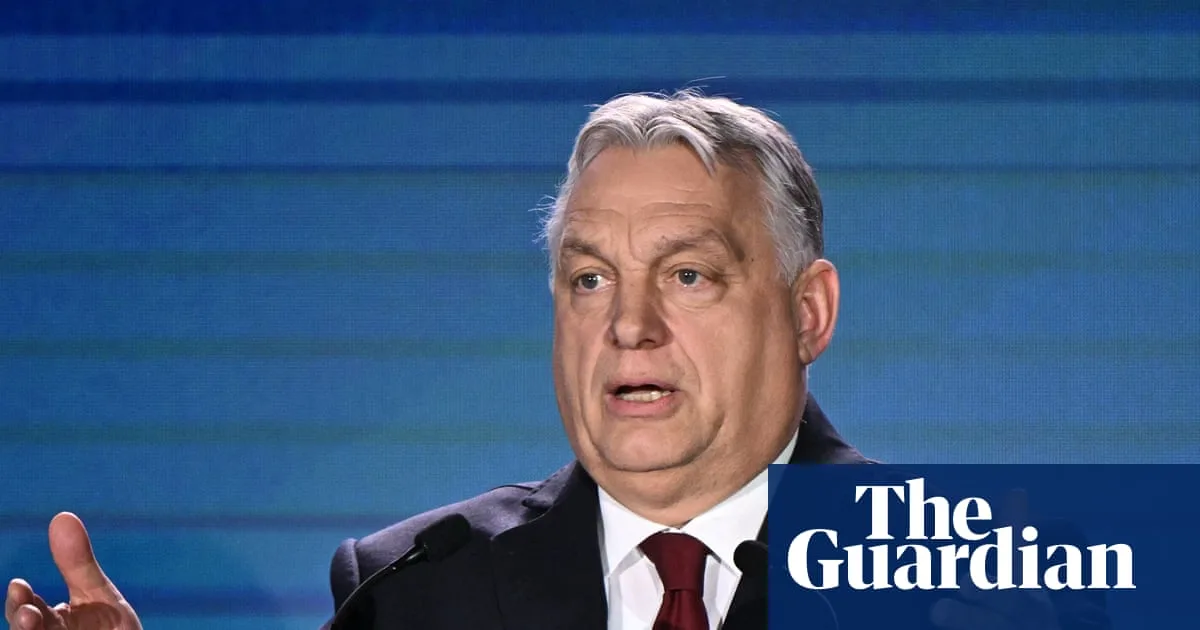
EU Leaders Condemn Viktor Orbán for Blocking Ukraine Aid Ahead of Hungarian Elections
EU Leaders Condemn Orbán for Ukraine Aid Veto Before Elections

European Union leaders have launched a rare and forceful public condemnation of Hungarian Prime Minister Viktor Orbán, accusing him of deliberately obstructing vital financial assistance to Ukraine in a calculated move to bolster his domestic political standing ahead of critical national elections next month.

A Breach of Trust and Collective Decision-Making

During a tense summit in Brussels, leaders from across the bloc expressed profound frustration with Orbán's unilateral veto of a €90 billion loan package intended to support Ukraine's war-ravaged economy and military efforts. This decision directly contravenes a unanimous agreement reached by all 27 member states in December, which Orbán himself had previously endorsed.

Finnish Prime Minister Petteri Orpo articulated the collective sense of betrayal, stating to reporters, "He's using Ukraine as a weapon in his election campaigning, and it's not good. We had a deal, and I think that he betrayed us." This sentiment was echoed by other leaders who emphasised the fundamental EU principle of loyalty and the binding nature of collective decisions.

Wide Pickt banner — collaborative shopping lists app for Telegram, phone mockup with grocery list

Election Dynamics and Geopolitical Posturing

Orbán, who trails in opinion polls ahead of the April 12th elections, has centred part of his campaign on portraying Ukrainian President Volodymyr Zelenskyy as an existential threat to Hungary. He has alleged, without providing evidence, that Zelenskyy and European Commission President Ursula von der Leyen aim to drag Hungary into the ongoing conflict with Russia.

German Chancellor Friedrich Merz accused Orbán of "setting up this blockade in Europe now for domestic political reasons and because of an election campaign." Austrian Chancellor Christian Stocker dismissed the electoral pretext as invalid given the dire humanitarian and military situation in Ukraine.

Belgian Prime Minister Bart De Wever underscored the procedural breach, stating it is "unacceptable to decide with the leaders and then after say 'but I'm not ready to execute what I decided.'"

The Energy Feud at the Heart of the Deadlock

The immediate trigger for Orbán's veto is an escalating energy dispute. Deliveries of Russian oil to Hungary and Slovakia via the Druzhba pipeline, which transits Ukraine, were halted in January due to pipeline damage. Ukrainian officials attribute this damage to Russian drone attacks, while Orbán accuses Zelenskyy of intentionally withholding supplies.

Orbán has framed the issue in existential terms for Hungary, vowing to continue blocking the Ukraine loan until oil shipments resume. "What we are talking about is not politics, it is existential for Hungary. To get the oil is existential for the Hungarians," he asserted.

Broader Implications for EU Unity and Security

This standoff has exposed significant vulnerabilities in the EU's consensus-based decision-making model, where a single member state can hold critical aid hostage. The bloc is now racing against time, as EU officials stress Ukraine must receive a substantial portion of the loan by early May, requiring progress within the next two to three weeks.

In an attempt to break the impasse, von der Leyen and European Council President António Costa have offered EU funding to repair the damaged pipeline. A technical team is currently in Kyiv awaiting security clearance to assess the site.

Meanwhile, the deadlock has broader repercussions. Hungary is also blocking a new round of EU sanctions against Russia, and Slovak Prime Minister Robert Fico withdrew support for a summit statement on Ukraine because it did not address the oil delivery issue, highlighting fractures within the bloc.

Historical Context and Energy Dependencies

The EU largely reduced its dependency on Russian oil and gas following the 2022 invasion, but Hungary and Slovakia secured exemptions due to their landlocked status and claimed lack of alternative suppliers. Notably, Croatian Prime Minister Andrej Plenković pointed out that both nations pay approximately 30% less for Russian oil, a significant economic incentive.

President Zelenskyy, who addressed the summit via video link, remains staunchly opposed to allowing Russian energy transit through Ukraine, arguing that such revenue directly fuels Putin's war machine, which has systematically targeted Ukrainian energy infrastructure.

Pickt after-article banner — collaborative shopping lists app with family illustration

The confrontation underscores the complex interplay between domestic politics, energy security, and European solidarity, with the immediate welfare of Ukraine and the credibility of the European Union hanging in the balance.




