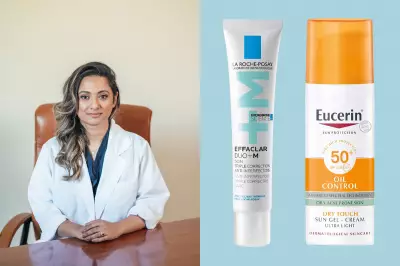
Every week in my Harley Street clinic, I sit across from women who are spending hundreds, sometimes thousands, of pounds a year on oral collagen drinks, gummies and powders. They come to me desperately hoping for a meaningful change in their skin, convinced by clever marketing that this is the secret to erasing wrinkles and plumping sagging skin.
I decided it was time to look more closely at the evidence because, quite frankly, the claims were not aligning with what we understand about how the human body actually works. That disconnect is something I see repeatedly in clinic, and it is rarely questioned in the way it should be.
The global collagen market is a £1 billion behemoth. It is propped up by celebrity endorsements, relentless social media influencers and glossy advertisements, all promising a version of a fountain of youth.

What is particularly striking is how often these brands use the phrase 'clinically proven' as a shield, citing scientific studies to justify high price points and creating the impression that the benefits of oral collagen are established fact rather than something that still requires careful scrutiny. In my view, that confidence is not supported by the quality of the evidence.
As a consultant dermatologist and founder of the Self London dermatology and lifestyle clinic, I have built my practice around evidence-based medicine. That means not just reading conclusions, but understanding how those conclusions were reached.
When a product claims to structurally change the skin, I do not take that at face value. I go back and read the available clinical data. To explore this further, I worked with Dr David Robert Grimes, a biostatistician, to examine the major meta-analyses (where data from numerous independent studies is collated in order to determine overall trends) that collagen brands frequently cite to support their claims.
These large reviews are often presented as the highest level of evidence, yet that status only holds if the underlying data has been handled appropriately. When we went back to the underlying data, the methodologies and the statistical approaches used, what emerged was not a single dramatic flaw but a consistent pattern of problems that, taken together, materially weaken the conclusions.
One of the most important issues was how outcomes were combined. Different studies measured skin using entirely different methods and these fundamentally different metrics were treated as though they were directly comparable but in reality they are not. Combining them in this way creates the appearance of a consistent effect where the data itself is fragmented and difficult to interpret in any clinically meaningful way.
We also identified basic statistical errors, but perhaps most concerning was the issue of industry bias. When we looked at the studies claiming collagen improved skin hydration, the majority were funded by the brands selling the supplements, while independent studies were far less likely to show any significant effect. A similar pattern was seen in studies assessing skin elasticity.
There are also broader limitations that are rarely discussed. Most studies are short, typically lasting between eight and twelve weeks, whereas skin ageing is a long-term biological process. Small changes in hydration measured over a few weeks do not necessarily translate into visible or sustained improvements in skin quality, particularly when participants are often engaging in other behaviours that affect the skin, such as using sunscreen, topical treatments or undergoing in-clinic procedures.
In practice, it becomes very difficult to isolate collagen as the meaningful variable. At a physiological level, oral collagen is broken down into amino acids during digestion, like any other protein, and the idea that it selectively targets the skin in a clinically meaningful way remains unproven. It is a compelling narrative, but not one that is currently supported by robust evidence.

So, are you wasting your money?
Based on the current evidence, I would say this: there is no robust, independent data to support the strength of the claims being made. That does not mean collagen is harmful, but it does mean that the benefits are far less certain, and far less meaningful, than the marketing suggests. More importantly, the evidence itself is not as solid as it is often presented, and that is the part patients are rarely told.
If you want to invest in your skin, it is far more sensible to focus on what we know works. Daily broad-spectrum sunscreen, a clinically proven retinoid and well-chosen professional treatments in a clinic setting have decades of evidence behind them. Collagen supplements, at present, do not.
Dr Anjali Mahto is a consultant dermatologist and founder of Self London.