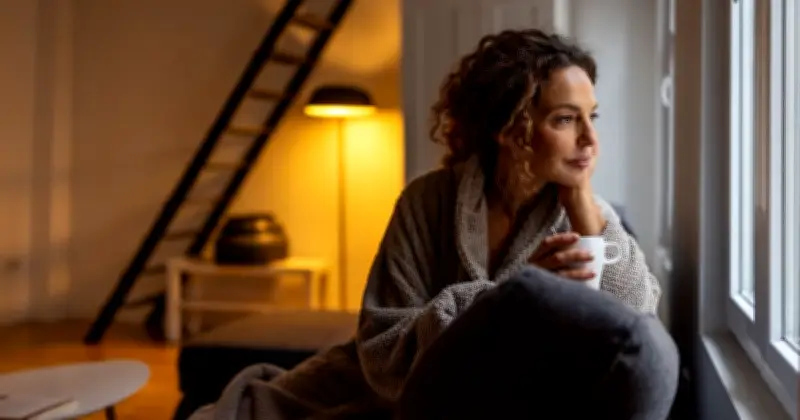
Cocooning is having a moment this autumn, as many feel a natural urge to rest and retreat. However, spending too much time indoors can affect mood, movement, sleep, social connection and vitamin D levels. Leading health experts explain how to retreat without compromising wellbeing.
Make your home a sanctuary
Carrie Neely, Artist and Designer in Belfast, says a clear, clutter-free home allows you to switch off. “Clutter means your mind is always ‘on’, scanning and sorting. Declutter little and often rather than in one big purge and leave one surface completely empty.” She advises skipping harsh overhead lighting and choosing candles, soft lamps and warm bulbs for the evening.
Colour also affects mood. For cosiness, Neely recommends deep and warm shades such as chestnut, terracotta or aubergine. For bedrooms, she suggests muted dusty tones like soft clay, sage or warm greige, avoiding anything too bright or stimulating.
Healthy retreat and vitamin D
Professor Margareta James, Psychologist at Harley Street Wellbeing Clinic, says there is a distinction between consciously stepping away and withdrawing from life. “A useful question is: am I choosing this because I need some time alone, or because I am avoiding something?” If stepping back helps you feel calmer and more grounded, your cocoon is working, but if your world is becoming smaller, it may be time to seek support.
Professor Susan Lanham-New, Professor of Human Nutrition at the University of Surrey, notes that vitamin D can only be made from sunlight from April to September in the UK. “All you need is 20 minutes’ daily exposure to the sun without burning for lighter skins, and 40 minutes for darker skins.” She adds that vitamin D deficiency is associated with lethargy, tiredness and increased susceptibility to infection, and that the UK government recommends 10 micrograms (400 IU) daily during autumn and winter.
Seasonal herbs and aromatherapy
Corin Sadler, Medical Herbalist and Senior Nutritionist at Viridian, recommends herbs like Ashwagandha for calm, Valerian for sleep, Rhodiola for energy and Echinacea for immunity. “If you are on medication, check with your GP, pharmacist or medical herbalist for any contraindications.”
Jo Kellet, Tisserand Accredited Aromatherapist, suggests essential oils such as Himalayan cedarwood for calming the mind, cardamom for energy, citrus oils for lifting spirits and lavender for relaxation. She advises never applying essential oils neat to the skin.