
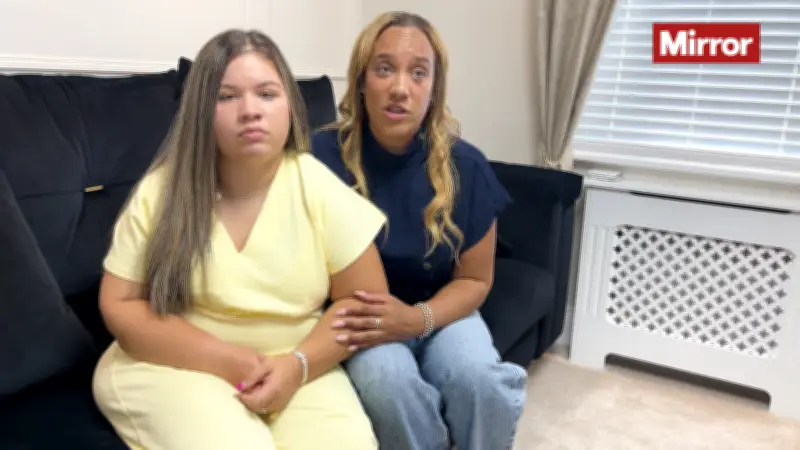
A mother has described the agonising decision to allow surgeons to cut her teenage daughter's brain in half in a radical operation to stop life-threatening seizures.
Fiona Williams, 41, watched her daughter Neive, 16, suffer up to twelve seizures a day since the age of four. It took medics nearly a decade to diagnose Rasmussen's encephalitis, a rare inflammatory brain disease estimated to affect fewer than 500 children globally.
Surgeons told Fiona the only option was an intricate eight-hour procedure to permanently disconnect the two hemispheres of Neive's brain. They warned the risky surgery could cause permanent vision or speech loss.
Life-or-death decision
Fiona faced a stark choice: agree to the operation or risk a seizure ending her daughter's life. She said: "It was terrifying. At first I didn't want Neive to have the operation. I was scared she might not be the same person when she woke up, I was worried it would mess with her personality, or if it would cause further damage. It's serious surgery."
She added: "I knew there could be complications but it was also a life or death decision. But we knew we needed to do something about this because we couldn't just sit and watch it go on."
The procedure, known as hemisphere disconnection, severs the links between the two halves of the brain so seizure signals cannot spread. After surgery at Great Ormond Street Hospital, Neive has been seizure-free.
Surgery success
Fiona said: "It's changed our lives. Having the surgery was the hardest decision but Neive had her last seizure 10 minutes before the operation. She hasn't had one since. It's amazing."
Neive, who loves Harry Potter and books by David Walliams, joked about the metal plate in her head: "I'm part metal, half robot."
Neive first began having seizures at age four, possibly triggered by chickenpox. She had focal seizures where she went blank, then a major tonic-clonic seizure on Bonfire Night in 2015. An MRI at Newcastle's RVI revealed an abnormality, and specialists eventually identified inflammation on the left side of her brain.
Failed treatments
Over ten years, Neive was prescribed steroids, anti-epileptic drugs, and immune suppressants, but nothing worked. She developed epilepsia partialis continua, a jerking in her leg, and became so weak she needed a wheelchair.
In 2021, a brain sample was sent to a US laboratory, leading to the Rasmussen's diagnosis, a condition thought to affect just 12 children in the UK. The disease causes progressive loss of motor skills, speech, and can lead to paralysis on one side.
In 2022, Neive underwent the operation at GOSH. Fiona recalled the tortuous wait: "On the day of the operation we were told to leave the hospital at 8am. They didn't want us there. It was awful. We were just kind of mulling round Leicester Square in a daze."
Afterwards, Fiona said: "Seeing Neive was awful. She was still coming around and the doctors were saying she'd done well. But we still didn't know if the surgery had affected her speech."
She added: "The doctors were absolutely amazing. Neive hasn't had a seizure since the surgery. It's changed her life. She's very brave. We're so proud of her. I wish we'd have had the operation sooner."
Ongoing challenges and research
Since the operation, Neive has developed scoliosis and weakness on her right side, losing fine motor skills in her right hand. She has undergone three further operations to correct scoliosis and hip problems.
Fiona said: "She's had four operations in four years. It's more than some people will have in their entire lives. But now we're off the medication and we can go on holiday together without taking a suitcase full of medication."
Researchers are now studying Rasmussen's encephalitis to find early indicators. Dr Eva Ioannidou, of UCL Great Ormond Street Institute of Child Health, said: "Most children are healthy before developing Rasmussen's encephalitis. The seizures associated with Rasmussen's encephalitis usually become more frequent over time and can't be fully controlled with medications."
Dr Ioannidou's study, funded by Action Medical Research and the British Paediatric Neurology Association, will examine brain tissue, cerebrospinal fluid, and blood samples. She said: "By the time most children are diagnosed with Rasmussen's encephalitis, irreversible brain damage has often already occurred."
Dr Caroline Johnston, Senior Research Manager at Action Medical Research, said: "Our commitment is to support groundbreaking research for rare conditions, like Rasmussen's encephalitis, for which there are limited treatments and no cure."
Fiona added: "Rasmussen's encephalitis is so rare and there's still so much doctors don't know. Research is incredibly important because earlier diagnosis and better treatments could make such a difference for families like ours."




