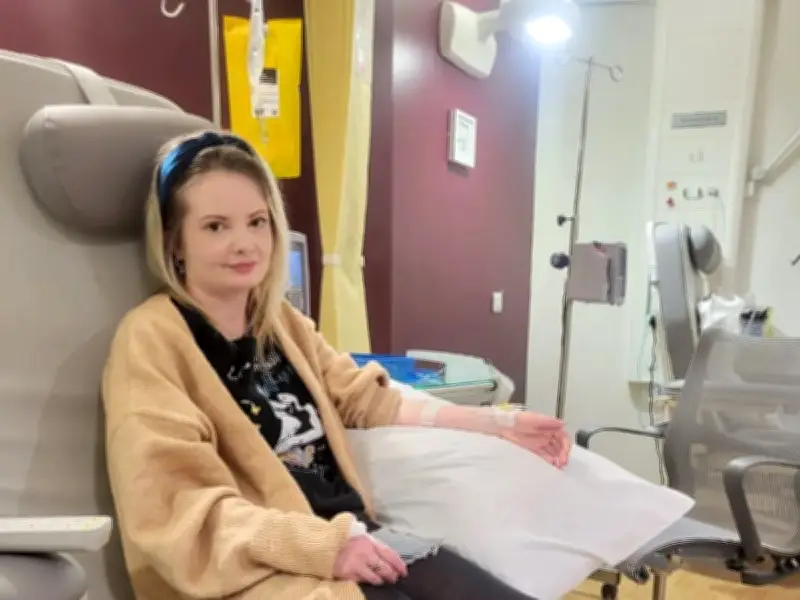
Gemma Coleman, 37, from Turton, Lancashire, is backing new research at The University of Manchester into one of the most aggressive forms of ovarian cancer, after her own diagnosis left her unable to have children.
Gemma was diagnosed with two separate primary cancers affecting her ovary and womb in 2022. Treatment triggered an immediate surgical menopause, meaning she would never be able to become pregnant. She described the experience as "heartbreaking".
She said: "People often tell me I'm an inspiration, but although I tried to look brave on the outside, inside I was struggling. My life was completely tipped upside down. We always dreamed of having children. Having that choice taken away was heartbreaking."
Research funded by £2.5m grant
The research, led by The University of Manchester, has been fuelled by a new £2.5m Cancer Research UK Grant. The funding will help researchers investigate why some high-grade serous ovarian cancers resist existing treatments and identify new targets for future drugs.
High-grade serous ovarian cancer (HGSOC) is the most common and aggressive form of ovarian cancer. Targeted drugs called PARP inhibitors, which stop cancer cells repairing damaged DNA, don't work for around 60 per cent of people, who must still rely solely on surgery and chemotherapy.
Gemma underwent two major operations, including the removal of her ovaries, womb, fallopian tubes, lymph nodes and affected abdominal tissue, followed by eight months of chemotherapy. Now three years into remission, she remains under regular surveillance with scans and blood tests while managing long-term effects including chronic pain, fatigue, bone weakness and fibrosis.
Hope for better treatments
Gemma, who lives with husband Jak, 39, and their cat Moggie, said: "When I was diagnosed, it felt like a death sentence. Surviving cancer isn't the end of the story. You have to learn to live with the long-term physical and emotional impact of treatment. Research gives people like me hope that one day cancer won't be something people fear in the same way, but something that can be treated much more effectively."
She added: "I'm finally starting to come through the other side. I'm still not well enough to return to work full time because I get very tired and weak, but I hope that will come. Research is so important because it gives people facing ovarian cancer hope that better treatments are on the horizon."
There are around 7,700 new ovarian cancer cases in the UK every year. In the North West alone, there are around 930 ovarian cancer cases in the region every year - around 18 per week or more than two every day.
Experts comment on the funding
Cancer Research UK's Executive Director of Research and Innovation, Dr Iain Foulkes, said: "Every breakthrough in cancer treatment begins with research. We've already seen the life-changing impact that targeted therapies like PARP inhibitors can have for some patients with ovarian cancer, and now we need to build on that success. By investing in long-term research programmes like Professor Taylor's, we're building on decades of progress and supporting the discoveries that could lead to the next generation of personalised treatments for patients who currently have limited options."
Professor Stephen Taylor, Head of Division for Cancer Sciences at The University of Manchester, said: "This award is incredibly important for our team. It's a privilege to have Cancer Research UK's long-term support which has enabled us to build this research programme over almost three decades, and this new funding means we can continue working together to tackle one of the biggest challenges in ovarian cancer. Our laboratory is home to the largest resource of living ovarian cancer cell cultures of its kind in the world. By understanding how these cancers grow and respond to treatment, we can identify new weaknesses that could be targeted with future drugs."
He added: "PARP inhibitors have transformed treatment for some women, particularly those whose tumours have BRCA gene mutations, but this occurs in only about 40 per cent of patients. The remaining 60 per cent are still largely limited to surgery and chemotherapy, and many feel left behind. Our goal is to identify biomarkers that will help us match future treatments to the women most likely to benefit. Every discovery brings us a step closer to more personalised treatment for women with ovarian cancer."