
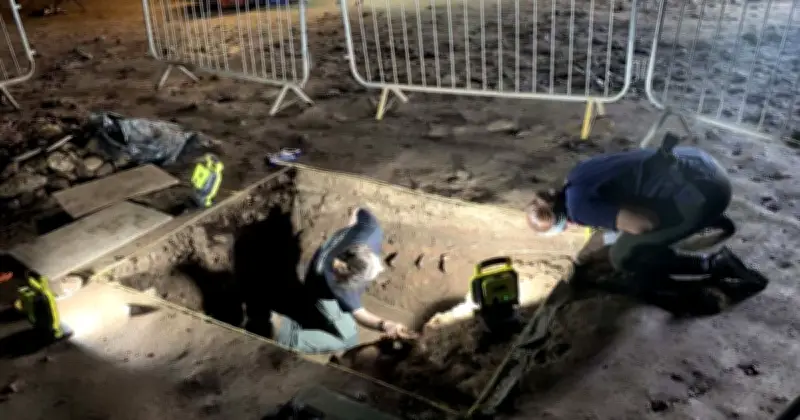
Wogan Cavern, lying under Pembroke Castle in Pembrokeshire – the birthplace of Henry Tudor – was long dismissed as little more than a Victorian tourist curiosity. Now, after small-scale excavations between 2021 and 2024, experts say the site could rewrite Britain's early human history.
Accessed today by a spiral staircase from the castle grounds, the vast chamber stretches 23 metres and rises to 10 metres. Generations assumed any archaeological treasure had been cleared out long ago, but the recent digs have proved otherwise.
A haul of prehistoric bones
The excavations have yielded well-preserved bones of mammoth, woolly rhinoceros, reindeer, wild horse and – most startling of all – a hippopotamus that once wallowed in the Welsh landscape some 120,000 years ago. Alongside the animal remains sit stone tools and clear evidence of human presence spanning more than 100,000 years.
Dr Rob Dinnis of the University of Aberdeen, who led the early excavations and directs a major five-year project funded by the Calleva Foundation, said: “There is no other site like it in Britain – it is a once-in-a-lifetime discovery. Not only is there extremely rare evidence for early Homo sapiens, but there are also hints at even earlier human occupation, probably by Neanderthals.”
A timeline of occupation
Researchers believe the cave could chart an unbroken sequence of human activity. At the most recent end are hunter-gatherers who sheltered there after the last Ice Age, around 11,500 years ago. Further back lie traces of Britain's earliest modern humans, dating to between 45,000 and 35,000 years ago. And deeper still may lie the footprints – or at least the tools – of Neanderthals.
The hippo bones open an even older window. They date to the last interglacial period, when Britain enjoyed a warmer climate and exotic animals roamed its rivers and plains. Together, the finds offer a rare opportunity to study how successive waves of people adapted to dramatic swings in climate and environment over millennia.
Ancient DNA and scientific potential
Professor Kate Britton, a specialist in archaeological science at Aberdeen, highlighted the scientific potential. Ancient DNA has already been recovered from both bones and sediments, while the exceptional preservation of remains will allow high-resolution dating and detailed reconstruction of past ecosystems.
Keeping the discovery in Pembroke
Pembroke Castle Trust is expanding its team and facilities so that the discoveries remain in Pembroke, turning the castle into a centre not only of medieval history but of deep prehistory. Collections Manager Dr Jonquil Mogg said: “Pembroke Castle has long been a very important part of Welsh and British history. Wogan Cavern has the potential to also establish it as a place of huge significance to British archaeology.”
Castle manager Jon Williams added: “We have watched with great interest as Wogan Cavern has started to reveal its secrets – it’s very different from the medieval history we usually deal with.” New excavations begin at the end of May.
For a nation whose early history has often been pieced together from fragments, the cave beneath the castle walls may yet deliver a continuous, richly detailed narrative of human survival, migration and adaptation on these shores – a story written not in parchment, but in bone, stone and sediment.




