
India has become a key part of Israel's weapons supply chain, according to a recent Amnesty International investigation, as the two countries deepen ties amid the conflict in the Middle East.
Shift in India's Role
The report reveals a fundamental change: for years, New Delhi was primarily a major customer of Israeli weapons, but through joint ventures and manufacturing partnerships, India is now a "significant contributor" to Israel's weapons production. Indian companies, including state-owned enterprises, have delivered drone warheads, artillery shell casings, small arms parts, and military vehicle components to Israeli military suppliers, despite the risk these could end up in weapons deployed in Gaza.
Amnesty traced hundreds of thousands of weapons components shipped from Indian factories to Israeli military suppliers between 7 October 2023 and 30 November 2025, including 390,516 small arms parts for military grade weapons, 564,970 parts of explosive ordnance, and 298 components of military vehicles.
Political and Strategic Context
Under Prime Minister Narendra Modi, India's ties with Israel have taken on a different character, according to Stanly Johny, international affairs editor at the Hindu. "It's also at the strategic and defence level," he said. The Amnesty report has not resulted in large-scale public debate or political backlash in India, which Johny attributes to support for Israel among Modi's voter base. "There is a clear ideological confluence between Hindutva and Zionism," he added.
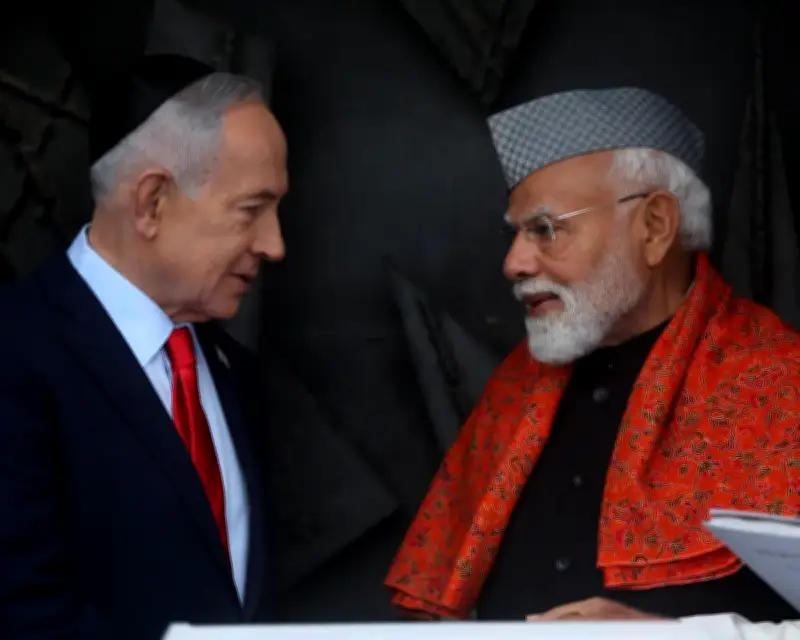
Modi has cultivated a personal rapport with Israeli Prime Minister Benjamin Netanyahu, visiting Israel in 2017 as the first Indian prime minister to do so, and again earlier this year, just 48 hours before Israel and the United States launched attacks on Iran. In July, after US Vice-President JD Vance called the US Israel's "only powerful ally" left, Netanyahu responded: "We have some other friends, like a small country called India. It has 1.4bn people, and boy, do we have tremendous support there."
Government Response and Opposition
The Indian government has declined to give a direct answer about weapons supplies to Israel. In 2024, external affairs minister S Jaishankar said in parliament that information is not in public domain and that exports of military products are guided by "national interest." Foreign ministry spokesperson Randhir Jaiswal responded that India's exports are governed by national laws and international obligations.
Amnesty identified three state-owned Indian companies – Munitions India Limited, India Optel Limited, and Advanced Weapons and Equipment India Limited – supplying Israel with weapons, which it said could expose India to the hazard of "complicity in ongoing genocide in Gaza." Pushback has come from human rights activists, student bodies, trade unions, India's left-leaning parties, and the Congress party. In 2024, a group of civil servants, activists, and academics petitioned the supreme court to suspend military exports to Israel, but the court dismissed the case, ruling it fell within the discretion of the executive.
Broader Implications
India has also sent thousands of workers to Israel, often to replace Palestinians barred from entering after 7 October 2023. Last year, the government told parliament that more than 20,000 Indian workers in construction and caregiving had moved to Israel after an agreement signed in November 2023. Meanwhile, India has shored up its own arms supplies from Israel: between 2021 and 2025, New Delhi was Israel's largest defence customer, accounting for 29% of total arms sales, according to Stockholm International Peace Research Institute.
For Johny, India's growing closeness to Israel is beginning to come at a cost, particularly with the war in Iran threatening India's energy security and economic repercussions across the Gulf. "India has to continue to stay engaged with Israel, but it is important to restore balance to its approach to west Asia," he said, adding that it needs to forcefully defend its own interests.




