
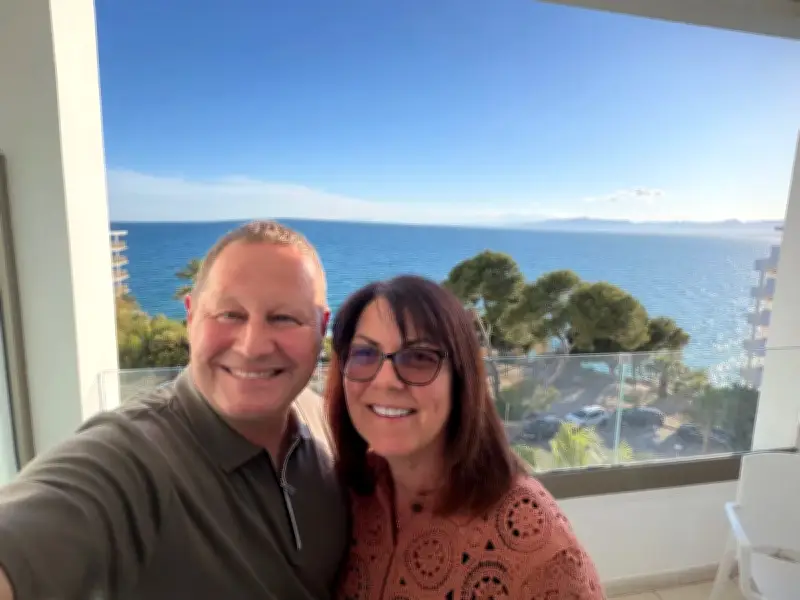
Jason Walker, 57, from Longridge near Preston, is determined to beat cancer for a second time ahead of his daughter Abbey's wedding in Montenegro next May. He has been living with the disease for more than a decade after being diagnosed with stage 3 multiple myeloma in 2014, aged just 45.
The initial diagnosis came as a "huge shock" as he was living an active lifestyle. He was diagnosed after suffering persistent back pain and double vision.
A decade of treatment and setbacks
Tests revealed multiple myeloma had spread throughout his body, causing chronic bone pain, particularly around his pelvis. The cancer had also affected the area around his pituitary gland and was pulling on his optic nerve.
Doctors told him the disease was incurable and that treatment would focus on achieving long-term remission and extending his life.
“It was a huge shock,” said Jason. “One minute I was working, playing squash and getting on with family life and the next I was being told I had terminal cancer.”
He underwent intensive chemotherapy and, despite his diagnosis, continued working. But just two days after completing treatment, Jason suffered a heart attack while working in a customer’s kitchen in Liverpool.
“I thought I had got through the hardest part and then I had a heart attack caused by a blood clot possibly due to the chemotherapy,” he said. “It was frightening, but thankfully I recovered.”
Cancer returns and a new trial begins
Over the following decade, Jason underwent two stem cell transplants, both of which were successful. He then enjoyed five years in remission and returned to an active family life, playing squash and padel and going to the gym. But in November last year, Jason noticed several soft, spongy lumps developing on his head - and tests confirmed that his myeloma had returned.
"I need to get through this as I’m giving her away, and want to be well enough to walk my beautiful daughter down the aisle," said Jason, who has been married to his wife Michelle for 35 years and has two grown-up children. They are also grandparents to seven-year-old Harper, their son Oliver’s daughter.
Jason is now the first patient on a pioneering blood cancer trial at The Christie in Manchester, looking into whether a new drug could reduce the potentially dangerous side-effects of cancer treatment.
The study is testing whether an experimental anti-inflammatory treatment, POLB 001, can prevent or reduce Cytokine Release Syndrome (CRS), an immune reaction that can occur after powerful cancer immunotherapy treatments.
After Jason was left so weak from cancer drugs that he struggled to climb the stairs, he was referred to The Christie to see whether there were clinical trials he might be eligible for. He became the first patient recruited to the TOPICAL clinical trial and last month started 14 cycles of treatment, while continuing to work within his kitchen painting business.
Hope for the future
"This isn’t my first experience of taking part in research and I'd rather be on the trial than not," he said. "It gives you a security blanket. I feel very lucky to be on the trial at The Christie and I hope it works, not just for myself, but for the wider myeloma warriors out there. Any hope in a difficult situation is good. I feel blessed to be on the trial, it's like I've won something better than the lottery."
"I try to keep a positive attitude and laugh about cancer, but I do sometimes get mad and swear at it," he added. "Cancer doesn't care, but I won't let it get to me.
"If taking part helps improve treatment for other people living with myeloma, that's something really worthwhile," he said. "I've been living with this disease for 12 years and you have to keep looking forward. I'll keep fighting and making the most of every day."
The trial is led by The Christie NHS Foundation Trust and will take place at five other NHS hospitals across the UK. Around 30 patients with relapsed or treatment-resistant multiple myeloma are expected to take part, with early results expected later this year.
Dr Emma Searle, consultant haematologist at The Christie, who is the chief investigator on the TOPICAL trial said: “Immunotherapy treatments are transforming survival rates for patients with difficult-to-treat blood cancers, but their use will continue to be restricted until we find a way to deliver them safely outside of specialist hospitals.
"Because of the risk of Cytokine Release Syndrome (CRS), which is unpleasant and can be dangerous, many patients can’t be treated near to home, which is a real problem. Many patients have to stay in hospital to receive immunotherapy, and some must travel long distances for treatment in specialist centres.
“If this new therapy can safely reduce the risk of CRS, it could help give these treatments near to or in peoples’ homes. Ultimately, our aim is to help more patients benefit from these life-saving therapies while reducing the burden of treatment on patients, families and the NHS."




