
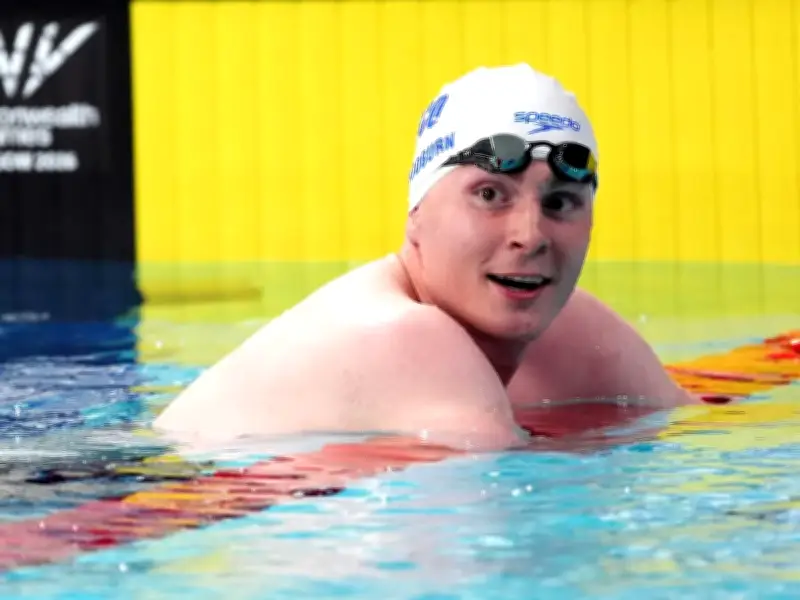
Scottish swimmer Archie Goodburn, 25, who was diagnosed with three inoperable brain tumours, has urged Prime Minister Andy Burnham to fund research and support clinical trials for those living with the cancer. His impassioned plea in August has brought attention to the stories of patients and families affected by brain tumours.
Every year, 13,000 people in the UK are diagnosed with a primary brain tumour. Only 12.9 per cent of adults in England live for five years or more after diagnosis, and it is the leading cause of cancer deaths in children and adults under 40.
Speaking directly to the Prime Minister, Goodburn said: "So Andy Burnham, if you believe and you want to make a change and a difference to the future of our country and our young population, please listen to us. Please establish a national brain cancer lead and give us a chance to fight for our lives because honestly, the things that patients are going through out there is just unbelievable and so unjust."
Prime Minister responds to plea
Burnham responded to the plea and vowed to meet Goodburn, who was diagnosed with three inoperable oligodendrogliomas when he was 22. The swimmer's campaign has helped shed light on the experiences of those living with brain tumours, as well as families who have lost loved ones.
Police officer James Mann was a "larger than life" character who played the youngest of the family card "brilliantly" and managed to wheedle out of any situation with his brother Ben, 26, and sister Katie, 24. His mum Dianne told The Mirror: "He was just so vibrant as a person, a force of nature - a force for good."
A keen sportsman with a passion for rugby, James was the epitome of fun, health and laughter "living his best life". Everything changed when he returned to his Bedfordshire home following a week's holiday in Greece. On the day he arrived home, James told Dianne he felt "sort of discombobulated" as though his ears had not popped since the plane landed. Following repeated misdiagnoses, including one for vertigo, Dianne went with him to the GP, telling them he was "declining so rapidly, you have to do something different".
James Mann's diagnosis and final months
Then came November 10. "That was the beginning of the end for James," Dianne, 54, said. Brain tumours are graded from one to four based on how fast they grow. James was diagnosed with the rare H3K27 midline glioma, where the patient has a typical prognosis of nine months. It came as a shock - James never got ill, with Dianne struggling to recall a time when he even had sniffles. "He was just not a poorly person," she said.
He underwent multiple scans and was ultimately referred to Addenbrooke's Neuro Ward in Cambridge, where he went straight into surgery to release the pressure on his brain caused by the enormous tumour. About 70 per cent of the tumour was removed, though he would undergo five surgeries in total following complications. But James's tumour was extremely aggressive and rapidly multiplied. Dianne described it as being "like a big boulder in a river" that prevented fluid flowing around it, which created a "horrific pain" in his head. "It's like the most horrific smash and grab," Dianne said. "The speed and the force of what happened, it was like he had been hit by a bus because the ferocity and brutality of what happened was so harrowing."
James was in hospital just short of six weeks and was on life support for five days when he fell into a coma following his final emergency brain surgery. In what Dianne described as "true James fashion", he came around before returning home. Returning to Cambridge, James was told he had weeks or, at best, three months to live. Knowing he had weeks to live, James set out to create a checklist of things he wanted his siblings to do once he passed on, discussing it together all three of them before telling them to carry on. "He did this bespoke blueprint for Ben and how to he needed to live his life without James, and then he did the same with Katie...he said 'just because I'm not going to be here anymore, it's no excuse for you'." James died at home on January 30 this year, 12 weeks after his diagnosis. About 150 people were at his funeral on March 4, held 20 days before what would have been his 22nd birthday.
Sally Penny's story of survival
Sally Penny, 43, a mum-of-two, told The Mirror that her life changed at 7:30am in mid-September 2024. "I woke up with a bit of a gasp," she said. Sally managed to alert her husband of 20 years, Brett, 44, and then instantly went into a seizure. When she came around, she was surrounded by paramedics asking her questions like where she lived. Instead of answering Hemel Hempstead, her home for the past two decades, she replied Ickenham, in West London, where her parents live. She was rushed to hospital and went through CT and MRI scans that revealed she had a brain tumour.
Recalling being told the harrowing revelation while with her mum Sarah, in her 70s, Sally said: "That was the diagnosis, and then I pretty much went home and cried for four months." Her fears were justified. Brain cancer typically reduces life expectancy by an average of 27 years, according to The Brain Tumour Charity. When Sally was shown a scan of her tumour, she remembered thinking: "I don't know what a brain scan is supposed to look like, but I bet it's not supposed to look like that." The white "smudge" down one side was about the size of her fist she recalled.
Thankfully, her surgery a few months later removed about 90 to 95 per cent of the tumour. Sally was diagnosed with an oligodendroglioma, the same type of tumour as swimmer Archie. She has been taking vorasidenib for 18 months after the drug was approved for NHS use in England. The targeted drug can be used to treat people who have grade 2 astrocytoma or oligodendroglioma with IDH1 or IDH2 mutations to slow their growth and significantly delays the need for chemotherapy or radiotherapy, according to The Brain Tumour Charity.
While the drug let Sally feel like she had been given her life back, she has not taken it for granted. "My friends will often say, 'oh for our 50th', and I've had this moment of thinking, 'oh, God, will I be here. I have to nip off because I can't hear it because I don't know for sure.'" She hopes one day there could be a cure so she can grow old and see her grandchildren. "I've got the same dreams as everyone else, mine are just looking a bit more precarious now." The fleet coordinator has documented her journey on Instagram, where she bravely shared a photo of herself with 37 staples in her head following surgery. She is also an Involvement Champion with the Brain Tumour Charity, where she helps give lived experience. She and Archie are members of Brain Cancer Justice, who campaign for a national brain cancer lead, the right of patients to try new treatments via trials, as well as more funding for research.
Funding and hope for the future
Parliamentary under-secretary of state for the Department of Health and Social Care Preet Kaur Gill said in June this year that £45.2 million has been spent on brain cancer and tumour research since a government pledge in 2018. Just one and two per cent of the total national spend on cancer research was allocated to brain tumours between 2002 and 2021. There is hope Archie's desperate plea will transition to effective changes for people living with brain tumours and for those yet to be diagnosed in the future.
Cameron Miller, Director of Strategy at The Brain Tumour Charity, told The Mirror: "Archie is a powerful voice for people affected by brain tumours, and we're pleased to see this issue placed firmly on the national agenda. It's vital that the Prime Minister hears first-hand from people affected by this condition if he is to understand the challenges they face and the changes that are so urgently needed."
"At The Brain Tumour Charity, we will continue to work with government, healthcare professionals and industry to push for commitments that incentivise research into brain tumours, address the translational research gap and improve access to clinical trials. Only then will we see far fewer heart-breaking experiences like those Dianne's family endured."




