
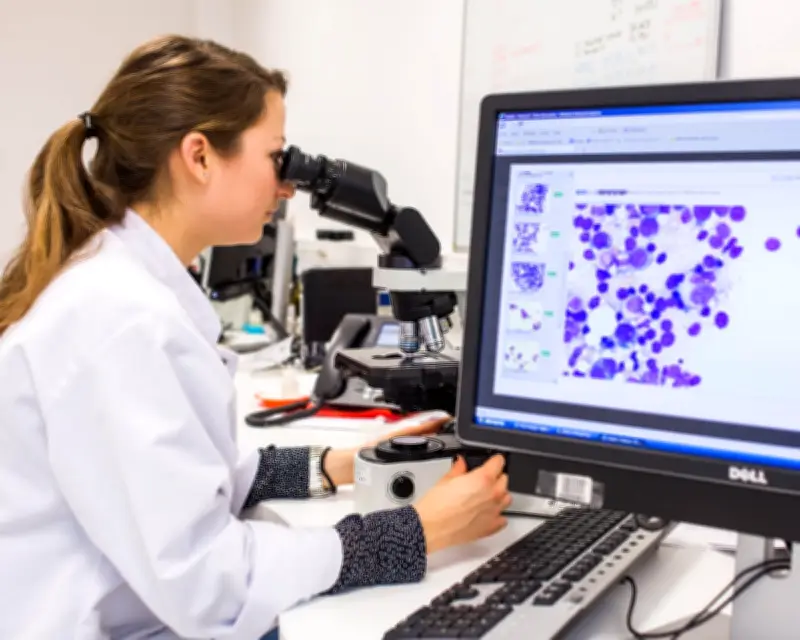
The search for better cancer treatments remains a global priority. In today's newsletter, researchers are providing new insights into early detection and treatments, but access to life-saving care remains uneven, leaving patients with a long road ahead.
Headlines
Israel has launched airstrikes on central and western Iran in apparent defiance of Donald Trump, who urged restraint. The escalation threatens to drag the Middle East back into regional war. Vulnerable families, including women fleeing abuse, are being illegally dumped hundreds of miles away by London councils. Ukraine's President Zelenskyy discussed scaling up air defences with UK, France, and Germany after Russia fired hypersonic weapons. Silicon Valley companies embrace Maga politics, says former UK deputy PM Nick Clegg. David Lammy told US VP JD Vance he was wrong to blame the murder of a British teenager on mass migration.
In Depth: Incremental Progress in Cancer Research
Cancer does not discriminate. Despite strides in reducing smoking, lung cancer remains the most common form globally, with 1.8 million deaths annually. Breast, colorectal, and stomach cancers follow. The American Society of Clinical Oncology (ASCO) annual meeting in Chicago gathered over 40,000 experts to discuss progress. While a magic bullet cure lingers in the public imagination, progress is gradual. Cancer encompasses over 200 diseases, each requiring a unique approach.
"Scientific discoveries in cancer are incredibly incremental," says Andrew Gregory, the Guardian's health editor. "You don't tend to see huge advances every year." This year's summit featured notable progress, including a drug sparing bladder cancer patients from surgery and yoga reducing distress in survivors. However, experts warned of a workforce shortage, with a 100 million person shortfall expected by mid-century. A blood test for over 50 cancers failed its main objective.
Doubling Survival Rates for Pancreatic Cancer
Pancreatic cancer is one of the deadliest. Once spread, only 1% of patients survive more than three years. Only 10% can have surgery. A new daily pill doubled survival time in a 500-person trial, with fewer side effects than chemotherapy. Patients taking the drug lived about 13.5 months compared to 6.5 months with chemo. Experts call it a "gamechanger." The drug stops a signal that tells cancer cells to reproduce. "This is not a cure," warns Andrew, "but it is a huge step change."
Pinpointing Hidden Cancer Cells
Early trials of a new smart drug, originating from Oxford, have shrunk tumors by at least 30% in six common cancers by stopping them from hiding from immunotherapy. The drug removes the "invisibility cloak" that keeps tumour cells hidden, enabling the immune system to destroy them. The trial included 83 patients who had previously failed to respond to treatment. Further large-scale studies are needed.
Weight Loss Drugs and Cancer Prevention
Studies indicated that GLP-1 medications could help prevent and treat cancer. One found users were 30% less likely to develop breast cancer. Another found using weight loss drugs alongside standard treatments reduced the risk of death by 30%. More research found those on weight-loss drugs were up to half as likely to see cancer spread. The studies are observational and do not yet find a causal link. Inflammation reduction may play a role, but more research is needed.
What Else We've Been Reading
Dr Marnie Lovejoy, chair of the Grayling Society, aims to get more women into fly-fishing. The Guardian's World Cup Bracketology game has gained attention. Steve Goldman's exhibition of worst album covers opens in Nottingham. Jason Burke's Sunday read explores one man's possible role in antisemitic attacks across Europe. AI's rapid advancement is outpacing regulation and understanding.
Sport
Denmark's Christian Eriksen collapsed on the pitch but was conscious. Alexander Zverev won his first major in his fourth final. England beat New Zealand in the first test at Lord's by 115 runs.
The Front Pages
Guardian: "Iran fires wave of missiles at Israel." Telegraph: "Iran fires missile barrage into Israel." Times: "Starmer ban on 'harmful' social media for children." i Paper: "Burnham set to challenge Starmer." Mail: "Spend now on defence or pay 'cost in blood'." FT: "OpenAI plots revamp of ChatGPT as 'superapp'." Express: "Britain won't send us back, boast criminals." Mirror: "For Sam and all the kids we've lost." Metro: "Thanks ... but no Yanks!"
Today in Focus
Germany's most wanted woman, Daniela Klette, has been sentenced to 13 years for violent crimes as a leading member of the Red Army Faction.
The Upside
Performer Mama G wrote The Proudest Bird in the World inspired by two lesbian grandmothers she met at Blackpool Pride, addressing the lack of LGBTQ+ representation in children's literature.




