
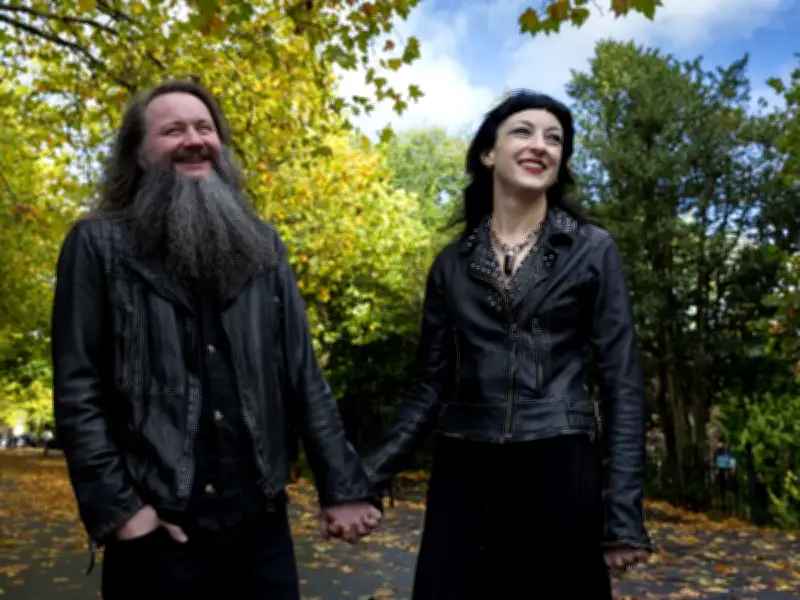
When music journalist Laura Kelly's husband Davidt Dunlop suffered a cardiac arrest early one morning, her CPR efforts – with the Bee Gees' Stayin' Alive song playing in her head – helped to keep him alive until an ambulance arrived to take over.
Laura, 44, later posted about the experience on social media, and it went viral with millions reading her post. Now Davidt, 50, a teacher and artist, has been fitted with an implantable cardioverter defibrillator (ICD), an internal device which monitors his heart rate and sends readings back to the hospital. If he goes into a dangerous rhythm that can cause a cardiac arrest, the device will deliver a 'shock' to try and correct it.
Today, to mark Restart a Heart Day, Laura, who lives in Glasgow, is urging everyone to keep hearts beating by learning CPR.
A morning lie-in turns into an emergency
"My husband and I were enjoying a lie-in when he had his cardiac arrest. I was doing something dumb on my phone when he poked my back. One look was all it took to see that something was very wrong. Davidt's eyes were wide, his face flushed, his body was tense. He managed to choke out, 'I love you'."
Two weeks earlier Davidt had suffered his first cardiac arrest as he was being driven to hospital by his boss Fiona after taking unwell at work. Fiona called Laura - petrified - to say Davidt was being worked on by an ambulance crew at the side of the road. Maybe 20 minutes later, two police officers arrived at Laura's door and said they would escort her to the hospital.
After a few hours, the doctors at the Golden Jubilee Hospital in Glasgow had put in a stent to open up the blockage in one of the arteries in Davidt's heart. They were told this blockage caused his cardiac arrest.
A long road to recovery
That day - sat in a tiny, stuffy room, waiting to see if she'd ever see Davidt alive again - was among the hardest in her life. Her friends rushed to be there, her mum got on the soonest flight from Belfast, her brother and sister-in-law the soonest from London. It was half a whole day before she was allowed to see Davidt. When she went in, he was plugged into a tonne of machines. His skin felt so cold and so hard. He was grey. They'd got through the first emergency, but hope was desperately fragile.
That night, Laura went home with no idea if the brilliant, creative man she loved would ever wake up. It wasn't until far into the next day that he started to come round. His first concern was where his favourite Problem Patterns t-shirt was - a strong hint that Davidt was back. There was a long road ahead, but after a couple of weeks he was able to come home and start his rehabilitation.
Using 'Stayin' Alive' for CPR
Which brings us back to that morning lie-in, because the story was not over. This time Laura didn't hesitate, she called 999. But she knew that Davidt's chances were poor. Less than one in 10 people survive an out of hospital cardiac arrest, according to the British Heart Foundation. Every minute without cardiopulmonary resuscitation (CPR) and a defibrillator reduces survival chances by up to 10%.
So, it was all down to her. She'd never done CPR training. But as a long-time music journalist, she certainly knows how 'Staying Alive' by the Bee Gees goes. And she knew the worst thing she could do was nothing. She dragged him off the bed, onto the hard floor and started compressions.
The ambulance crew arrived fast, but those minutes felt like hours. When they got there, they told her she was doing good, so she should keep going while they set up. Then they took over and she was left standing in their back room, in her pyjamas, to wait for what came next.
As a writer, the only way Laura can make sense of anything is with words. So, she wrote. She told her experience simply, a little swearily - and very truthfully - on X. The response was immediate. People sent good wishes, people shared. More than 11 million ended up reading that first post. Most amazingly, dozens of people who'd performed CPR on their loved ones were kind enough to share their stories.
"We were - once again - quite stupendously lucky. Davidt eventually did pull through. He's here with me today, thanks to amazing medical professionals, the wonders of science, the best friends and family, brilliant public information campaigns featuring the brothers Gibb and, strange as it feels to say… me."
Learning CPR is so important
A cardiac arrest is when your heart has stopped beating normally and blood is not being pumped around your body. It can happen when your heart's electrical system does not work properly and develops a life-threatening rhythm. There are more than 7.6 million people in the UK living with heart or circulatory conditions that can put them at higher risk of having a cardiac arrest. However, some cardiac arrests can happen with no known prior health or heart conditions.
The survival rate in Scotland is less than 1 in 10, but early CPR and defibrillation can more than double the chances of OHCA survival.
Lizzie Moscardini, Senior Programme Manager for RevivR at the BHF, said: "Laura's story is a powerful reminder of why learning CPR is so important. Stayin' Alive by the Bee Gees is often used in CPR training because the song's tempo is roughly the same as the recommended chest compression rate of 100-120 bmp. RevivR is the BHF's free online training tool which teaches you how to do CPR and use a defibrillator in just 15 minutes. All you need is a cushion to practice compressions and your phone or tablet. Many of us will witness a cardiac arrest in our lifetime and RevivR is one way you can be ready for that day."




