
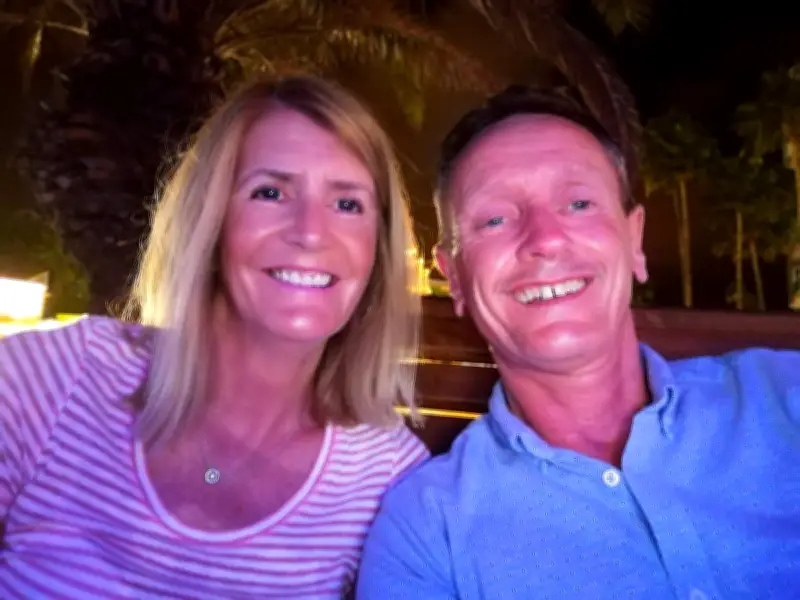
Julie Kelly, 62, from Scarborough, North Yorkshire, is calling for more to be done around lung cancer diagnosis and treatment after her husband Sean died nine months after being diagnosed with small-cell lung cancer. Sean, an active 59-year-old who ran countless marathons and represented England, was diagnosed in February 2025 after finding it difficult to breathe while running.
Diagnosis and treatment
Doctors initially gave Sean a prognosis of 10 to 12 months with treatment. He underwent chemotherapy, immunotherapy, and radiotherapy, but died in November 2025. Before his death, Sean was invited to 10 Downing Street to speak about the importance of lung cancer screening, calling it "one of the saddest and most proud moments of (his) life."
Julie said: "We want more to be done around this. He was a 59-year-old elite athlete and he gets struck down by this. What it tells you is it can happen to anybody and I think that’s the message. So, what can be done to push more of this when it comes to prevention and an awareness of lung cancer?"
A life of fitness and love
Julie met Sean in 1985 while working as a receptionist at the Grand Hotel in Scarborough. She initially didn't want to date him, as he was the general manager's son, but he persuaded her. They married two years later and celebrated nearly 40 years together, having two children.
Sean had no health issues and was "always active," picking up running again in his 40s. He joined Scarborough Athletic Club and loved encouraging others. "He was absolutely fit as a fiddle," Julie said. "The worst that ever happened to him was he had his appendix out, but apart from that, he was very fit, very healthy, never poorly."
Final marathon and diagnosis
Sean ran his final marathon, the Chester Marathon in October 2024, in two hours, 48 minutes and three seconds. When he started finding it difficult to breathe, he saw his GP in January 2025. Initial X-rays showed perfect observations, but a follow-up CT scan revealed lung cancer in early February.
"We were in complete disbelief, shock," Julie said. "We just thought, 'they’ve got it wrong. It can’t possibly be. Look at him.'" A later appointment confirmed small-cell lung cancer (SCLC), which had progressed to stage four with lesions in his kidneys and liver.
Treatment and legacy
Sean started chemotherapy and immunotherapy, but the cancer spread to his brain. Despite this, he took on a walking challenge for Roy Castle Lung Cancer Foundation, raising over £4,000. He was later invited to Downing Street in June 2025 to celebrate the foundation's 35th anniversary.
In his speech, Sean said: "It is fair to say that I did run well. All I now want to do is help people after me and remind people like yourself how important screening is. I had my chance, I took it, and this is probably one of the saddest and most proud moments of my life."
After his fourth round of chemotherapy, Sean was in "excruciating pain" and stopped treatment. He entered Saint Catherine's Hospice on October 20 and died on November 14, surrounded by loved ones.
Grief and continued advocacy
Julie described grief as "an ever-changing process and it’s a day-by-day process." She finds comfort in work, fitness, and spending time with grandchildren. In Sean's memory, she took part in the London Landmarks Half Marathon earlier this year.
Julie wants to share Sean's story to "keep his legacy going" and raise awareness of SCLC. She advises others: "There’s no script and there’s no planning and the one thing I’ve learned is not to think too much and just let (the grieving process) happen. I just want to keep his legacy going because he was all about helping other people."
The National Institute for Health and Care Excellence (Nice) published final guidance in June recommending serplulimab with carboplatin and etoposide for untreated extensive-stage small-cell lung cancer. Around 1,150 people in England could benefit from this infusion treatment, which is now available in Wales and England.




