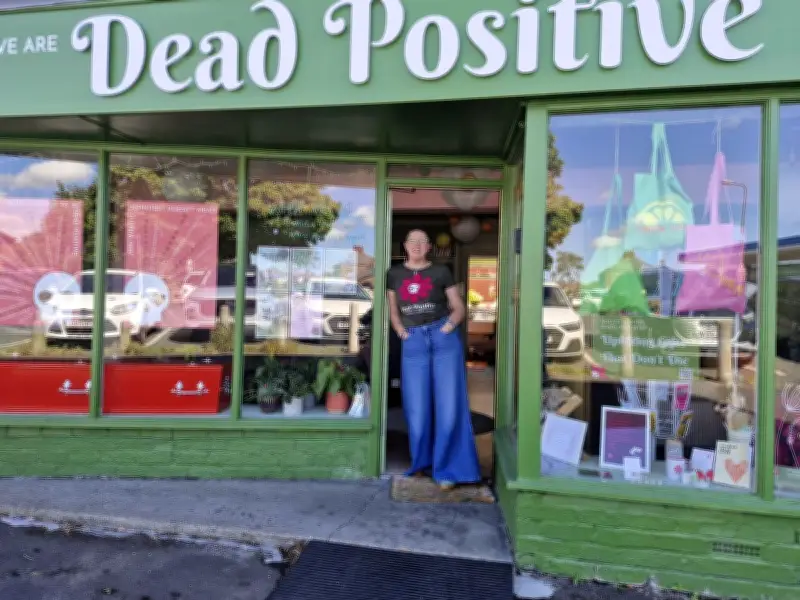
Kirstie Atherton, a 51-year-old mum from Widnes, spent most of her adult life as a counsellor and author. In 2020, she woke at 3am with what she describes as an "epiphany" that she should work in funerals. "I literally had an epiphany, I woke up right at 3am in the morning thinking, 'Oh my God, I should go and work in funerals'. Then I had to get out of bed and Google it and see if that is a thing. Can you be a celebrant? How do you qualify? What do you do? That was nearly six years ago now."
Just a year later, Kirstie became a full-time celebrant hosting and planning weddings and funerals. Two years ago she opened Dead Positive CIC on Warrington Road, Widnes. Much of her work involves supporting people at the end of their lives.
A "phenomenal honour"
She said: "My work is quite different because I do lots of my work with people as they are dying. That might be three to six months before they actually die, where they've decided that they've been in control of everything else in their lives, they've been independent, they organised their own wedding, so they don't see why they shouldn't organise their own funeral."
"It's the most phenomenal honour to do that for someone. It sounds really cheesy when you say that, but it's huge for someone to trust you with the last thing that is going to be done for them on this earth. Someone to trust you with that, it's just a huge, huge privilege that I never ever take for granted because I know how much it matters."
She acknowledged that it can be hard to face the inevitable end of friendships formed with clients. "I think that everybody we meet, we meet for a reason. I very much believe that I'm meant to do every funeral that I've been asked to do, and that's what I've come into their lives for, and that's what they've come into my life for."
"Every single day of my life I am confronted with the fact that somebody's life has just ended. So I am acutely aware that this very moment that we have now is the only one that we're guaranteed."
Finding balance
The emotional weight sometimes hits home. Kirstie said: "The people I think who survive and thrive in this type of work are the people who can learn that balance of 'I'm no good to a grieving family if I lose it'. I've got to be professional and hold it all together. I am their anchor while they are being tossed around in this sea. So while I am with them, I am absolutely that. Then, when I come home, I go and sit at the bottom of my garden and have a strategic cry. You just kind of learn to let it out in that way."
"It's kind of like a little bit of a sanctuary, where I know I'm perfectly safe there, I'm surrounded by beauty, I know that the world is a beautiful place, and I know that brutal things happen to us within this world."
As director of Dead Positive CIC, she offers end-of-life care services and bereavement support. One of her proudest achievements has been trying to address the "Victorian-era sombreness" around death. She and her staff host "bereavement cafes".
"Bereavement cafe is a peer-led model, so we facilitate a space in which people who identify as being bereaved can be together. We've literally had people come to the bereavement cafe whose son had died the week before, who literally came the week after. But it can also be people who lost their parent when they were a child 40 years ago, it can be absolutely anyone."
"If something happens and it triggers you and you need to cry, then people are accepting of that fact. Sometimes people come to the bereavement cafe and sit there and talk about what they watched on tele last night, that's okay, too. So basically we provide a safe space. There are us volunteers on hand where if somebody needs us then we are there to support them, and obviously we've got all our years of knowledge and experience to answer questions."
Challenging the stigma
She said it has been her mission to change the stigma around death since starting the business. "I think people think that us saying that we are 'dead positive' is like we're really super upbeat about death, and it absolutely isn't that at all."
"It's just about acceptance and that death happens to every single one of us. It's literally the only thing that happens to every single one of us, that we are born and that we die. The idea that it's this thing over there in the corner that we've all just been encouraged to turn away from and not engage with, when it's so fundamental to everything, is just anathema to me."