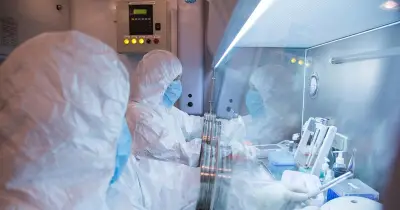
The World Health Organisation (WHO) has issued an official update following the sudden death of scientist Darya Shipilova at the high-security Irkutsk Anti-Plague Research Institute in Siberia, Russia. Rumours had circulated that she accidentally smashed a test tube packed with lethal bacteria inside the top-secret facility.
The UN health agency has now confirmed that no case of plague has been officially registered. However, in a chilling declaration, WHO admitted they still do not know what killed the lab worker on October 2.
WHO statement highlights key uncertainty
In a tense statement, the WHO revealed: “Based on the information provided… WHO has not identified evidence of ongoing transmission associated with this event. A key uncertainty remains the absence of a confirmed diagnosis in the deceased laboratory worker.”
Moscow’s health watchdog Rospotrebnadzor insists post-mortem tests on Shipilova – and checks on nearly 200 quarantined contacts – came back completely clear of high-threat super-bugs, India Times reported. Russian officials claimed she died of an "unknown" form of severe pneumonia, while firmly rubbishing wildly circulating local reports that a second lab worker had also fallen ill as "false information".
Kremlin insists no pathogens escaped
Kremlin health chiefs insist the dead scientist was fully vaccinated and that zero deadly pathogens escaped into the public domain. Earlier this month, Shipilova’s death sparked public health fears worldwide. Pneumonic plague was immediately suspected. It is a lung infection caused by the bacterium Yersinia pestis.
At the time, the governor of neighbouring Buryatia said the woman had “died, maybe of the plague”, Al Jazeera reported. Russia’s health watchdog Rospotrebnadzor confirmed the young scientist’s official cause of death had been logged as “pneumonia of unknown aetiology”.
Quarantine measures and WHO pressure
According to local authorities on October 6, around 60 percent of those held in isolation had already been allowed to leave quarantine. Meanwhile, WHO chief Tedros Adhanom Ghebreyesus pressed Moscow on Wednesday (October 7) over media claims that a second worker had fallen ill with an unidentified chest infection, but Russia brushed off the reports as “false information”.
This comes after Russia was told to "come clean" over fears its secret bioweapons programme is "mammoth", the Daily Star previously reported. Marshall Billingslea, former US Special Presidential Envoy for Arms Control, worked in the 1990s as a senate Foreign Relations Committee staffer. At the time he interviewed Ken Alibek, former second-in-command of Biopreparat, the Soviet Union's biological warfare programme. Alibek exposed a "mammoth" infrastructure, naming the Irkutsk institute as a site that performed classified biological warfare work.