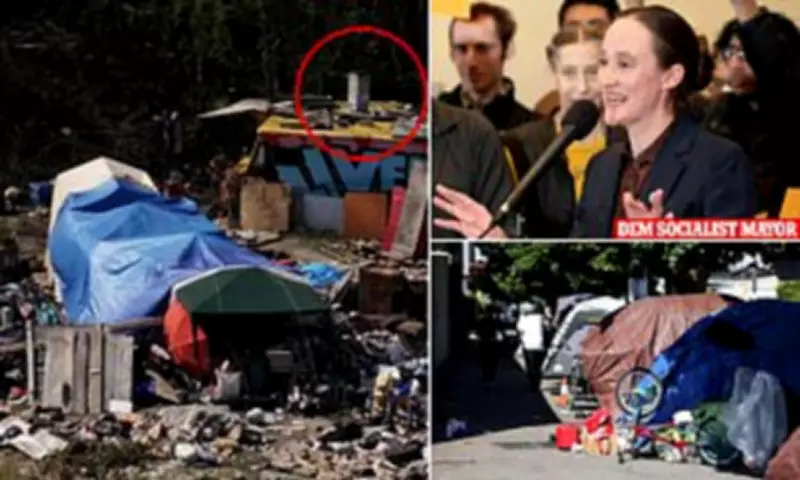
Seattle's Homeless Encampment Crisis Intensifies with Emergence of Makeshift Chimney
A homeless encampment in Seattle's Ballard neighbourhood has become so deeply entrenched that a makeshift chimney has erupted from one of its structures, casting doubt on the effectiveness of newly elected Democratic Socialist Mayor Katie Wilson's plans to address the city's homelessness crisis. Mayor Wilson, who took office in January after being elected in November 2025, has been in her role for just over four months but has already launched an ambitious initiative aimed at getting homeless individuals off Seattle's streets.
Ambitious Tiny Home Plan Faces Scrutiny
Seattle possesses the fourth-largest homeless population in the United States, according to the US News and World Report. In response, Mayor Wilson's administration has proposed constructing 500 new tiny homes by June, with three city council committees already advancing a request for $5 million in funding to support this expansion. The full city council is scheduled to review the proposal next week.
Currently, Seattle operates more than 600 tiny homes distributed across 20 villages. However, some city officials have voiced significant concerns regarding the programme's apparent lack of success. During a recent funding presentation by Wilson's staff, Councilmember Dan Strauss highlighted that encampments in the Ballard area have not only persisted but expanded in recent months.

'There is a building in the middle of our street that has a chimney,' Strauss stated, as reported by KOMO News. 'This is something I haven’t seen since the pandemic.'
Resident Frustrations and Unfulfilled Promises
Local residents living near tiny home villages share these apprehensions, complaining that the mayor's solution has failed to deliver on promises made by city authorities. Peter Eastey, a business owner near an encampment in Rainier Beach along Seattle's southern edge, told KOMO that when the Low Income Housing Institute opened a village nearby, assurances were given that it would eliminate encampments.
According to Eastey, this commitment was not honoured, and repeated appeals for assistance have been ignored by the city. 'Sheer lack of action, absolute sheer lack of action on the city’s part,' Eastey emphasised. He specifically pointed to a large, uncontrolled homeless encampment that he believes serves as a sanctuary for thieves, alleging that stolen goods are prevalent without any accountability from law enforcement.
'Most of the stuff in there is stolen, not most of it, I suspect all of it is stolen, and there’s no accountability for that,' Eastey declared. 'They know it’s stolen, the police know it’s stolen, but they won’t go on and pull it out of there.' He demanded greater accountability from city officials, warning that 'if that doesn’t happen, things need to change.'
Budgetary Challenges and Programme Costs
Mayor Wilson's administration has identified $17.5 million within Seattle's budget that could be allocated to combat homelessness. The mayor's office estimates that the annual cost of managing a single tiny home, including on-site staff and support services, averages $35,000. Nevertheless, this push for expansion comes as Seattle grapples with a substantial $140 million structural budget deficit.
A memo issued by the mayor's office in late February instructed city departments to reduce spending by five to ten percent. While police, fire, and homeless services are expected to be largely shielded from cuts, other departments such as the Office of Economic Development may face significant reductions. These potential austerity measures coincide with a slowdown in the city's tech industry growth and a decline in new construction projects.
The Daily Mail has contacted Mayor Wilson's office for comment on these developments, underscoring the ongoing debate over the efficacy and feasibility of Seattle's approach to its homelessness crisis.