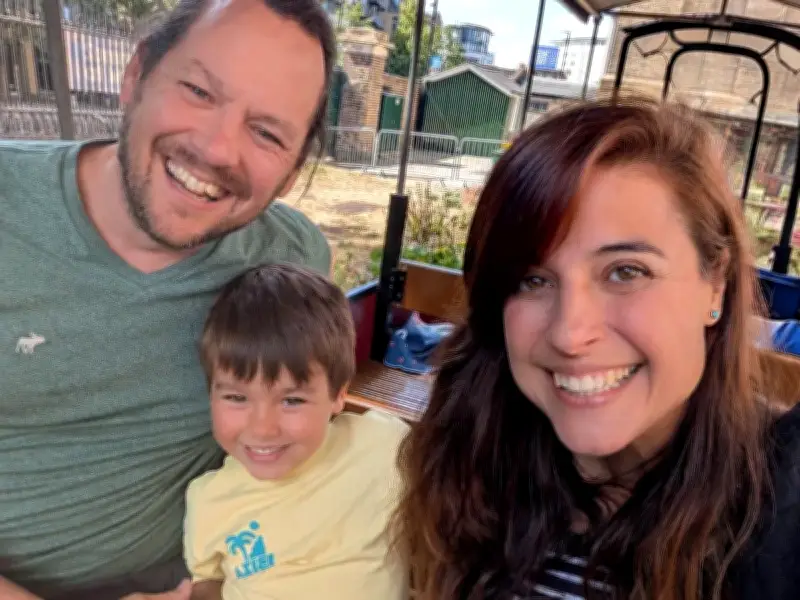
A Greater Manchester mum living with terminal pulmonary fibrosis is calling for urgent action amid long waits for diagnosis. Fiona Hinton, 44, mother to three-year-old Harry, first experienced a persistent dry cough and breathlessness in 2017 but was not diagnosed until 2019.
Pulmonary fibrosis is a lung disease that occurs when tissue becomes damaged and scarred. According to the NHS, it can be caused by a variety of things, including infections, but gets progressively worse. Those who suffer from stiff tissue find it harder for the lungs to work properly. Some people can stay stable for months or years at a time, while the condition gets worse faster in others and causes early death.
Research reveals long waits and misdiagnosis
New research from the charity Action for Pulmonary Fibrosis, based on more than 1,200 people with the condition, found that one in three people waited for more than a year for diagnosis. People are then said to have faced a 'postcode lottery' for access to specialist care and support.
Some people can benefit from anti-fibrotic drugs to slow down progression of the disease if they receive an early diagnosis. However, one in five people said they saw a medical professional at least five times before being referred to a specialist. Additionally, many people surveyed said they were misdiagnosed, with symptoms like breathlessness and persistent cough being mistaken for less severe conditions like asthma.
Living with the condition
Ms Hinton's condition is caused by scleroderma, a very rare autoimmune disorder. Speaking to PA, Mrs Hinton, who carries oxygen tanks around to help her breathe, said: "I'll never forget the moment I was diagnosed, the realisation that pulmonary fibrosis was essentially a death sentence."
"I remember getting out of the hospital, my mum and dad had waited for me, and I just cried and cried in the car. I was like, 'I don't understand, I'm 37 and I'm dying'... I walk with a tank on my back…The tank weighs about 10lbs. They last about an hour-and-a-half, so I have to make sure I have enough in my car to go back to to change to switch out, so I'm tethered by the tank. But I'm massively thankful that that is an option because otherwise I would be housebound."
She is currently on the anti-fibrotic drug nintedanib to slow progression of her fibrosis. When her son was one, Mrs Hinton was given two years to live, which she has now surpassed. "I think they don't know how long I've got because essentially the rest of my body is healthy. Because the rest of me is relatively fit and healthy, it kind of compensates for the impact of the damaged lungs. So I don't know how long I've got but my lung function is low. It's below 40% and they say under 30% is where you really start to struggle more. I think I'm quite vulnerable in that I think a bad kind of pneumonia or chest infection could do damage to those very fragile lungs, and so you can suddenly dip. But for the last couple of years, I've been fairly stable," she said.
Impact on family and transplant decision
Joining calls to raise awareness of pulmonary fibrosis and the need for earlier diagnosis, Mrs Hinton said one of the biggest impacts of the condition on her life has been as a mother to Harry. She explained: "It has massively impacted me in the way I parent because obviously I can't be as active with him, so I wouldn't take him on my own to soft play, for example. That's just not an option because I couldn't call him up and get him. But I've been incredibly blessed in that my husband's massively supportive and my mum and dad and friends have been wonderful."
While she is on the waiting list for a donor lung transplant, Mrs Hinton has marked herself as currently 'suspended' on the list. She noted that it's a 'balancing act between giving up the quality of life you have now, versus going through what could be a life-changing operation'. "It's a massive op. There's huge risks. Also lung transplants, out of all the transplants, are one of the least successful. So lung transplants are improving, and I think the work they do is incredible, but it's a big risk. And I am very much, being completely candid, sat on the fence between giving up what I have now, which is a limited but relatively stable quality of life, and risking it all on the hope that the transplant works. I'm not at the absolute end of the road. I'm not far off, but I'm not quite there yet," she said.
Daniel Saxton, chief executive of Action for Pulmonary Fibrosis, stated: "Pulmonary fibrosis is a devastating condition and for far too long it has been under-recognised, underfunded and misunderstood. For many people in our community, time becomes the most precious thing they have. Yet too often, people are left waiting. Waiting to be believed. Waiting for a diagnosis. Waiting for access to the care and support that could help them live better, for longer. Pulmonary fibrosis has outcomes comparable to many cancers, but people with pulmonary fibrosis do not experience the same urgency of response… We need the NHS, government and everyone who shapes services to act on this evidence and deliver faster diagnosis, fairer access to specialist care and consistent support across the UK."