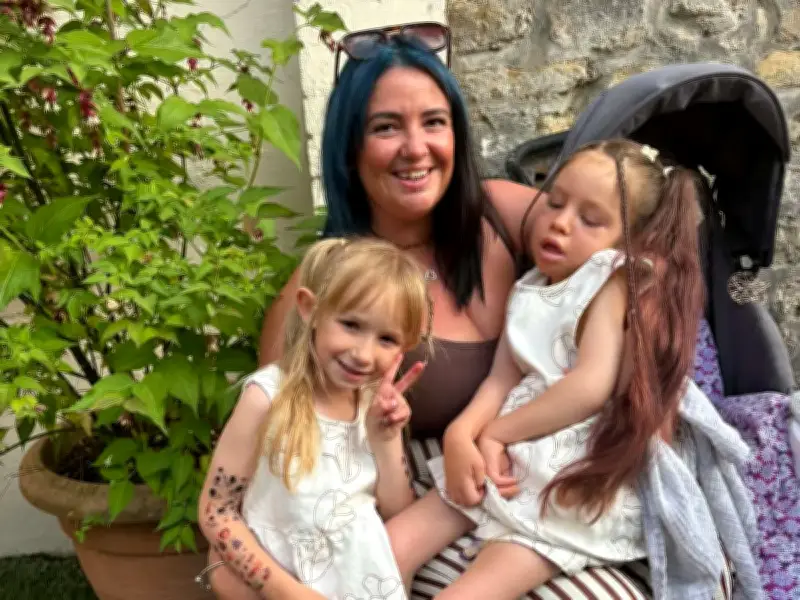
Ally Wallace, a mother from Northumberland, has strongly criticized the Government's decision not to include a life-limiting brain disorder in the newborn screening test, a decision that will not be reviewed for at least three years. Ally, 36, has two young daughters with Metachromatic Leukodystrophy (MLD), a genetic condition that affects the brain's 'white matter' and leads to the loss of physical and mental skills.
Two daughters, two different outcomes
Nala was two years old when she was diagnosed with MLD and could not receive treatment because her brain had already deteriorated too far. Now seven, Nala has lost the ability to walk and talk, and her life expectancy is between five and eight years. Her younger sister Teddi, five, was tested for the condition at 10 months old following Nala's diagnosis and received treatment. Teddi was the first person to undergo Libmeldy gene therapy on the NHS at the age of one and now shows no symptoms of MLD. The therapy works by inserting functional copies of a faulty gene into the patient's own stem cells.
There was previously no treatment for MLD, but in February 2022, the NHS struck a deal for the gene therapy, which is reportedly the most expensive drug in the world. Ally, from Shilbottle, has been calling for MLD to be added to the newborn screening test since her daughters were diagnosed four-and-a-half years ago, arguing that earlier diagnosis could allow more children to receive treatment and survive.
Frustration over screening decision
However, the UK National Screening Committee (NSC) has advised against screening for MLD, citing uncertainty about the accuracy of the screening test and whether early treatment improves long-term health outcomes. The next review is due between 2029 and 2030. Ally told ChronicleLive: "It's just absolutely devastating. Me and other MLD families have been fighting for a long time to try and get this on the newborn screening test. Kids aren't being checked when there's treatment available on the NHS. How many kids could have had it found at birth and could have be saved?"
She added: "It's just so frustrating. They just keep saying it's not about the money and they don't know how successful it is. For me, it seems absolute nonsense. I feel like it's about the money and they don't want to admit it. I just feel what they're saying about it just seems like an excuse. There's plenty of evidence that the treatment is successful. For one child to be so alive when her older sister is dying, that should be evidence in itself! Regardless of if they are going to run and jump like a typical child they're still going to live and families will have that child alive with them."
A family's fight continues
Ally said that when MLD is found at the age of two or two-and-a-half, it is too late for treatment. She said: "No family should have to bury their child. No parent should be planning their child's funeral like we are. There's nothing I can do for Nala but I don't want to see any other family go through what our family is going through. Until it gets put on the newborn screening I won't stop fighting. It just seems, as hard as we're fighting, we're getting pushed away at every opportunity."
Ally, who works as a pharmacy dispenser, said she felt "disbelief" when she learned the screening decision wouldn't be reviewed until 2029 or 2030. She said: "I just want them to rethink the newborn screening a lot quicker than what they're thinking about. In another three to four years so many more children could be dying of the disease."
Nala was diagnosed after Ally became concerned about her daughter's foot position and walking difficulties. After an emergency MRI scan at the Royal Victoria Infirmary (RVI) in Newcastle, Nala was found to have MLD. Teddi was then tested and also found to have the disease, but only Teddi could undergo treatment. Teddi spent three months at Royal Manchester Children's Hospital undergoing gene therapy in 2022, which involved removing all her stem cells and replacing the faulty genes. She is now a healthy five-year-old who can read, write and spell, while Nala has regressed significantly since her diagnosis in May 2022.
Ally described Nala's condition: "She can't walk, she can't talk, she's completely blind and she's developed epilepsy. She's being fed through a peg in her stomach and finding it hard to gain weight. She can't move her own body at all. She completely relies on other during every single aspect of life." She added: "We know as a family we haven't got very long left with Nala, she's seven now. We know that if they don't have treatment the only thing you're facing in the future with your child is death. Essentially your watching your child disappear and disappear. It can happen so quickly, it can happen out of nowhere."
Teddi attends regular check-ups at Royal Manchester Children's Hospital and the Great North Children's Hospital in the RVI. Ally said: "So far Teddi has had absolutely no symptoms. There's no sign of MLB reaching her brain at all. Teddi is an absolute whirlwind. She's a total character. It's absolutely amazing to see what the treatment has done for her. I could have had two children in the same position as Nala. Watching them together is heartbreaking. I always assumed, having two little girls so close in age, that they would be little best friends. Instead Teddi has almost become Nala's big sister. She's absolutely amazing with her."
A Department of Health and Social Care spokesperson said: "Our thoughts are with all those affected by metachromatic leukodystrophy (MLD) and their families. Decisions on routine newborn screening must be guided by science, and the independent UK National Screening Committee has concluded that further evidence is needed before MLD can be recommended for such a programme. In the meantime, we are testing over 100,000 babies for changes in genes linked to more than 200 rare genetic conditions, including MLD, through our world-leading Generation Study, run by Genomics England in partnership with NHS England - transforming how we detect some rare diseases."