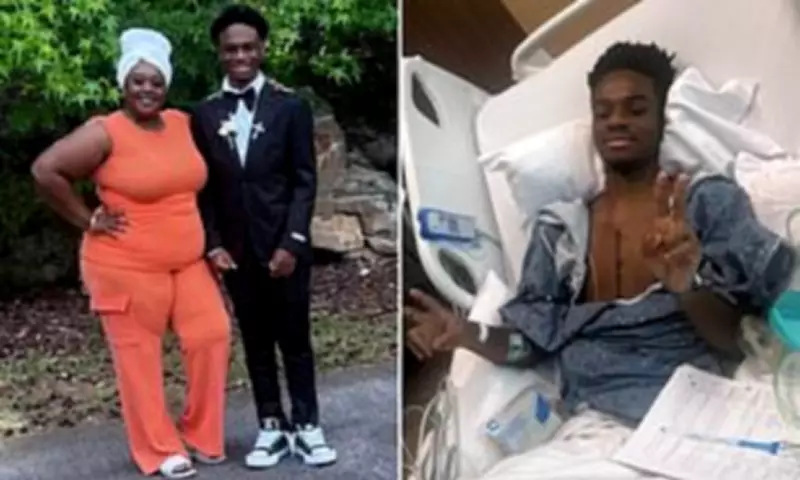
A Georgia mother has been hailed as a hero after saving her 14-year-old son's life when he suffered cardiac arrest during track practice. Tamara, whose last name was not disclosed, was attending her son Collin's track practice when he suddenly collapsed and went into cardiac arrest. Her quick thinking and prior preparation enabled her to perform CPR on her son, restarting his heart and ultimately saving his life.
Collin's Medical Journey
Collin was rushed to Children's Healthcare of Atlanta, where he spent four days and was diagnosed with anomalous aortic origin of a coronary artery (AAOCA), a rare congenital heart condition that increases the risk of sudden cardiac arrest. Due to this condition, Collin underwent open heart surgery and has since made a full recovery, according to the hospital. The Daily Mail has reached out to the family for further comment.
Advocacy for CPR Training
Following the incident, Tamara has become an advocate for parents learning CPR, crediting the lifesaving measure for keeping her son alive. She emphasizes that immediate bystander intervention is critical in cardiac arrest situations.

The Importance of Bystander CPR
More than 436,000 Americans die from cardiac arrest each year, surpassing deaths from colorectal, breast, and prostate cancers, influenza, pneumonia, auto accidents, HIV, firearms, and house fires combined, according to the American Heart Association. Most cardiac arrests occur outside of a hospital, making bystander intervention vital for survival. The American Heart Association states that if a bystander performs CPR immediately after cardiac arrest, the victim's chances of survival triple.
Hands-Only CPR Guidelines
The American Heart Association recommends compression-only CPR for bystanders who encounter someone who has suddenly collapsed. This technique involves interlocking hands and pushing 100 to 120 compressions per minute into the center of the chest. The survival rate for cardiac arrest outside a hospital is roughly 10 percent, but it rises to 21 percent for those who experience it in a hospital setting.