A UK eye surgeon has warned that cheap “fly-in, fly-out” eyelid surgery deals sold on social media could leave patients with lifelong damage. The warning follows a BBC investigation that exposed heartbreaking complications among people travelling abroad for bargain blepharoplasty.
Devastating worst-case scenarios
Mr Mohammad Dehabadi, consultant ophthalmic surgeon at OCL Vision who specialises in cosmetic oculoplastic surgery, said the worst-case scenarios can be devastating when cut-price “blephs” go wrong and patients are home before problems show.
He told the Daily Star: “Each individual patient will differ, but in the most serious scenarios you’re looking at permanent damage, such as the eyelid failing to close properly, corneal damage from prolonged exposure, visible scarring, or asymmetry that requires further surgery including skin grafting to correct.”
He added: “Skin grafts will solve the functional eyelid closure issues and make the eye safe again, but have a far worse cosmetic outcome than primary surgery. In rare cases, corneal exposure that isn’t treated in time can threaten vision permanently.
“With a qualified, skilled surgeon, these are not common outcomes, but their likelihood increases when aftercare and follow-up are inadequate.”
Growing complaints after cheap surgery abroad
BBC News reported that a growing number of patients are complaining of extreme pain and traumatic outcomes after undergoing cheap blepharoplasty abroad. It found they had often been influenced by glossy social media adverts and trending before-and-after videos.
Blepharoplasty, commonly called a “bleph” or eyelid lift, is a cosmetic or functional operation to remove excess skin, muscle and protruding fat from the upper and/or lower lids. It can be done to fix drooping lids that affect vision, or to reduce under-eye bags for a fresher look.
But Mr Dehabadi stressed it is surgery - not a beauty treatment - and problems can quickly become serious if the lid is left unable to shut properly. “If the eyelid can't fully close, the cornea is left exposed, particularly overnight,” he said.
“That leads to drying, irritation, and in more serious cases corneal abrasion or ulceration, which can scar the cornea and affect vision permanently.” He said: “It's a recognised surgical complication, usually caused by removing too much skin, or failure to assess the ocular surface before surgery.
“It's precisely the kind of thing that needs to be caught and managed early by the surgeon who understands exactly what was done in the operation.” And he warned that access to urgent follow-up is exactly what some budget overseas packages may not provide.
Risks of flying home after surgery
“Cabin pressure and dry air aren't ideal for a fresh surgical wound, and there's no clinical support on board if something starts to go wrong,” he said. “A patient noticing swelling, discharge, or bleeding at 30,000 feet has no way to be examined until they land, and even then they may be hours from their surgeon.”
Mr Dehabadi added: “That delay is exactly the problem, and early intervention is what prevents a minor issue becoming a major one. You want your post operative recovery period to be a calm and supported one, to allow your body to heal to the best of its potential.”
While overseas clinics can look like a no-brainer financially, the price gap is huge - and that’s before anything goes wrong. In the UK, typical private costs are around £2,000-£3,999 for upper blepharoplasty, £3,000-£5,250 for lower blepharoplasty, and £3,500-£9,395 for combined upper and lower surgery, according to Clinic Check.
Abroad, particularly in medical tourism hotspots like Turkey, the Czech Republic, and Croatia, prices can look dramatically cheaper: roughly £800-£1,400 for upper lids, £1,000-£1,600 for lower lids, and £1,500-£4,000 for “quad bleph” packages. Many overseas providers also advertise all-inclusive deals covering pre-op checks, anaesthetic, medication, hotel stays and transfers - a model designed to make the procedure feel as simple as booking a holiday, as per Medicine Park International.
Social media downplays reality
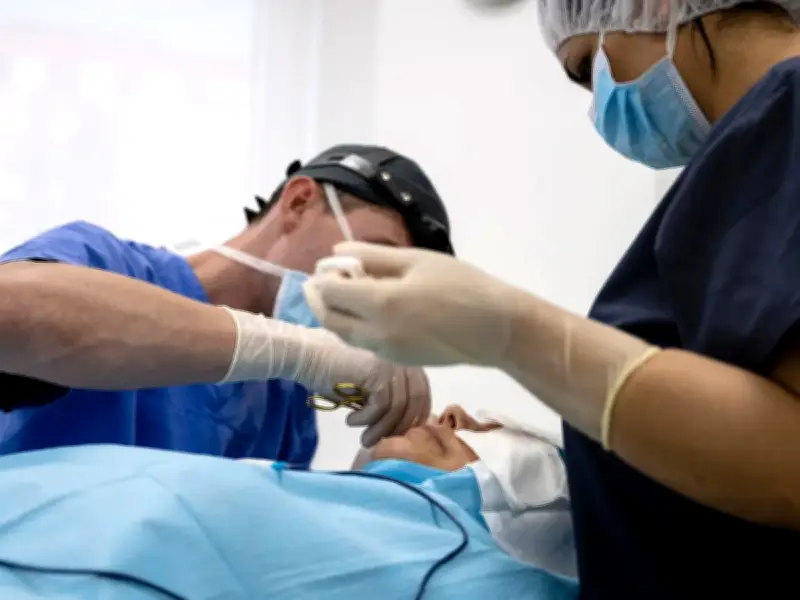
But Mr Dehabadi said social media can dangerously downplay the reality. “It’s a real surgical procedure under local anaesthetic, involving incisions, removal of skin, fat and sometimes muscle, and stitches that need proper care,” he said.
“Like any surgery, it's safe in the right hands, but it's not comparable to a beauty treatment. It carries the same risks as any operation, including infection, bleeding, scarring and, if aftercare is poor, permanent changes to how the eyelid functions.”
Asked if Britain could be seeing a “Turkey eyes” trend, similar to the “Turkey teeth” boom, he added: “I wouldn't want to put a label on it without seeing the data, but the pattern is a familiar one from other cosmetic procedures: aggressive marketing on social media, low prices, and package deals that don't make clear what aftercare actually involves, which makes this a concern.” Blepharoplasty is also surging worldwide.
The International Society of Aesthetic Plastic Surgery (ISAPS) reported more than 2.4 million eyelid surgeries performed globally in a single year, up from 2.1 million the year before - making it the most common cosmetic surgical procedure for both men and women. In the UK, the British Association of Aesthetic Plastic Surgeons (BAAPS) has reported a 13% year-on-year rise, with eyelid surgery climbing to the third most popular cosmetic procedure overall, and becoming the top procedure requested by men.
“Anecdotally, I have taken care of multiple patients in my NHS and private practice who experienced complications abroad,” Mr Dehabadi said. “It’s important to note that privately, revision surgery is often far more expensive than the primary surgery would have cost.”
He added: “Corrective surgery is often more complex than the original procedure, because the surgeon is working with scar tissue and altered anatomy, so it typically costs significantly more than a first-time blepharoplasty, not less… patients should assume a revision procedure will cost significantly more than what they saved. In addition to the cost, it’s important to realise that revision surgery often does not have the same cosmetic outcomes that a primary procedure would have had.”
Red flags and advice for patients
Mr Dehabadi warned: “A big red flag is a consultation that's rushed, doesn't happen with the surgeon who'll actually operate, or doesn't properly examine your eyelids and general eye health. If nobody asks about your medical history, your eye health, or explains aftercare in detail before you've paid, that's a sign that patient care is not their priority.
“I'd urge people to check if their surgeon is on the GMC specialist register, ask exactly who will manage their aftercare, and get a written aftercare plan with a direct line to a clinician.” The expert concluded: “My main message to anyone considering this is to ask who will look after you if something goes wrong, not just who will perform the surgery.
“A good surgeon will welcome that question. If a clinic can't answer it clearly, you should steer clear. I understand the price difference abroad is tempting, but that saving can evaporate quickly if a patient needs corrective surgery or emergency care once they're back in the UK, and that's before you factor in the toll on their eyesight or confidence.
“Having your surgeon, your notes and your follow-up care all in one place shouldn’t be considered a luxury, but rather should be seen as part of the safety net. Vision is never an area to compromise on for convenience or cost.”