Archaeologists believe they have uncovered the real-life location where Jesus Christ was buried more than 2,000 years ago before subsequently rising from the dead three days later.
As reported in the Jerusalem archaeological journal Liber Annuus, researchers have re-found an ancient burial place that aligns with descriptions detailed in scripture millennia ago.
Discovery at the Church of the Holy Sepulchre
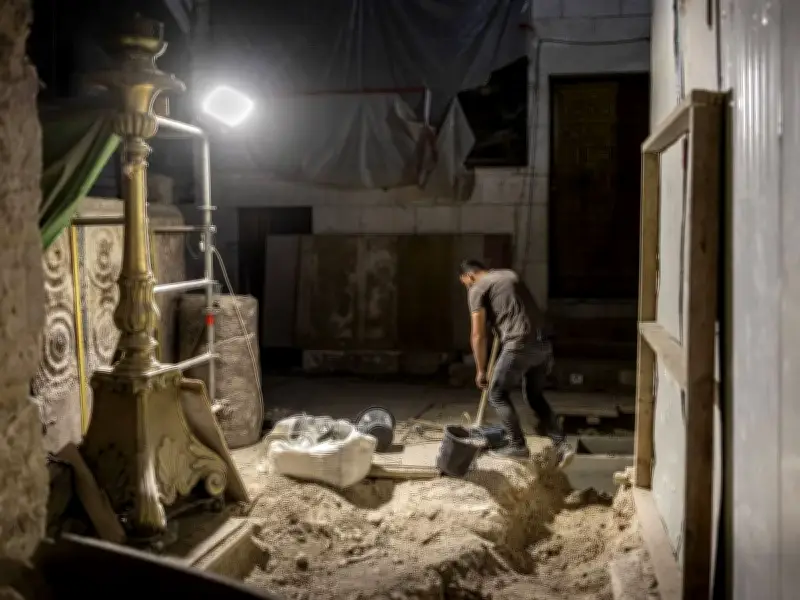
Francesca Romana Stasolla, an Italian archaeologist and lead researcher from Rome's Sapienza University, confirmed to the Daily Mail the discovery of "evidence of a funerary landscape" during a dig at Jerusalem's Church of the Holy Sepulchre. This ancient edifice is a fourth-century Roman church located in present-day Israel.

Many Christians hold the belief that this ancient church is situated at the exact spot where Christ was crucified, buried, and resurrected, but no solid evidence has ever substantiated these religious beliefs - until now.
Excavations since 2022
According to the New York Post, excavations at the Israeli site commenced back in 2022 during a restoration of the church's ancient floor. However, years later, it seems some believers may have been correct all along, as researchers have discovered an unexpected and unusual structure concealed beneath the earth.
Beneath the church lies a deserted quarry, cultivated land plots, rock-hewn tombs, and even an ancient garden. As stated in John 19:41: "At the place where Jesus was crucified, there was a garden, and in the garden a new tomb, in which no one had ever been laid."
In the tomb, researchers found exactly what they expected - nothing. No body, no bones, absolutely nothing. An orchard of olive trees and grapevines has also been discovered at the ancient quarry site, which some believe may be the same plants mentioned by the Apostle John.
Scriptural parallels and historical significance
John 19:20 indicates that Jesus' crucifixion took place near Jerusalem, while a reference in Hebrews 13:12 specifies that the execution happened just outside the city gate - precisely where the long-lost quarry would have been during Jesus' lifetime.
Stasolla told an Israeli newspaper that the Good Book "mentions a green area between the Calvary and the tomb". "Tick, tick, and tick," she added, as her team managed to identify exactly that in the long-lost "cultivated fields" discovered within the quarry.
The graves at the quarry were found to be hewn from stone, aligning with descriptions of Jesus' tomb given by each of the 'Big Four' Apostles - Matthew, Mark, Luke and John.
While the list of parallels enshrined in scripture is plentiful, it still doesn't fully confirm anything. However, researchers say that uncovering the elusive truth isn't really the point.
According to Stasolla, the "real treasure" lies in revealing the lost history of those who shaped the ancient site by expressing and sharing their faith there. "Whether someone believes or not in the historicity of the Holy Sepulchre, the fact that generations of people did is objective," she stated.
"The history of this place is the history of Jerusalem, and at least from a certain moment, it is the history of the worship of Jesus Christ." It's also a tale about the strength of faith, enabling us to delve into the past and uncover what was once lost - almost as if the site itself had been reborn into a new era.