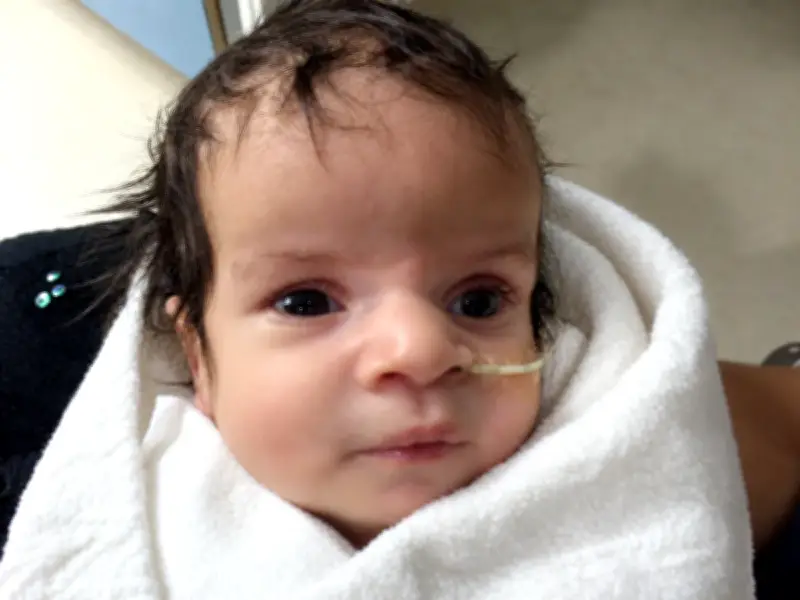
Aasam and Mariam Alim, from Essex, were told their daughter Aiza would not live past her first birthday after she was diagnosed with a rare genetic condition. Aiza died in April 2021, aged 14.
The first sign that something was wrong came just 12 hours after Aiza's birth on October 28, 2006. Mariam, 48, a personal assistant at an estate agency, said Aiza would not latch, take a bottle or be fed by a nurse with a spoon because she "wasn't swallowing anything down" and looked as though she "did a little stretch" to the side.
Within five days, the family was blue-lighted to Great Ormond Street Hospital (GOSH) in London after learning that the "stretch" was actually continuous seizures. A week of tests, including MRIs, CT scans, tissue samples, blood tests, ECGs and EEGs, led to a diagnosis of molybdenum cofactor deficiency (MoCD).
Rare condition and prognosis
MoCD is a very rare inherited metabolic disorder that causes a build-up of sulphite oxidase, which can damage the brain, according to Dr Harsha Moole, internal medicine physician-scientist and founder of FindMyDirectDoctor. When asked if Aiza would walk or talk, Aasam, 57, who works in data and business intelligence, said a doctor replied that "she won't live that long" and told them to prepare for the worst.
"I was in total shock and I just shut off," Aasam said. "I stopped listening to the words that were coming out of their mouths and I was in complete denial." Mariam added: "So then they left us in the room and we had a cry. We knew we'd just have to face every day and whatever comes with it because they said it could be something as simple as a chest infection that could take her."
Dr Moole explained that babies with MoCD usually look fine at birth, but within the first days of life severe seizures start that do not respond to usual medicines. Feeding is poor, muscle tone is low and development stalls. He noted that first cousins are more likely than unrelated couples to carry the same broken gene, with the overall chance of a genetic condition in a child for unrelated parents about 2% to 3%, compared with 5% to 6% for first cousins. MoCD itself is estimated at one in 100,000 to 200,000 newborns.
Early signs and diagnosis
Aasam and Mariam, who are first cousins, met in July 1998 at a family funeral and had an arranged marriage in August a year later. By February 2006, they were "ecstatic" to find out they were expecting, especially after a miscarriage a month earlier. Mariam said she had a good pregnancy with little sickness, and there was "no indication" that Aiza had a rare condition. She had an emergency caesarean section on October 28, 2006, because her waters "hadn't fully broken", but there were "no complications at all" with the procedure.
Aasam said he was "very excited" to have a baby girl, and Mariam said Aiza "seemed to be OK" when she awoke after surgery, but it changed within 12 hours. Aiza was placed on a drip in the neonatal intensive care unit after doctors realised she could not swallow, and then the parents were told she was having seizures. "I was so confused and scared," Mariam said.
Recalling the team of doctors explaining Aiza's diagnosis, Mariam said: "It was just like they were reading off a list of things she may not do, like walk or talk. It really built this dark picture… like all of the hope was just being taken out of this little bubble of mine. Then the last thing they said was that Aiza's on the severe end of the spectrum and she may not survive the first year."
Life with Aiza and final years
The parents kept the 12-month prognosis from friends and family, instead telling them Aiza had a rare neurological condition. They also decided not to pursue genetic testing or discuss having more children "while Aiza was here". Mariam said she was "on edge" for the first year, asking herself if the worst would happen each time Aiza went to hospital. "Then when she turned one, I was like… it doesn't matter if I have another hour, another second, another day, another year, let's make it fun."
The family celebrated Aiza's birthdays with what Aasam described as a "big, open house event" with friends and family. Throughout her 14 years, Aiza needed 24/7 care because she could not talk or move any part of her body except her eyes, relying on a wheelchair because of scoliosis. She was fed via a Mic-key button, a skin-level device placed through an abdominal stoma. She had regular seizures as a newborn until starting anti-seizure medication, but they returned when she was seven.
Mariam took Aiza to hospital on April 7, 2021, because of an elevated heart rate and blood pressure, and she died three days later. Aasam said their daughter had a "rapid deterioration" when her oxygen levels and heart rate dropped, and he felt "very grateful" to be there in her final moments. "I was with her on the bed and Aasam was beside her holding her hand," Mariam said.
The couple decided to share Aiza's story to give hope to other families with uncertain prognoses. Mariam said: "We have been through a lot and Aiza was our brightness. So I'd say to other parents to make lots of memories and have lots of hope that tomorrow will be a better day." Aasam's book about his daughter's life is called Aiza and is available on Amazon.