
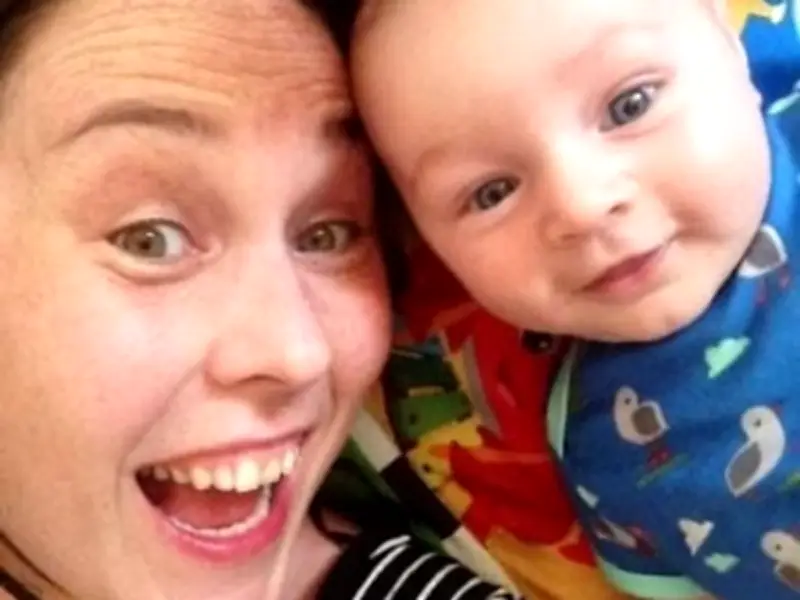
Heather Hinshelwood said: "I struggle to go to Jaime’s grave. I don’t like the cemetery and don’t like the thought of it. I don’t think he’s there."
The 46-year-old nurse, from Hamilton, lost her six-month-old son Jaime in 2017 as a result of undetected Kawasaki disease, after he was sent home from Wishaw General Hospital in Lanarkshire. Doctors believed he had a common viral condition, but he later suffered a ruptured coronary artery aneurysm and died. A post-mortem confirmed Kawasaki disease.
Heather, who has two other sons, Jack, 24, and Josh, 18, said she feels close to Jaime while walking in the countryside. "I’m a kind of spiritual person, so I believe when we pass away we go back to the universe," she explained. "I believe Jaime is around me in all things like nature and animals. I can feel Jaime in a stream, mountain or butterfly."
She recalled: "When Jaime died at first I would look for wee signs like birds, a rainbow, just things like that. He was born healthy, absolutely healthy. He contracted what they said was a viral infection. I asked at the hospital if it was Kawasaki because I’d been Googling everything and I was told no, it was viral."
"He came home and seemed to be getting better but then he suffered a ruptured coronary artery aneurysm, which killed him," she said. "After the post-mortem it was confirmed to be Kawasaki disease."
Rare condition
Kawasaki disease is a rare inflammatory condition that causes the blood vessels throughout a child’s body to swell, potentially damaging the coronary arteries if left untreated. In the UK, it is estimated to affect eight to nine out of every 100,000 children under the age of five each year, but it can be successfully treated if identified early.
Campaigning for awareness
Heather, who works for the NHS, has been working with the charity Societi to raise awareness among parents and doctors. She said: "One of Societi’s slogans is, ‘When you hear hooves, think zebras not horses.’ Instead of putting everything down to a viral condition, Kawasaki should be checked for."
She added: "They are supportive and have a big online presence highlighting symptoms and raising awareness. They always remember his birthday and the day he died with a social media post. They just make it that Jaime was here and is important in helping others while raising awareness of this insidious disease."
"A couple years ago I handed out information packs to local GPs which Societi provided," she said. "I decided the positive thing I could do from Jaime dying was to raise awareness so that other people don’t need to suffer the great loss of losing a child. I’m hoping I might have helped save a life. That’s what it’s all about, in Jaime’s memory."
Fundraising and family
Heather has already completed a skydive, a bungee jump and a laser tag event to raise funds for Societi. She also raised money for children’s bereavement charity Brightest Star and funded a cuddle cot in Jaime’s memory for Wishaw General, allowing parents to spend time with stillborn babies.
Heather keeps Jaime’s memory alive by talking about him regularly with his brothers. "How can you no? He was very much loved," she said. "And the boys will never forget their wee brother, he’s a big part of their life. They are both doing excellently. Jack is in the band Lacuna, who played at TRNSMT and Josh just got loads of As in his exams."
West Highland Way challenge
On August 16, Heather will tackle the West Highland Way to raise more funds and connect with Jaime. She said: "I’ve always liked nature and I like to think that Jaime’s spirit is around in everything. That’s a big part of why I chose the West Highland Way. Also it’s another personal challenge for fitness. I’m not getting any younger so it’s to try and keep in shape."
She is taking on the hike with her partner Scott Darroch, 48, who never met Jaime but has supported her. "We get on so well and we both love the outdoors," she said. "We’ve got matching boots. We might be at each other’s throats by the end of it but I hope not. As much as he wasn’t in Jaime’s life he’s very much accepting that I’ve got three boys. Scott has been nothing but supportive. He bought a wee lantern for Jaime’s tree, he’s just always so thoughtful."
Donations to Heather’s West Highland Way challenge can be made through her JustGiving page.
Key facts about Kawasaki disease
Kawasaki disease predominantly affects young children and causes inflammation of blood vessels throughout the body, particularly the coronary arteries that supply blood to the heart muscle. This inflammation can lead to blood clots and other serious complications.
If left untreated, Kawasaki disease can result in severe heart problems, and two to three per cent of untreated cases are fatal. In the UK, approximately eight in every 100,000 children are affected, with the majority of cases occurring in children under five. Around 15 per cent to 28 per cent of affected children experience cardiac complications, including coronary artery aneurysms. The condition is more common in boys than girls.
Common symptoms include:
- Rash
- Swollen glands in the neck
- Red eyes
- Cracked lips
- A swollen, red, bumpy tongue
In January, two-year-old Hudson from Knowle, Bristol, collapsed and died on January 8, weeks before his third birthday. His parents believe he died from a coronary artery rupture after Kawasaki disease, which he developed at seven months old, damaged his heart’s blood vessels. In May, Rue Airlie, then 11 months old, from Dundee, was taken to hospital after developing a temperature, a rash and swollen glands. After several days, he was diagnosed with Kawasaki disease. Rue’s life was saved after he received a plasma transfusion.




