
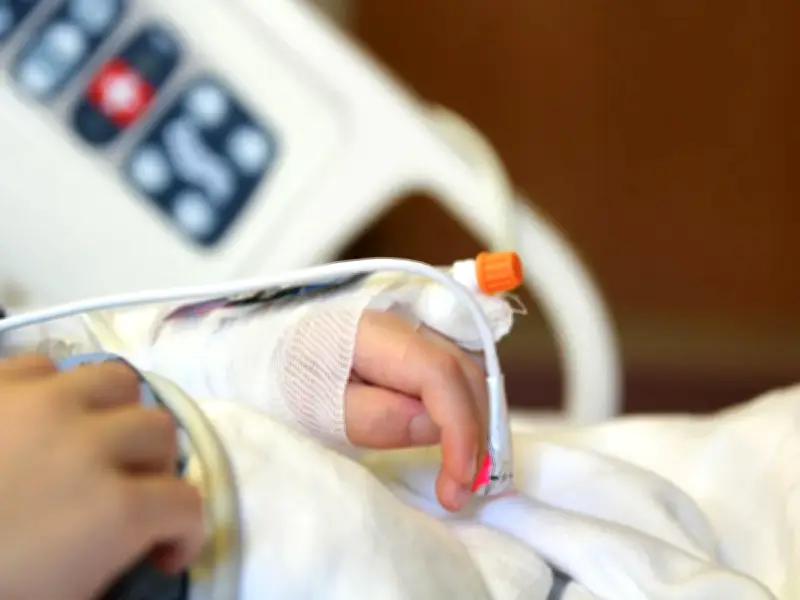
A toddler in the Netherlands has become the youngest person in the world to die by euthanasia, according to a newly released report from a Dutch review board. The child, who was "almost 24 months" old, died at the end of last year after suffering from a range of severe health conditions.
Until now, it had only been known that a child under 12 had been euthanised in the country. The child's gender has not been disclosed.
Severe health conditions from birth
During their short life, the child suffered from cerebral palsy, brain damage, visual impairment, and epileptic seizures. They also struggled to breathe due to mucus in their lungs and their body was unresponsive to medication.
The child was born prematurely during a holiday abroad at just 26 weeks, according to the report by the Committee for Late-Term Abortion and Termination of Life in Newborns and Children. This led to serious complications including "extensive brain damage" and infections that resulted in sepsis by the time the baby was four months old.
At eight months old, the child was diagnosed with infantile spasms syndrome (also known as West syndrome), a rare and serious type of epilepsy, and cerebral palsy, PEOPLE reports. This resulted in an acute sleeping disorder, alongside respiratory problems, coughing fits, and a swallowing disorder.
Doctors disagreed on the decision
The report found that in the course of the child's life, "there was a complete lack of development or improvement." It reads: "Despite all medical and non-medical interventions, the parents and the doctor observed no improvement in the child's condition and were convinced that the child was suffering unbearably and without prospect of relief."
After concluding that the baby's suffering could not be alleviated through medical treatment, the parents, alongside a doctor, decided to end the youngster's life. The doctor who carried out the assisted death consulted other independent doctors for a second opinion, the report says. Those physicians established that "at that time, the child was not continuously suffering unbearably" - a legal requirement for euthanasia to go ahead.
"The epilepsy caused a great deal of discomfort, but the epileptic seizures were not continuous," the document reads. "Their conclusion was that there were still reasonable alternatives, such as palliative options and other medications that could possibly result in better control of the epileptic seizures."
Despite this conflicting assessment, the child was euthanised after the doctor sought another second opinion from a physician who determined that the child's 'unbearable suffering was clearly visible' and the requirements for ending the child's life through euthanasia had been met.
Committee's assessment and Dutch law
The committee also found that the doctor made the correct assessment in ending the child's life. "Every facet of 'being human' in terms of motor skills, behaviour and personality was severely affected, and there would be no improvement," its report states. "The child had very severe developmental delay; at the age of almost two years, the child's developmental age was estimated to be that of a six-week-old baby."
The doctor administered the euthanasia by gradual sedation with "coma-inducing substances". According to Dutch law, a doctor's decision about terminating the life of a child aged one to 12 "must be based on general medical standards and current medical knowledge," and "the doctor must exercise due medical care when performing the procedure."
In 2002, the Netherlands was the first country to legalise assisted dying, and two years ago it became legal for incurably ill children aged from one year old to 12 to be euthanised. For a child to be considered under the country's laws, they must be "unbearably suffering with no hope of recovery", and the parents must be consulted.
According to the Dutch government's website, minors can request euthanasia from the age of 12 as long as they're capable of assessing and understanding what's best for them. Those aged 12-15 need parental or guardian consent, while those aged 16 or 17, parents or guardians must be consulted in the decision-making process - but their consent is not required.
Previous youngest case and UK context
The youngest person to be euthanised before now is believed to have been a 12-year-old in Belgium. Belgium became the first country where euthanasia was available for all children in 2014.
In the UK, six in 10 people support the return of the assisted dying Bill to Parliament, according to new polling. But a third of the public feel the law should only be changed if there is more funding for end-of-life care alongside it. Support for assisted dying being legalised has remained relatively stable since the Terminally Ill Adults (End of Life) Bill was first introduced to Parliament in late 2024, the Ipsos polling found.
The new polling found 34% of people said assisting dying should be made legal but only if it is accompanied by additional investment in state-funded end-of-life care. Meanwhile, three in 10 (30%) said they agreed with the statement that assisted dying should be made legal, even without extra investment in this kind of care. One in 10 people said they opposed legalising assisted dying and said there should be more funding for end-of-life care, while 7% said assisted dying should not be legalised even if it was accompanied by further investment in such care.
Campaigners broke down in despair after the assisted dying bill was voted down earlier this month, as their "dreams and hopes of a peaceful death" were shattered, saying "democracy has been hijacked". But there were gasps and cheers inside Parliament as the Terminally Ill Adults (End of Life) Bill was voted down by 286 votes to 270, in a result that almost certainly scuppers hopes of a law change until after the next general election. Campaigners slammed MPs for allowing a small handful of peers to 'cheat and hijack democracy' by forcing the bill out with more than 1,000 amendments.




