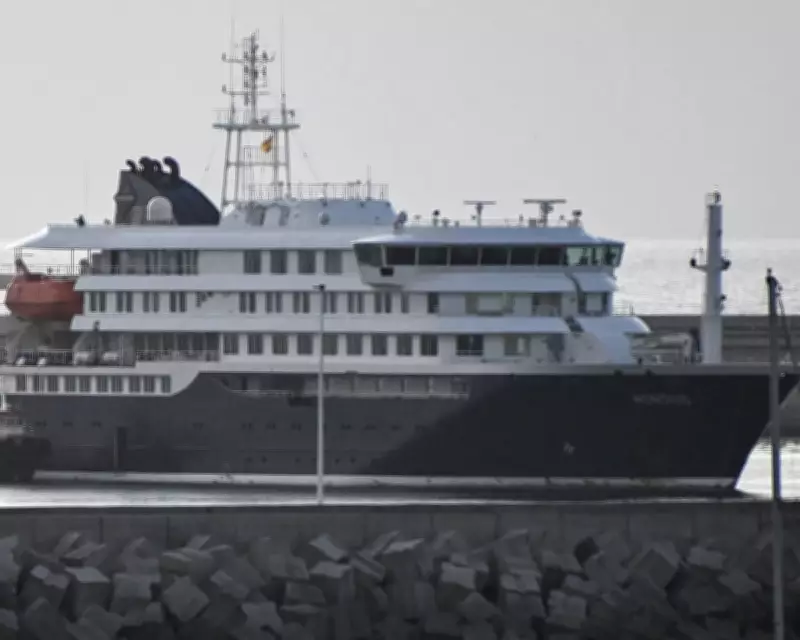
The MV Hondius, the cruise ship at the centre of a hantavirus outbreak that has left three people dead, reached the Canary Islands on Sunday and has finally been evacuated, ending the ordeal for the remaining 149 passengers and crew.
On a dusty hill overlooking the Atlantic Ocean in the south of Tenerife, groups of tourists and locals gathered to witness one of the island's best new attractions. Some gazed through binoculars while others took photos on their phones of the vessel anchored near the Granadillo commercial port.
Christened the "rat virus boat" by the internet after three people travelling onboard died of hantavirus, a disease normally carried by rats and mice, its story has enraptured people all over the world. Now, after reaching the Canary Islands shortly before dawn on Sunday, the ship is finally being evacuated.

The scene was watched from a hire car by Amy Byres and Emma Armitage from Sheffield, on holiday in Tenerife for Byres's 22nd birthday. "We've got some time to kill before our flight later," Armitage said. "It was either this or lay by the pool all day," added Byres. The pair said they had spent their holiday fascinated by the story of the passengers trapped on board and confined to cabins, in between their whale-watching and quad biking activities.
But down at the dock, the mood was more sober. First, only a handful of Spanish passengers appeared, looking dazed and bewildered, wearing face and hair coverings and large blue ponchos over their clothes. Clutched in one hand were small plastic bags containing only a few possessions. The rest of their luggage needed to remain on the ship to be taken to the Netherlands for decontamination.
It was the first time many of them had been outside since they were locked down in their cabins several days ago, after the deaths of a Dutch couple and a German passenger. It took a while for the cause to be diagnosed as hantavirus. The disease, though not uncommon, is rarely spread person-to-person. The variant is not new, and health bodies have sought to reassure people that it is a known pathogen, not a new disease such as Covid-19.
The director general of the World Health Organization (WHO), Dr Tedros Adhanom Ghebreyesus, repeated the refrain that the outbreak was "not the start of a Covid pandemic" dozens of times in the lead up to the 24-hour evacuation period in Tenerife.
The passengers and crew from 23 countries are being repatriated thanks to an enormous international effort led by the WHO and coordinated by the Spanish government, which offered Tenerife as a base to launch the rescue. It was Spain's obligation under international law to offer the Canaries' assistance as one of the closest territories that had the resources to help.
Boatload after boatload of blue plasticky figures appeared, to be loaded on to coaches by health workers in hazmat suits and face masks. Inside, plastic sheets covered the seats and, in scenes reminiscent of the Covid-19 pandemic, hazard tape marked seats that could not be used. Those leaving the ship were not allowed to sit next to each other.
But what happens when each passenger gets home is a matter of some contention. While the WHO recommends each passenger isolate for 45 days from the last contact point, 6 May, it cannot enforce that. The UK and Spain have put in place hospital quarantines for those coming off the ship but many countries have not.
Causing further concern is the absence of testing. Those onboard have had their temperatures taken by WHO tropical medicine doctors and have shown no symptoms of a possible infection. But only a PCR test would confirm whether hantavirus – which has an incubation period of up to eight weeks – is present in their systems. Every country would need to carry out their own.
Among the media brought to the island by the MV Hondius's arrival, questions were being asked about whether this was enough. Tedros was asked at a press conference at the Granadilla port late Saturday night whether allowing passengers to travel all over the world and relying on them to self-isolate with no oversight could cause further outbreaks. "Based on our assessment, what you have said is not going to happen," he told the media.

The planned approach by the US caused particular alarm, after the country's withdrawal from the WHO last year. Returning passengers to the country are being asked to self isolate, something an American journalist asked Javier Padilla Bernáldez, the Spanish secretary of state for health, for his opinion on. He said the European Commission and the European Centre for Disease Prevention and Control were "trying to achieve a certain degree of coordination, and not a high variation among the different countries." "But every country has its own confidences," he said.