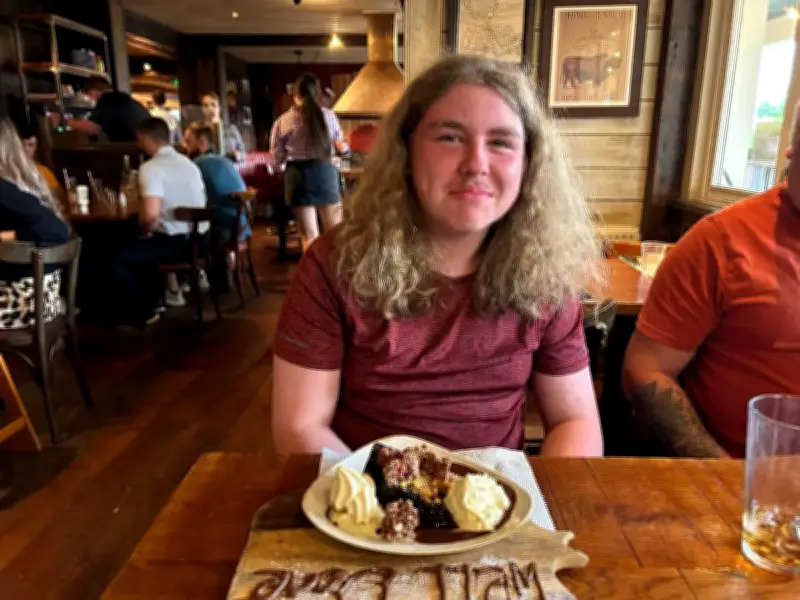
An 18-year-old from Southport who thought he had a virus before collapsing on his driveway was diagnosed with Acute Myeloid Leukaemia (AML). Blade Rimmer had been preparing to sit his final A-level exam at King George V Sixth Form College, but became too unwell to attend.
His mother, Marie Rimmer, 59, told the ECHO that Blade had been feeling unwell for some time. She said: "Blade was taking his final exams at King George V Sixth Form College in Southport, and he just became unwell. We thought it was a virus; he went off his food, he was just washed out, went to bed."
Despite having one final exam scheduled for June 10, Blade remained too ill to sit it. His mother phoned the school, which told her that a doctor's letter would be required for Blade to receive a grade. Marie said: "We didn't make it to the doctor's. I arranged for a taxi, but he collapsed in the driveway, so I took him straight to the Southport and Formby Hospital, where he got the diagnosis of Acute Myeloid Leukaemia [AML]."

Diagnosis and Treatment
The next day, Blade was transferred to Clatterbridge Cancer Centre, where he began the first of four rounds of chemotherapy. According to the NHS, acute myeloid leukaemia is a rare cancer affecting the blood and bone marrow. It usually develops quickly and requires immediate treatment. It can occur at any age, though the risk increases with age, and its severity depends on the type, the patient's age, and general health.
After completing his final round of chemotherapy in December, Blade underwent a stem cell transplant. Marie said: "Everything seemed to be going okay. He came in for regular blood tests. He just wanted to get his life back on track. Then in May 2026, we discovered it [the leukaemia] had come back."
Relapse and Current Condition
Doctors put Blade on a course of Gilteritinib, a prescription cancer medicine for adults with relapsed or refractory acute myeloid leukaemia. Marie explained that after two or three weeks on the drug, his temperature fluctuated, reaching 38 degrees. During their regular twice-a-week blood tests, he was kept in hospital for two weeks after a bug was found in his bloodline. He received IVs and antibiotics before being sent home.
Marie said: "They were continuing the treatment, but we were back in within 36 hours. His temperatures just weren't settling at all. We came back here on June 18 and have been here ever since." Blade is now living full-time at Clatterbridge Cancer Centre.
Campaign and Fundraising
Before his diagnosis, Blade had been a typical teenager, having just passed his bike riding test and been accepted to study International Business at Edge Hill University. He had planned to buy a 125 Kawasaki bike for independence at university.
If Blade's current treatment fails, the usual next step would be a second stem cell transplant. However, current NHS policy requires patients to have relapsed more than 12 months after their first transplant, casting doubt on his eligibility.
Blade's case is being used to highlight a joint campaign by Anthony Nolan, DKMS UK, and Leukaemia UK. The charities have an ongoing petition calling on the government to fund second stem cell transplants on the NHS for patients who relapse within 12 months. Marie has given her full support, saying: "The first time you have the stem cell transplant, it doesn't always work, it can be anything from a few months to several months, but you've got to have every chance possible of being able to beat this."
Money is also being raised to support Blade's family financially while he continues living at Clatterbridge. Marie said: "To be here for 24 hours a day is hard financially. There is no kind of assistance. Thankfully, work and my husband, Kevin, and myself are all pulling together to try and make it so that Blade is never alone in the hospital. I'm here Monday to Friday, and then my husband comes in over the weekend to stay with him."