
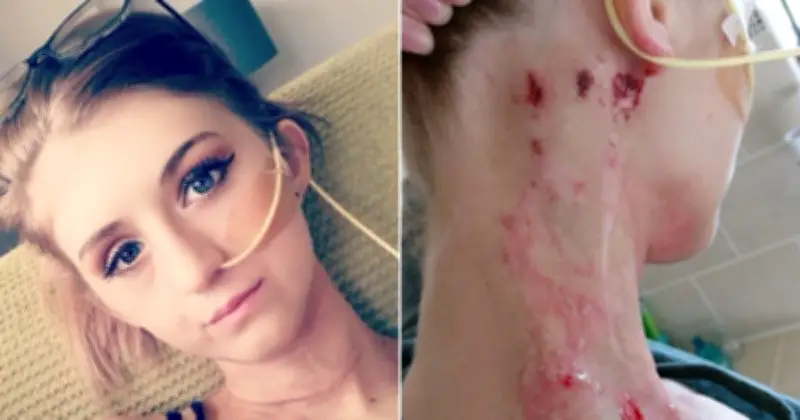
Molly Camber, 26, was the first child in the world to be diagnosed with a rare salivary gland cancer. She is sharing her story to highlight the risks of dismissing symptoms of mouth cancer, after spending two years being told by GPs that the lump on her neck was simply a reactive lymph node or glandular fever.
Molly was just 13 when the delay allowed a rare oral cancer to continue growing undetected in her face and mouth. More than a decade later, and after surviving a recurrence at 17, she is still living with the harsh effects of radiotherapy.
Two Years of Dismissed Symptoms
“I remember all of it,” Molly says. “I had a weird lump on my neck. We went to the doctors about it, and they kind of fobbed us off for about two years – kept calling us paranoid.”
“I asked the doctor outright if it was cancer, and he said ‘no’. Then eventually I started feeling and being sick pretty much every day. I worked on a farm, so I quit because we thought it was all the bacteria from the farm. But it didn't get any better.”
When Molly was finally referred to a paediatrician, they immediately scheduled an operation to remove the lump. A biopsy confirmed it was cancerous. A whole-body scan then revealed another tumour in her mouth. The teenager was only the 24th person in the world to be diagnosed with a rare salivary gland cancer – and the first child.
Brutal Treatment and Long-Term Effects
Molly underwent a total maxillectomy to remove part of her jaw, which was reconstructed using bone from her leg, and a total neck dissection to remove nearby lymph nodes. Then came 30 sessions of radiotherapy.
She recalls: “It was brutal. When you think of radiotherapy, you don't think it's that bad. But when it’s to the head and neck, it is absolutely brutal. I had burns down my entire neck, my skin was peeling away.”
“I was throwing up, I couldn't eat because my throat was also burnt. I couldn't speak, I couldn't eat, I couldn't even blow bubbles – that was one of the things I had to try and do in therapy.”
“I was on a lot a lot of morphine and a lot of drugs, so I was hallucinating. The pain was just horrific. I had no energy. And then there are the long-term effects – again, barbaric.”
Molly spent around a month in hospital, including a week in intensive care and two days in an induced coma, before being forced to adapt to “essentially a completely new version of myself”.
Recurrence and Ongoing Impact
Four years later, Molly was at college when she noticed a lump in her neck. This time, she did not take “no” for an answer when doctors told her an MRI scan was clear. “I persisted, said: ‘I'm telling you something is wrong.’ I just knew it,” Molly says. Further scans confirmed that the cancer had returned.
Molly underwent another total neck dissection followed by a further 30 sessions of radiotherapy. Almost 10 years on, she is still living with the effects of the harsh treatment and undergoing surgeries to repair some of the damage caused by radiotherapy. The repeated sessions have also left her at higher risk of secondary cancers, including thyroid cancer.
Molly says more research into kinder treatments and less-damaging methods of delivering radiotherapy is desperately needed. She said: “I feel like the long-term effects of radiation is not researched into nearly enough for head and neck cancer. I often find that I have to make tough decisions about whether to go ahead with surgery when the risks are unknown.”
Support and Warning to Others
Once a week, Molly joins a video call with a Mouth Cancer Foundation support group, where she can speak to people who have lived through similar experiences. She says: “As I went through it so young, I didn’t know anyone who was going through it. It's nice to know that there is a support group; I wish I'd found it sooner. We give each other tips and tricks on how to get through things.”
Cases of mouth cancer had more than doubled in the last two decades, increasing by 119%, according to the Oral Health Foundation. More than 11,000 people are now diagnosed with mouth cancer annually in the UK.
Molly urged anyone who notices changes in their mouth or neck not to wait, and to push for answers if doctors are dismissive: “I feel like the symptoms are kind of shrugged off, especially if you are younger and you've never smoked. Don't wait. I know that I may come across as paranoid to the doctors, but I do not care. I will get that lump checked, even if they say it's a lymph node. I will push for an MRI every time.”
“Doctors are so quick to kind of shrug people off. You need to advocate for yourself. And you're never too young for any cancer, even if it is a rare cancer. No matter your smoking status or drinking status, or how old you are, everyone should have the same right to access cancer diagnostics.”
November marks Mouth Cancer Action Month, and the Oral Health Foundation has urged people to “remove the doubt, get checked out” if they notice any change. Its president-elect, dentist Cathie Brady, says: “It’s easy to explain away an ulcer, patch or a lump, especially if it doesn’t hurt. But a change that persists for over three weeks needs to be checked by a healthcare professional. Most changes won’t be cancer, but you need a professional diagnosis to know for sure. If something is unusual for you, contact a dentist or doctor. You are not wasting anyone’s time.”
Ms Brady said dental practices should take concerns about changes in the mouth seriously and arrange prompt assessment. She added: “When you contact a practice, explain what has changed and how long it has been there. If you cannot get a dental appointment, contact your GP. If the problem continues or gets worse after you have sought advice, go back.”
Mouth cancer can affect anyone. Stopping tobacco use, drinking less alcohol and receiving HPV vaccination when eligible can help reduce the risk, but knowing the signs is important for everyone.




